Unprecedented Solar Images Confirm Long-Hypothesized Plasma Waves on the Sun’s Surface
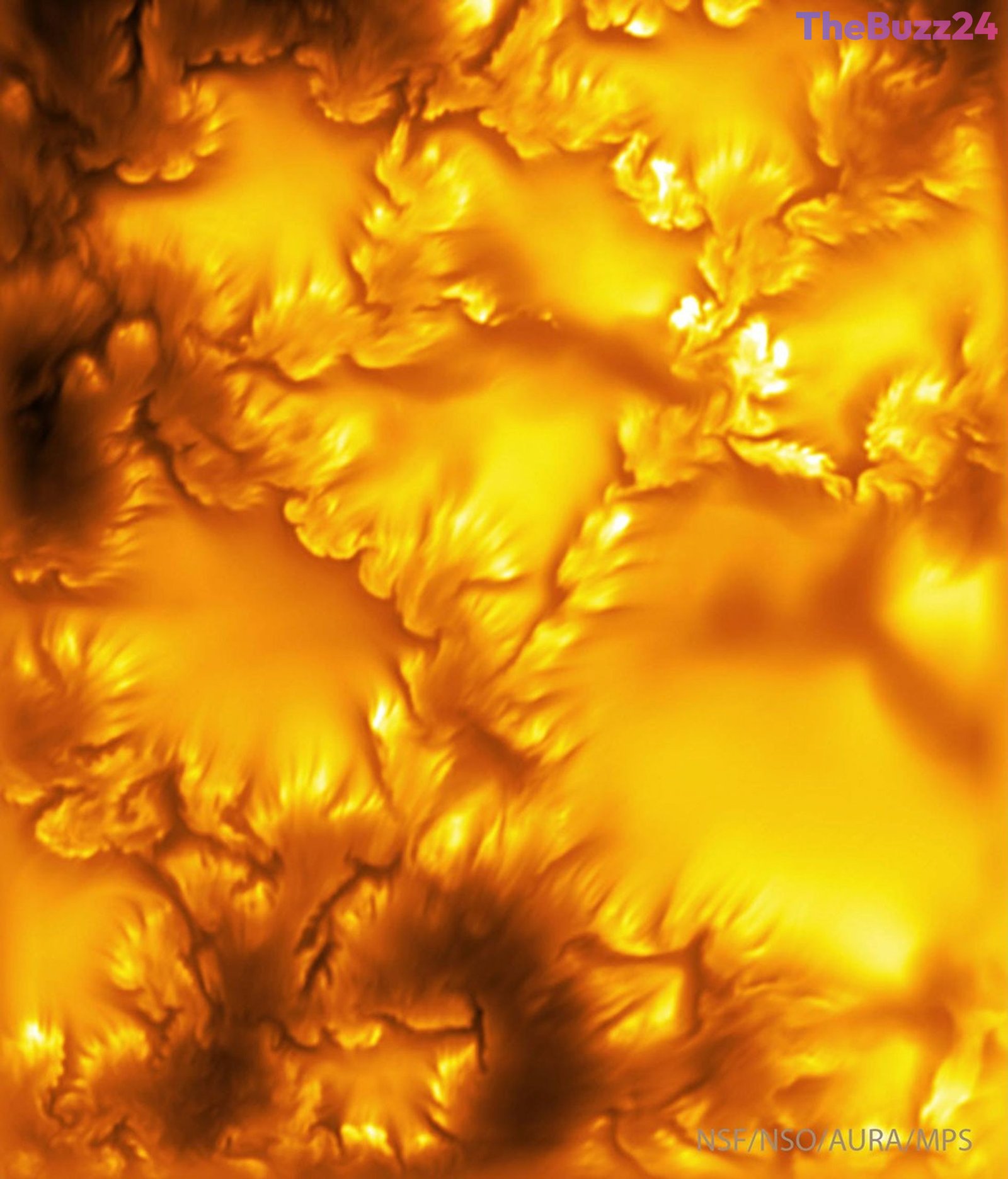
The Daniel K. Inouye Solar Telescope in Hawaii has captured the highest-resolution image of the Sun in visible light ever recorded. This historic visual breakthrough has provided scientists with direct confirmation of a long-hypothesized solar phenomenon known as the Kelvin-Helmholtz instability (KHI). The newly released imagery offers an unprecedented look at the turbulent processes shaping our star’s atmosphere.
The Kelvin-Helmholtz instability occurs when two streams of solar magnetic plasma flow past one another at different velocities, creating distinctive waves and swirling patterns. While researchers have long theorized that these dynamics exist on the Sun’s surface, the high-resolution capabilities of the Inouye Solar Telescope have finally offered definitive proof, showcasing intricate streaks and swirls along the boundaries of solar structures.
Although presented in a false-yellow hue for visual clarity, the photograph was actually captured in deep blue light. The scale of the image is immense, spanning a distance roughly equivalent to the radius of the Earth, yet its resolution is so precise that it resolves features the size of average terrestrial cities. The visual data reveals the smooth, shifting tops of solar granules, with the flower-like edges of these structures harboring the newly confirmed KHI swirls.
This scientific milestone is expected to catalyze further research into solar atmospheric physics. Scientists hope to utilize these detailed observations to investigate how the Kelvin-Helmholtz instability facilitates the movement of energy and magnetic fields, which could ultimately solve the long-standing mystery of how the surrounding solar corona is heated to millions of degrees.
Key Takeaways
- The Daniel K. Inouye Solar Telescope has captured the highest-resolution visible-light image of the Sun to date.
- The image provides the first direct visual confirmation of Kelvin-Helmholtz instability (KHI) occurring on the solar surface.
- These high-resolution observations could help scientists understand how energy transfers to and heats the solar corona.
Editor’s Analysis & Impact
The latest imagery from the Inouye Solar Telescope represents a monumental leap forward for heliophysics and observational astronomy. By capturing solar features at a city-sized resolution, researchers are no longer relying solely on mathematical models to understand the Sun’s turbulent atmosphere. The confirmation of Kelvin-Helmholtz instability (KHI) on the solar surface is particularly significant, as it provides a tangible mechanism to explain energy transport and magnetic field dynamics in plasma environments. This breakthrough will likely influence future space weather forecasting models. Understanding these micro-scale plasma interactions is crucial for predicting solar flares and coronal mass ejections, which can disrupt satellite communications and power grids on Earth. Ultimately, this achievement underscores the vital role of high-aperture ground-based telescopes in complementing space-based observatories.
Frequently Asked Questions
Q: What is the Kelvin-Helmholtz instability (KHI)?
A: The Kelvin-Helmholtz instability is a physical phenomenon that occurs when there is a velocity difference across the interface between two fluids or plasma streams. On the Sun, this manifests as waves and swirls when different streams of solar magnetic plasma flow past each other.
Q: How powerful is the Inouye Solar Telescope?
A: Located in Hawaii, the Daniel K. Inouye Solar Telescope is the world's most powerful solar telescope. It is capable of capturing details on the Sun's surface as small as a terrestrial city, despite the Sun being approximately 93 million miles away from Earth.
Q: Why is studying the solar corona important?
A: The solar corona is the outermost layer of the Sun's atmosphere and is mysteriously thousands of times hotter than the Sun's actual surface. Understanding how energy is transferred to heat the corona helps scientists better comprehend solar wind and space weather, which can impact technology on Earth.
AI Disclosure: This article is based on verified data and official reports. Our Team and AI have cross-referenced every financial detail with primary sources to ensure total accuracy.
More from this Category