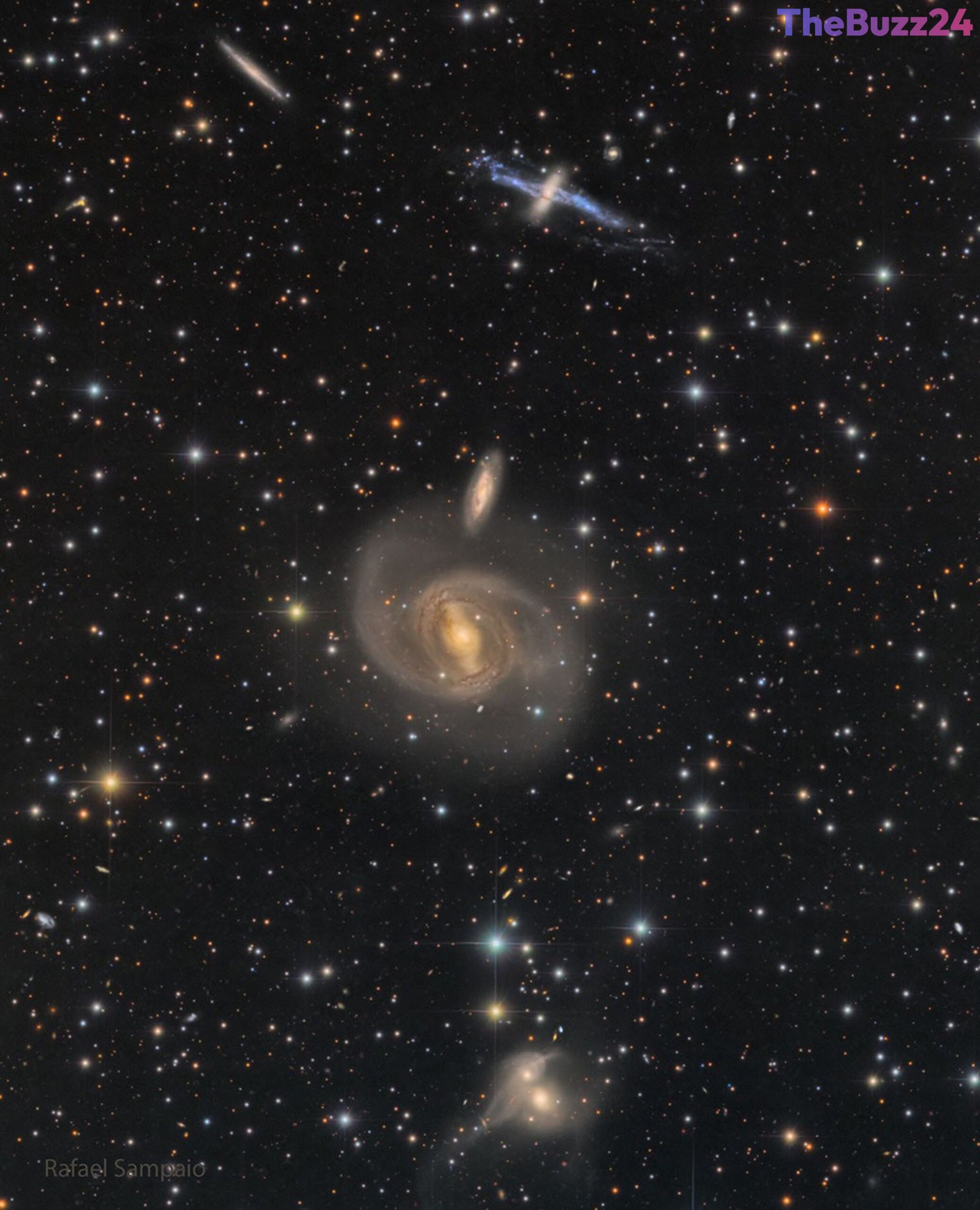
Astronomers Capture Fascinating Dynamics of Three Distinct Galaxy Pairs
A newly highlighted astronomical observation showcases three distinct pairs of galaxies, each exhibiting unique gravitational behaviors and evolutionary histories within the cosmos. Located within the broader Centaurus Galaxy Cluster, these celestial formations provide scientists with valuable insights into how galaxies interact, collide, and evolve over vast stretches of time.
At the top of the observation set lies a fascinating formation featuring a polar ring galaxy known as NGC 4650A. Adorned with a distinct blue stripe, this galaxy is believed to be the eventual product of a historical galactic collision, even though the two neighboring galaxies in this upper tier are not currently interacting. Meanwhile, the middle pair presents a deceptive cosmic illusion; despite their close appearance suggesting a strong gravitational embrace, their contrasting relative speeds indicate they are merely passing by one another rather than actively engaging.
In stark contrast, the lower pair of galaxies demonstrates an active gravitational tango. Designated as NGC 4622A and NGC 4622B, these two celestial bodies are currently locked in a mutual interaction that astronomers predict will culminate in a massive galactic merger approximately a billion years from now, ultimately forming a single, unified galaxy. Observations like these continue to deepen our understanding of cosmic mechanics and the complex life cycles of galactic structures across the universe.
Key Takeaways
- Three distinct galaxy pairs within the Centaurus Galaxy Cluster have been highlighted for their unique evolutionary states.
- NGC 4650A features a prominent blue polar ring, pointing to a history involving a past galactic collision.
- The bottom pair, NGC 4622A and NGC 4622B, are actively interacting and expected to merge into a single galaxy in about a billion years.
Editor’s Analysis & Impact
The detailed observation of interacting and non-interacting galaxy pairs serves as a cornerstone for modern observational astrophysics and cosmological modeling. By studying systems like the Centaurus Galaxy Cluster, researchers can refine simulations regarding dark matter distribution, galactic collisions, and the long-term fate of spiral and polar ring structures. As telescopic technology and imaging techniques continue to advance, capturing high-resolution dynamics of distant galactic encounters will yield critical data on the formation history of our universe, bridging theoretical physics with empirical astronomy.
Frequently Asked Questions
Q: What is a polar ring galaxy?
A: A polar ring galaxy is a type of galaxy that features an outer ring of stars and gas rotating perpendicularly to the plane of the main galactic disk. They are often formed through past collisions or gravitational interactions between separate galaxies.
Q: Are all three pairs of galaxies actively colliding?
A: No. While the bottom pair is actively interacting and heading toward a future merger, the top pair is not currently interacting, and the middle pair appears close visually but is moving at speeds that make gravitational interaction unlikely.
Q: Which galaxy cluster do these pairs belong to?
A: These galaxy pairs are likely members of the larger Centaurus Galaxy Cluster.
AI Disclosure: This article is based on verified data and official reports. Our Team and AI have cross-referenced every financial detail with primary sources to ensure total accuracy.
More from this Category