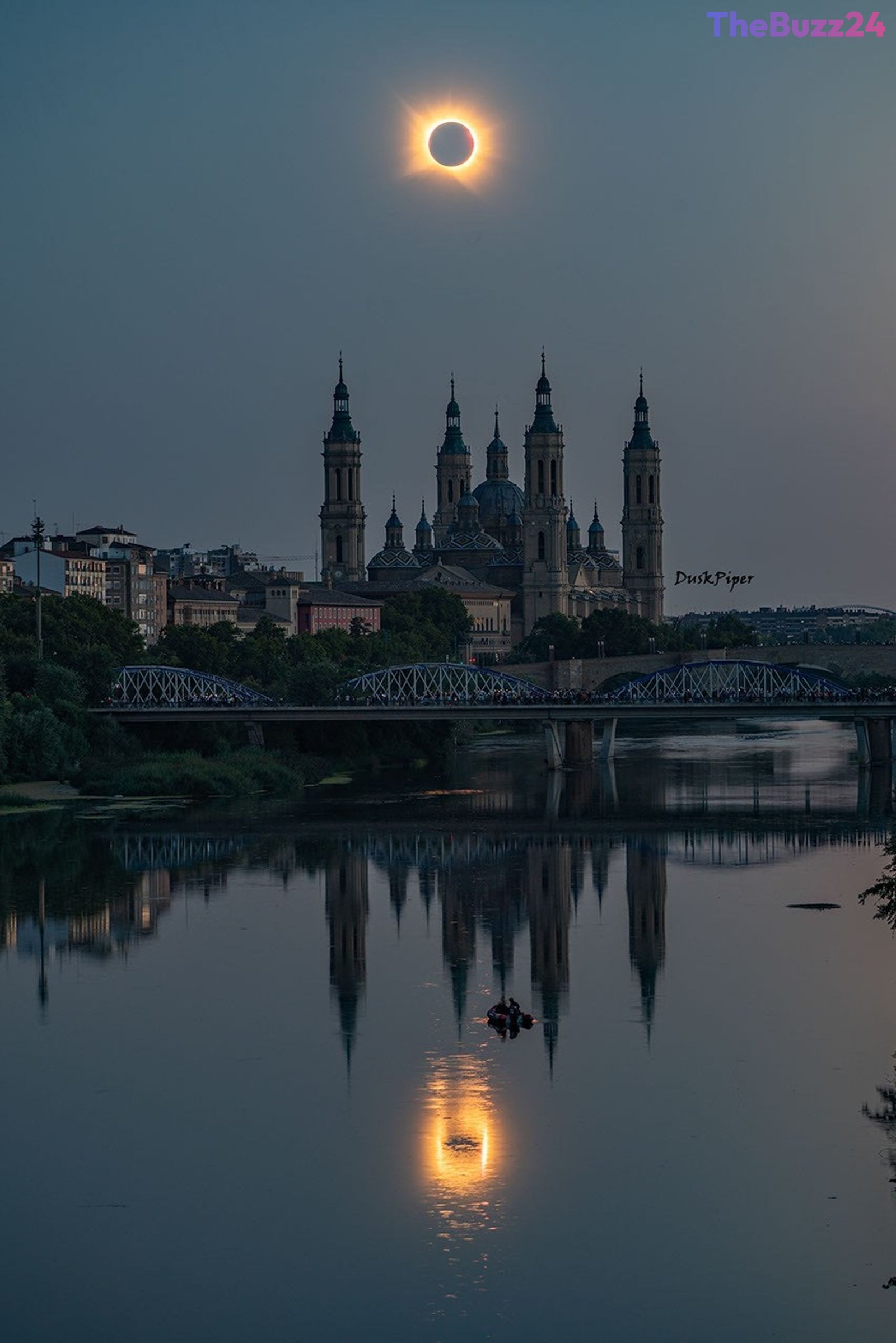
Celestial Spectacle: Spain Witnesses Rare Total Solar Eclipse
On August 12, 2026, a rare celestial event unfolded as a total solar eclipse swept across several regions, including Siberia, Greenland, Iceland, Spain, and Portugal. In Spain, the event was particularly momentous, marking the first major total solar eclipse the country has witnessed since 1905.
In the city of Zaragoza, the eclipse provided breathtaking views. Observers captured the sun’s corona as it appeared over the Cathedral-Basilica of Our Lady of the Pillar, while stunning reflections of the phenomenon were seen dancing on the surface of the Ebro River. As the moon’s shadow passed over, the sudden darkness brought a noticeable drop in temperature and a sudden silence from local wildlife, creating a profound atmosphere of awe.
Beyond the visual splendor, the eclipse serves as a critical window for scientific inquiry. Astronomers utilize these moments to study the solar corona, which remains millions of degrees hotter than the Sun’s surface—a phenomenon that continues to intrigue the scientific community. These observations help bridge the gap in our understanding of solar physics.
Citizens and amateur astronomers alike played a role in the event, documenting changes in air temperature, cloud cover, and animal behavior. These observations contribute to a broader understanding of how such cosmic events impact the Earth’s immediate environment and the biological rhythms of local ecosystems.
Key Takeaways
- Spain experienced its first major total solar eclipse in over a century.
- The eclipse path spanned several regions, including Greenland, Iceland, and Portugal.
- The event offers scientists a unique opportunity to study the extreme temperatures of the solar corona.
Editor’s Analysis & Impact
The 2026 total solar eclipse represents more than just a visual marvel; it is a significant astronomical milestone for Europe. The rarity of such an event in Spain—not seen on this scale since 1905—drives both scientific interest and massive tourism potential for the affected regions. From a scientific perspective, the opportunity to observe the solar corona in such clarity allows researchers to probe the mysteries of solar thermodynamics, specifically why the corona is significantly hotter than the photosphere. As the path of totality moves through diverse climates from Greenland to Portugal, the data collected on atmospheric and biological responses will be invaluable. This event underscores the intersection of cosmic phenomena and terrestrial impact, highlighting how celestial movements can momentarily alter the rhythm of life on Earth.
Frequently Asked Questions
Q: When was the last time Spain saw a total solar eclipse of this magnitude?
A: The last major total solar eclipse in Spain occurred in 1905.
Q: Why is the solar corona important to study during an eclipse?
A: The corona is the Sun's outer atmosphere, and studying it helps scientists understand why it is millions of degrees hotter than the Sun's surface.
Q: What physical changes occur during totality?
A: Observers often experience a sudden drop in temperature, a change in light quality, and shifts in animal behavior, such as birds quieting.
AI Disclosure: This article is based on verified data and official reports. Our Team and AI have cross-referenced every financial detail with primary sources to ensure total accuracy.
More from this Category