Cosmic Illusion: James Webb Space Telescope Captures Stunning ‘House of Mirrors’ Galaxy Cluster
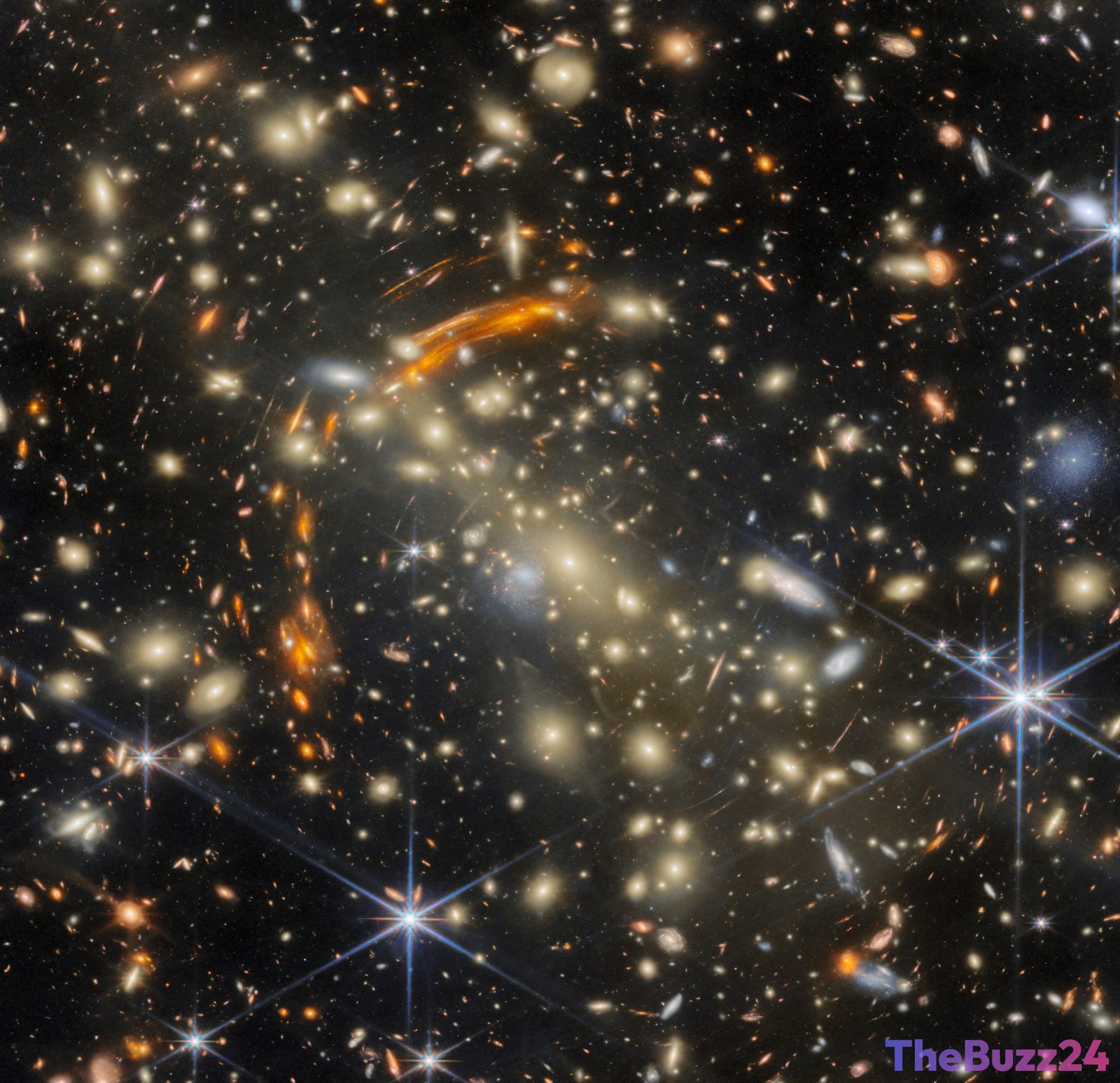
A newly released image from the James Webb Space Telescope has captured a mesmerizing cosmic phenomenon, revealing a distant galaxy cluster that acts like a massive, natural magnifying glass in deep space. The stunning visual showcases the galaxy cluster MACS J0454.1-0300, where brilliant golden galaxies dominate the foreground. However, the most intriguing elements of the image are the distorted, orange-hued galaxies that appear warped and multiplied across the cosmic canvas.
This visual distortion is the result of gravitational lensing, a phenomenon predicted by Albert Einstein’s theory of general relativity. When an immense concentration of mass, such as the MACS J0454.1-0300 galaxy cluster, sits between Earth and much more distant background galaxies, its gravitational field acts as a cosmic lens. This field bends, magnifies, and sometimes duplicates the light traveling from those background objects, creating a “house of mirrors” effect for observers.
The orange galaxies visible in the image are actually located much further away in the universe than the golden cluster itself. Without the magnifying power of gravitational lensing, these distant structures would likely remain invisible to modern instruments. By utilizing these natural cosmic lenses, astronomers can peer deeper into the early universe, studying the characteristics of ancient galaxies that existed billions of years ago.
This latest observation highlights the unparalleled capabilities of the James Webb Space Telescope in capturing high-resolution infrared data. By studying these lensed systems, researchers can map the distribution of both visible matter and elusive dark matter within massive galaxy clusters, further unlocking the mysteries of cosmic evolution and the fundamental laws of physics.
Key Takeaways
- The James Webb Space Telescope captured a striking image of the galaxy cluster MACS J0454.1-0300 exhibiting gravitational lensing.
- Gravitational lensing occurs when the immense gravity of a foreground cluster bends and magnifies the light of more distant background galaxies.
- This phenomenon allows astronomers to observe ancient, distant galaxies that would otherwise be too faint to detect.
Editor’s Analysis & Impact
The latest imagery from the James Webb Space Telescope (JWST) underscores the critical role of gravitational lensing in modern observational astrophysics. By leveraging these natural cosmic magnifiers, scientists can bypass some of the physical limitations of human-made optics, effectively turning massive galaxy clusters into secondary telescope lenses. This technique is vital for studying the early universe, offering insights into galaxy formation, cosmic expansion, and the distribution of dark matter—which does not emit light but exerts gravitational influence. As JWST continues to deliver high-fidelity infrared data, the astronomical community is poised to refine cosmological models. The broader implication of these findings is a deeper understanding of the universe’s structural evolution, proving that the synergy between advanced space technology and natural physics phenomena is our best tool for mapping the cosmos.
Frequently Asked Questions
Q: What is gravitational lensing?
A: Gravitational lensing is a phenomenon where a massive object, like a galaxy cluster, bends and magnifies the light from a more distant object behind it, acting like a natural magnifying glass.
Q: Why do some galaxies in the image look warped and duplicated?
A: The light from the distant background galaxies is bent as it passes through the intense gravitational field of the foreground cluster MACS J0454.1-0300, creating a distorted, "house of mirrors" effect.
Q: How does this help astronomers?
A: It allows astronomers to study incredibly distant and faint galaxies from the early universe that would normally be invisible, helping them understand cosmic history and dark matter distribution.
AI Disclosure: This article is based on verified data and official reports. Our Team and AI have cross-referenced every financial detail with primary sources to ensure total accuracy.
More from this Category