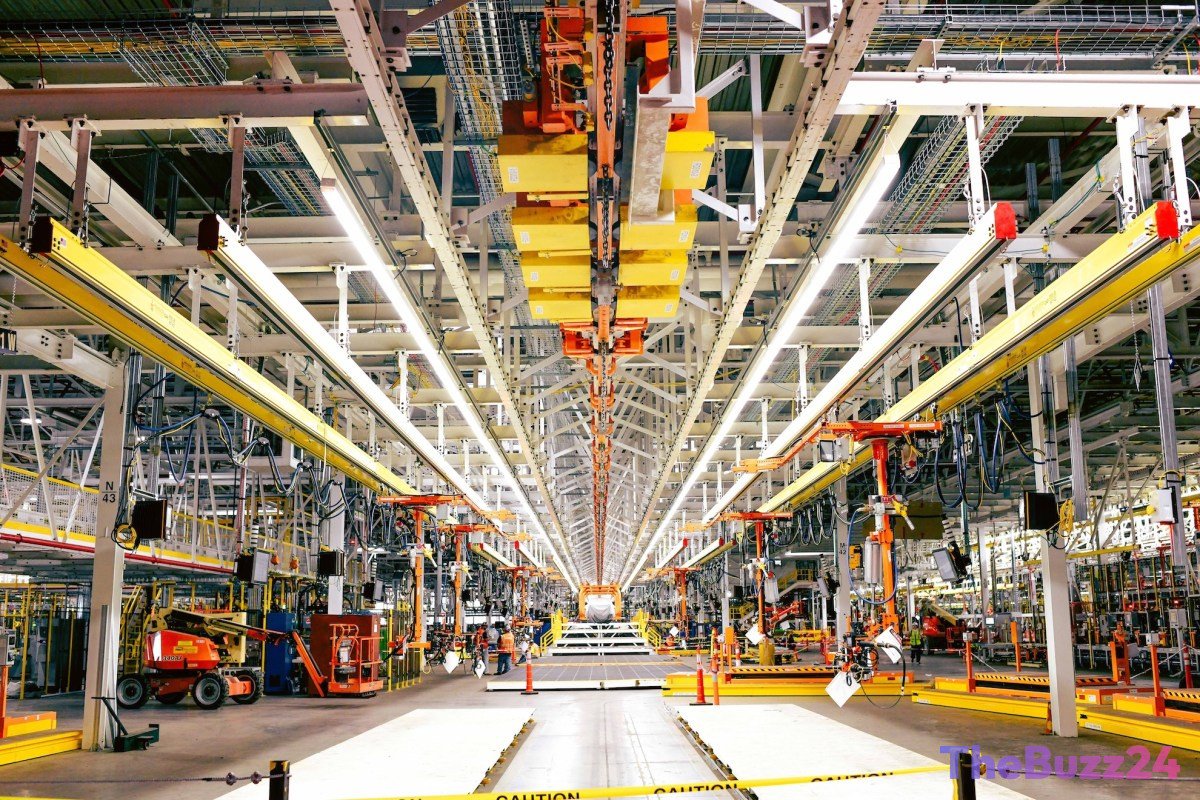
Ford’s $2 Billion Gamble: Inside the Revolutionary Factory Overhaul Set to Launch the Sub-$30K Fathom EV
Two years after halting operations at its historic Louisville Assembly Plant in Kentucky, Ford Motor Company is nearing the completion of a massive $2 billion manufacturing overhaul. The ambitious project represents a fundamental departure from the traditional moving assembly line pioneered by Henry Ford over a century ago. In its place, the automotive giant is constructing a highly modernized facility designed specifically to produce its next-generation electric vehicle, a highly anticipated midsize electric truck named the Fathom.
Positioned as a game-changer for the mass market, the Fathom is slated to launch with a starting price under $30,000. Ford confirmed that the factory transformation remains on schedule, with prototype production of the Fathom expected to begin in the first quarter of 2027. Customer deliveries are projected to roll out later that year. To ensure a seamless transition, the automaker is already testing production-level tooling ahead of the initial prototype builds, while factory workers undergo rigorous training at Ford’s development center in Allen Park, Michigan.
At the heart of this transition is a “universal production system” engineered by a specialized skunkworks team led by former Tesla executive Alan Clarke. Moving away from linear assembly, the new system utilizes a three-branched assembly tree. This method leverages large, single-piece aluminum unicastings to drastically reduce part counts. The front and rear sections of the truck will be built on separate branches, while a third branch integrates the structural battery with the interior cabin components, including seats and carpeting. The three sections will merge at the final stage, a process expected to boost assembly speeds by 15% compared to the plant’s previous output.
Beyond physical assembly, Ford is heavily upgrading the plant’s digital infrastructure. Wi-Fi coverage has been nearly tripled to 1,080 access points, providing the high-bandwidth, low-latency connectivity required for real-time software quality checks. This overhaul is critical for Ford, whose early EV ventures struggled with profitability while competitors like Tesla and Chinese automakers captured market share with high-volume, high-margin electric models.
Key Takeaways
- Ford is investing $2 billion to overhaul its Louisville Assembly Plant, abandoning its traditional century-old assembly line for a new 'universal production system.'
- The revamped facility will produce the Fathom, an affordable midsize electric truck priced under $30,000, with prototype production starting in Q1 2027.
- The new manufacturing process utilizes a three-branched assembly tree and large aluminum unicastings, boosting assembly efficiency by 15%.
Editor’s Analysis & Impact
Ford’s $2 billion overhaul of the Louisville plant is a high-stakes pivot that could define the automaker’s survival in the rapidly evolving EV landscape. By abandoning Henry Ford’s iconic moving assembly line in favor of a modular, three-branched system, the company is directly adopting manufacturing efficiencies popularized by Tesla. This structural shift, combined with the use of large unicastings, is designed to slash production costs and enable a sub-$30,000 retail price for the Fathom. To compete with low-cost Chinese EV manufacturers and Tesla’s dominant market share, Ford must prove it can build EVs profitably at scale. If successful, this universal production system will serve as the blueprint for Ford’s global manufacturing future, transitioning the legacy automaker from a struggling EV player into a highly efficient, tech-forward competitor.
Frequently Asked Questions
Q: What is the Ford Fathom and when will it be available?
A: The Fathom is Ford's upcoming all-electric midsize truck, which is expected to start under $30,000. Prototype production is scheduled to begin in the first quarter of 2027, with customer vehicles launching later that year.
Q: How does Ford's new universal production system work?
A: Developed by a team led by a former Tesla executive, the system replaces the traditional linear assembly line with a three-branched assembly tree. It uses large single-piece aluminum unicastings to reduce parts, assembling the front, rear, and center (battery and cabin) of the vehicle on separate branches before joining them at the end.
Q: Why is Ford upgrading the digital infrastructure at the Louisville plant?
A: Ford has nearly tripled the plant's Wi-Fi density to 1,080 access points to provide the high-bandwidth, low-latency connectivity necessary for advanced, real-time software quality checks during assembly.
AI Disclosure: This article is based on verified data and official reports. Our Team and AI have cross-referenced every financial detail with primary sources to ensure total accuracy.
More from this Category