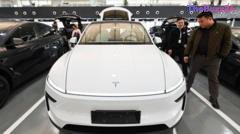
China Initiates Massive EV Recall, Including Millions of Teslas, Over Hidden Door Handle Safety Concerns
China has launched a sweeping recall affecting over four million electric vehicles (EVs), with nearly three million Chinese-made Teslas at the forefront, due to significant safety concerns surrounding their hidden door handle designs. The minimalistic handles, a signature feature in many modern EVs, have been identified as difficult to locate and operate during emergency situations, posing a potential hazard to occupants.
The recall encompasses various models from Tesla, including the Model 3, Y, S, and X, alongside vehicles from prominent Chinese manufacturers such as XPeng, Xiaomi, and Geely. The issue gained critical attention following two fatal crashes in China involving Xiaomi EVs, where power failures were suspected of preventing doors from being opened. Tesla acknowledged in a statement that its door handles are “difficult to identify and operate because their colour is similar to the interior trim,” which could impede quick escape or rescue efforts in extreme scenarios like a severe collision causing a low-voltage system failure.
To address the immediate safety risks, Tesla plans to affix warning labels to the interior doors of recalled vehicles and deploy a software update designed to automatically lower the windows after a collision. However, industry experts like Tu Le, founder of Sino Auto Insights, suggest these measures might be temporary fixes rather than lasting solutions. The widespread adoption of hidden handle designs, initially popularized by Tesla’s Model S in 2014, has prompted a strong regulatory response in China. New rules, set to take effect on January 1, 2027, will ban hidden door handles, mandating that all new cars sold in the country must feature mechanical releases on both the inside and outside of their doors. This move underscores a global shift towards prioritizing safety over purely aesthetic design, a sentiment echoed by US safety regulators who have also probed Tesla’s door handles and suggested new formal safety standards for all carmakers.
Key Takeaways
- China has initiated a massive recall of over 4 million electric vehicles, including nearly 3 million Teslas, due to safety concerns over hidden door handles.
- The primary safety risk is the difficulty in opening these doors during emergencies or power failures, potentially hindering occupant escape and rescue efforts.
- Chinese authorities are implementing new regulations, effective 2027, to ban hidden door handles, requiring mechanical releases on all new vehicles sold in the country.
Editor’s Analysis & Impact
This extensive recall in China highlights a critical juncture for the electric vehicle industry, forcing manufacturers to re-evaluate the balance between sleek design and fundamental safety. The market impact could be significant, potentially leading to increased R&D costs for design modifications and a shift in consumer perception regarding EV safety features. For companies like Tesla, XPeng, and Xiaomi, it underscores the immense influence of the Chinese regulatory environment, which is increasingly setting global standards. The future outlook suggests a move towards more practical, safety-centric designs, potentially inspiring similar regulatory actions in other major automotive markets. This event serves as a stark reminder that rapid technological advancement must always be underpinned by robust safety protocols.
Frequently Asked Questions
Q: What is the main reason for the EV recall in China?
A: The recall is primarily due to safety concerns surrounding hidden door handles, which have been deemed difficult to locate and operate, especially in emergency situations or after a power failure, potentially trapping occupants.
Q: Which car manufacturers are affected by this recall?
A: The recall affects several major electric vehicle manufacturers, including Tesla (with nearly 3 million vehicles), as well as Chinese carmakers XPeng, Xiaomi, and Geely.
Q: What solutions are being implemented for the recalled vehicles?
A: For recalled vehicles, manufacturers like Tesla are implementing solutions such as placing warning labels on interior doors and issuing software updates to automatically lower windows in the event of a collision, aiming to facilitate escape and rescue.
AI Disclosure: This article is based on verified data and official reports. Our Team and AI have cross-referenced every financial detail with primary sources to ensure total accuracy.
More from this Category