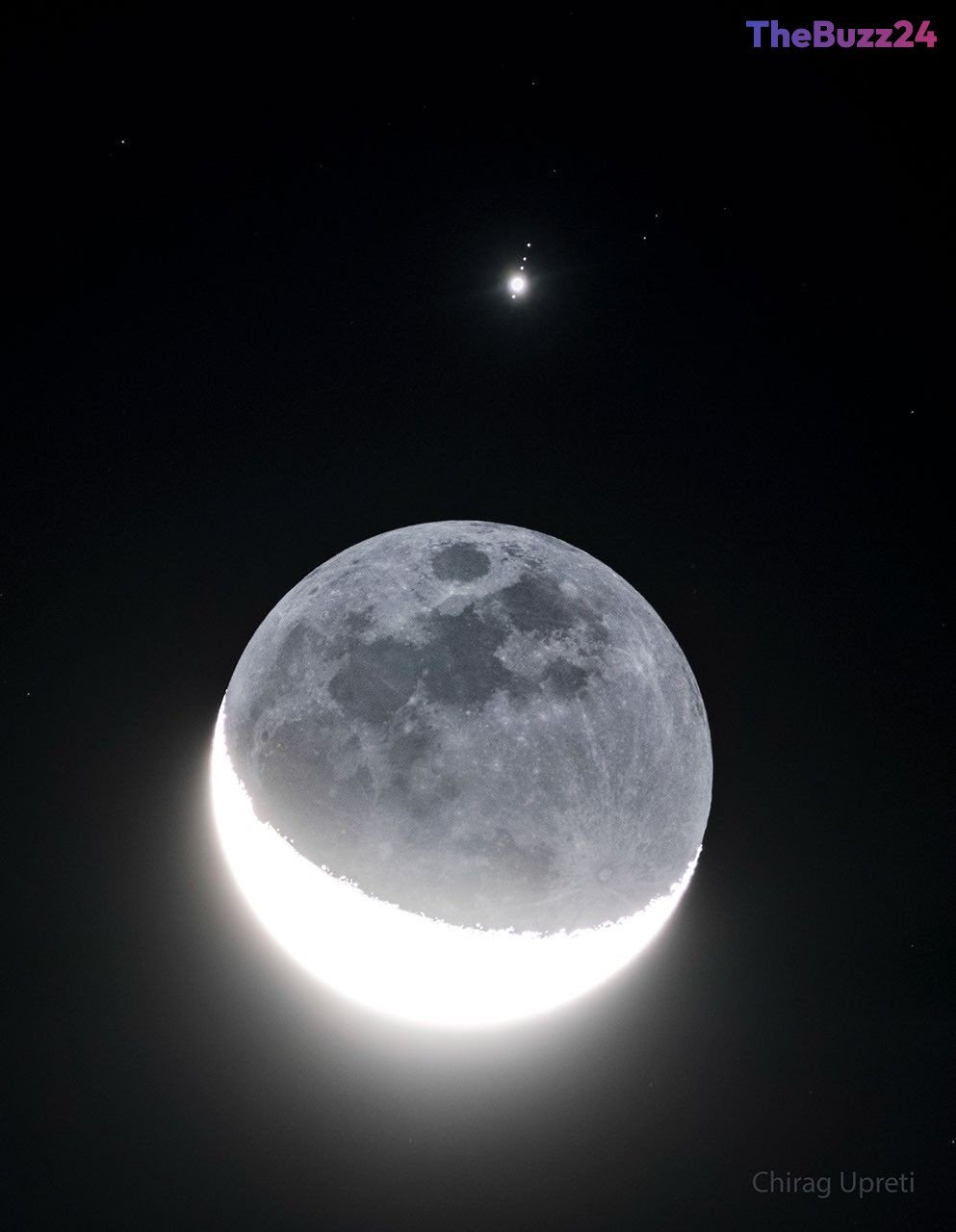
Rare Celestial Alignment: Jupiter and Its Galilean Moons Photographed Alongside Earth’s Moon
A remarkable astronomical event was captured recently in Westchester, New York, showcasing a rare alignment between Earth’s Moon and the gas giant Jupiter. The photograph highlights five distinct moons in a single frame: Earth’s natural satellite and the four large Galilean moons of Jupiter. This visual alignment occurred as the Moon passed directly in front of the giant planet from the perspective of observers on Earth.
The resulting image provides a striking contrast between the two bodies. Earth’s Moon is depicted with a bright, overexposed sunlit crescent on one side, while the night side remains visible due to the faint glow of Earthshine. Positioned vertically above the lunar surface, Jupiter’s primary satellites—Ganymede, Io, Callisto, and Europa—appear in a near-perfect line, offering a rare sense of scale for observers.
These four Galilean moons are significant in planetary science, with three of them—Callisto, Ganymede, and Io—being larger than Earth’s own Moon, while Europa is only slightly smaller. The observation coincides with ongoing scientific efforts to study the Jovian system, most notably through the Juno robotic spacecraft, which continues to conduct close-range flybys of these moons to gather data on their composition and potential habitability.
Key Takeaways
- A unique celestial alignment allowed for the simultaneous photography of Earth's Moon and Jupiter's four Galilean moons.
- The image captures the relative scale of the moons, noting that three of Jupiter's satellites are larger than Earth's Moon.
- NASA's Juno spacecraft remains active in the Jovian system, providing ongoing research into the moons featured in the alignment.
Editor’s Analysis & Impact
The capture of such a precise celestial alignment serves as a powerful reminder of the dynamic nature of our solar system. Beyond the aesthetic value, these events provide amateur and professional astronomers alike with opportunities to visualize planetary mechanics in real-time. The continued presence of the Juno spacecraft in the Jovian system underscores the high priority placed on studying these moons, particularly Europa and Ganymede, which are subjects of intense interest regarding astrobiology and subsurface oceans. As imaging technology improves, the ability for ground-based observers to document these rare configurations enhances public engagement with space science. Future missions and continued monitoring of the Jovian system will likely yield more data on the geological activity of these moons, potentially reshaping our understanding of planetary formation and the conditions necessary for life beyond Earth.
Frequently Asked Questions
Q: What are the Galilean moons of Jupiter?
A: The Galilean moons are the four largest moons of Jupiter: Io, Europa, Ganymede, and Callisto. They were first discovered by Galileo Galilei in 1610.
Q: What is Earthshine?
A: Earthshine is the faint illumination of the dark portion of the Moon's surface caused by sunlight reflecting off the Earth and hitting the Moon.
AI Disclosure: This article is based on verified data and official reports. Our Team and AI have cross-referenced every financial detail with primary sources to ensure total accuracy.
More from this Category