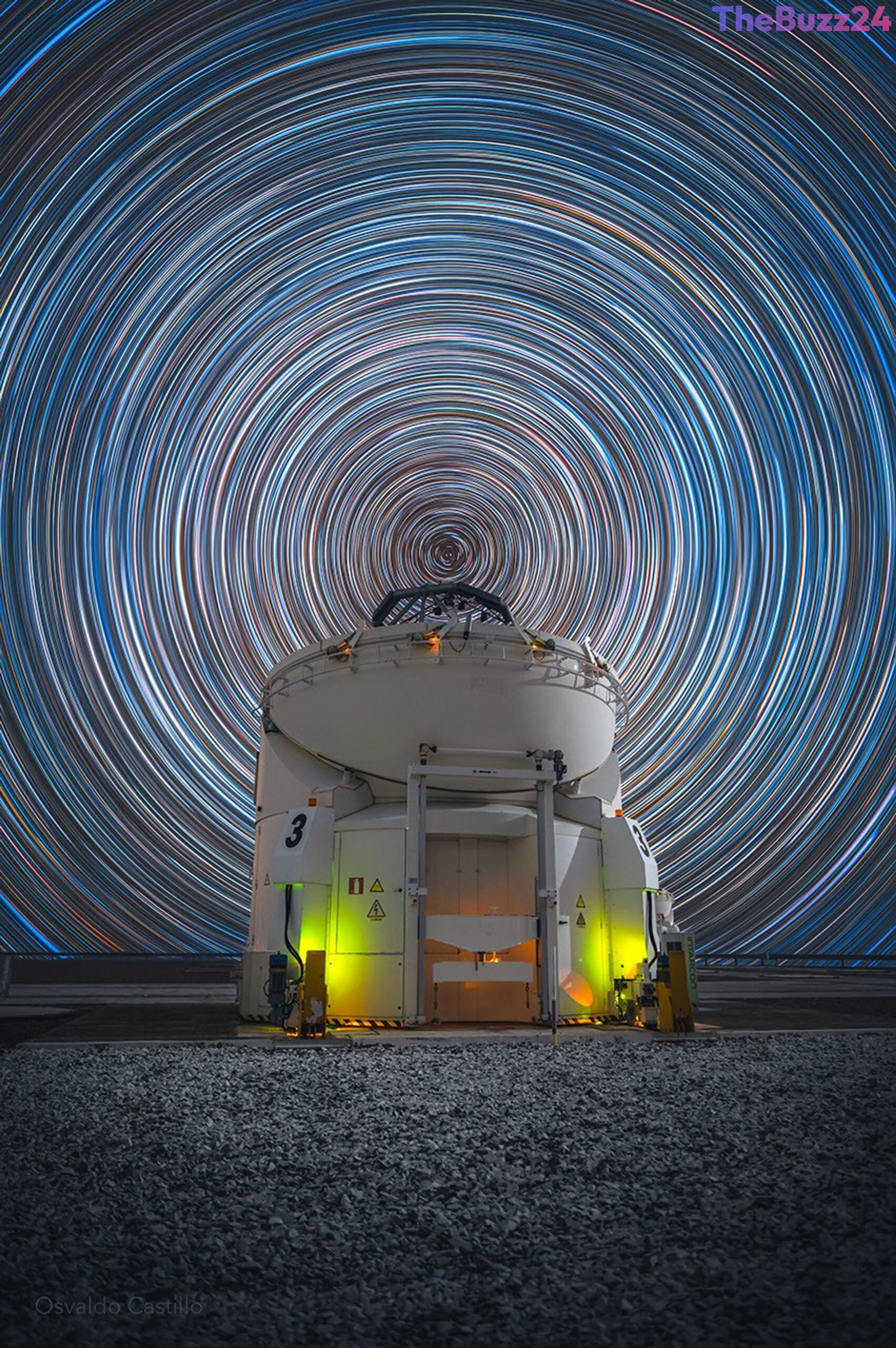
Capturing the Cosmos: How Star Trails Reveal Earth’s Rotation Over Paranal
At the Paranal Observatory in Chile, located 25 degrees south of the equator, the Earth’s rotation carries the surface eastward at speeds exceeding 1,500 kilometers per hour. While this velocity surpasses the speed of sound at sea level, the movement remains entirely imperceptible to human senses. However, this planetary motion can be vividly illustrated through the technique of long-exposure astrophotography, which captures the apparent rotation of the night sky.
A recent composite image, created by stacking 300 consecutive 25-second exposures, reveals the graceful, concentric arcs of star trails circling the south celestial pole. By fixing a camera to a tripod, the photographer successfully traced the movement of the stars as the Earth rotated beneath them. The resulting image highlights the celestial mechanics of the southern hemisphere, where the stars appear to pivot around the southern extension of Earth’s axis.
In the foreground of this striking scene, one of the observatory’s 1.8-meter auxiliary telescopes, known as AT 3, stands faintly illuminated. The composition serves as a reminder of the observatory’s unique position on a rotating planet, providing a clear window into the cosmos while grounding the viewer in the physical reality of our world’s constant motion.
Key Takeaways
- Earth's rotation at the Paranal Observatory in Chile moves the surface at over 1,500 kilometers per hour.
- Star trail photography uses long-exposure stacking to visually demonstrate the Earth's rotation relative to the celestial poles.
- The image captures the south celestial pole, providing a clear view of the southern hemisphere's night sky rotation.
Editor’s Analysis & Impact
The intersection of high-precision ground-based astronomy and public-facing science communication remains vital for fostering interest in space exploration. By utilizing sites like the Paranal Observatory, astronomers and photographers can bridge the gap between complex celestial mechanics and accessible visual media. This type of imagery not only serves an educational purpose but also highlights the importance of maintaining dark-sky sites for scientific research. As space observation technology advances, the ability to document these phenomena with increasing clarity reinforces the necessity of global cooperation in astronomy. The future outlook for such projects remains strong, as digital stacking techniques continue to democratize high-quality astrophotography, allowing both professionals and enthusiasts to contribute to our collective understanding of the universe’s dynamic nature.
Frequently Asked Questions
Q: How are star trail images created?
A: Star trail images are created by taking a series of long-exposure photographs over an extended period and then 'stacking' them together using software to show the continuous movement of stars across the sky.
Q: Why do stars appear to rotate in circles in these photos?
A: Stars appear to rotate in circles because the Earth itself is rotating on its axis. The center of these circles corresponds to the celestial poles, which are the points in the sky directly above the Earth's North and South Poles.
AI Disclosure: This article is based on verified data and official reports. Our Team and AI have cross-referenced every financial detail with primary sources to ensure total accuracy.
More from this Category