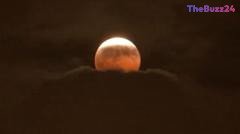
Global Stargazers Treated to Spectacular ‘Blood Moon’ Lunar Eclipse
Skywatchers across the globe were treated to a breathtaking celestial display as a total lunar eclipse, popularly known as a “Blood Moon,” illuminated the night sky. The rare astronomical phenomenon occurs when the Earth aligns directly between the Sun and the Moon, casting its shadow across the lunar surface. As sunlight filters through Earth’s atmosphere, shorter blue wavelengths are scattered, leaving only the longer red wavelengths to reflect off the Moon, giving it a dramatic, copper-red hue.
The celestial event was visible to millions of people across various continents, including parts of North and South America, Asia, and Australia. Observatories and amateur astronomers alike set up telescopes in parks, backyards, and public squares to capture the progression of the eclipse. The event lasted for several hours, with the period of totality—when the Moon is completely engulfed in Earth’s shadow—lasting for over an hour, providing ample opportunity for photography and scientific observation.
Astronomers emphasize that lunar eclipses offer unique opportunities to study the Earth’s atmosphere and the thermal properties of lunar dust. Unlike solar eclipses, which require specialized protective eyewear, a lunar eclipse is completely safe to view with the naked eye. This accessibility makes it one of the most widely shared and celebrated astronomical events, fostering a global sense of wonder and curiosity about our solar system.
Key Takeaways
- A total lunar eclipse, or 'Blood Moon,' occurred as the Earth positioned itself directly between the Sun and the Moon.
- The distinctive reddish color is caused by Rayleigh scattering, where Earth's atmosphere filters out blue light and projects red light onto the Moon.
- The event was safely visible to the naked eye across multiple continents, sparking widespread public interest and scientific observation.
Editor’s Analysis & Impact
The widespread public engagement with the recent ‘Blood Moon’ highlights a growing global interest in astronomy and space science, often fueled by social media and real-time photography sharing. For the scientific community, these events are more than just visual spectacles; they serve as critical moments for public outreach and education, inspiring the next generation of aerospace engineers and astronomers. Furthermore, observing how the lunar surface cools during the rapid temperature drop of an eclipse provides researchers with valuable data on the composition of lunar soil (regolith). As space agencies like NASA and international partners prepare for sustained human presence on the Moon through programs like Artemis, understanding these thermal dynamics becomes increasingly practical. The event underscores the enduring power of celestial phenomena to unite global audiences in shared scientific curiosity.
Frequently Asked Questions
Q: What causes the Moon to turn red during a total lunar eclipse?
A: The red color, often called a 'Blood Moon,' is caused by a phenomenon called Rayleigh scattering. As sunlight passes through Earth's atmosphere, shorter wavelengths of light (like blue and violet) are scattered away, while longer wavelengths (like red and orange) pass through and are bent, or refracted, onto the Moon's surface.
Q: Is it safe to look at a lunar eclipse without protective glasses?
A: Yes, unlike solar eclipses, lunar eclipses are completely safe to view with the naked eye, binoculars, or telescopes. You are only looking at reflected sunlight from the Moon, which is not intense enough to damage your eyes.
Q: How often do total lunar eclipses occur?
A: Total lunar eclipses occur roughly once every one to two years on average. However, they are only visible from the night side of the Earth, meaning any given location on Earth may only experience one every few years.
AI Disclosure: This article is based on verified data and official reports. Our Team and AI have cross-referenced every financial detail with primary sources to ensure total accuracy.
More from this Category