Hubble Reveals Mysterious Decagon at Saturn’s South Pole, Mirroring Northern Hexagon
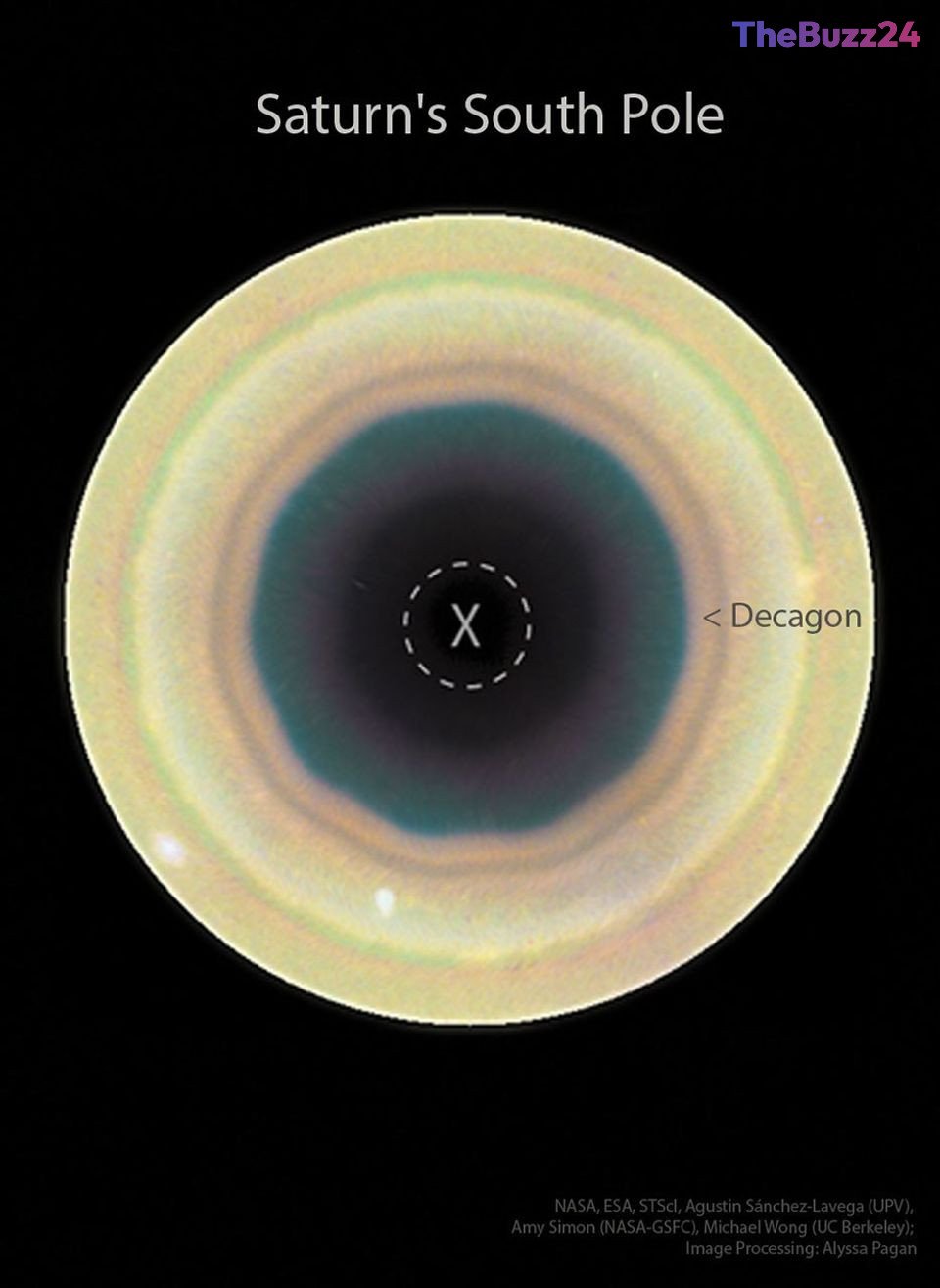
Recent observations by the Hubble Space Telescope have unveiled a striking decagonal (10-sided) cloud pattern swirling around Saturn’s South Pole. This discovery adds another layer of mystery to the gas giant’s atmospheric dynamics, drawing parallels to the long-standing hexagonal cloud structure that has captivated scientists at Saturn’s North Pole for decades.
The northern hexagon, a remarkably stable six-sided atmospheric feature, was first detected in 1987 by NASA’s Voyager spacecrafts during their rapid flybys of the ringed planet in the early 1980s. It has persisted for over 40 years, making it one of the most enduring and enigmatic weather phenomena in the solar system. The newly observed southern decagon, captured in a composite image by Hubble, appears most prominent within the darker inner regions of the pole, surrounded by bands of circulating clouds.
Scientists hypothesize that these distinct geometric boundaries are likely formed by wave interactions within Saturn’s atmosphere. This occurs as fast-moving gases closer to the poles interact with slower-moving gases further away, creating the conditions for these stable, multi-sided patterns to emerge. The precise mechanisms, however, remain a subject of ongoing research and debate among planetary scientists.
While the northern hexagon’s stability has been well-documented over many years, the longevity and evolution of the southern decagon will undoubtedly become a focal point for future studies. Continued monitoring by advanced telescopes like Hubble will be crucial in understanding the forces that shape these unique and persistent atmospheric phenomena on Saturn.
Key Takeaways
- The Hubble Space Telescope has identified a decagonal (10-sided) cloud pattern at Saturn's South Pole.
- This new discovery mirrors the well-known, stable hexagonal cloud structure previously observed at Saturn's North Pole by Voyager spacecrafts.
- Scientists believe these geometric patterns are likely caused by wave interactions between fast and slow-moving gases in Saturn's atmosphere.
Editor’s Analysis & Impact
The discovery of a decagonal cloud pattern at Saturn’s South Pole by the Hubble Space Telescope is a significant advancement in planetary science. It not only deepens our understanding of atmospheric dynamics on gas giants but also highlights the unique complexities of Saturn’s weather systems. This finding could spur new theoretical models and observational campaigns, potentially leading to breakthroughs in fluid dynamics and meteorology beyond Earth. For the space industry, it underscores the invaluable role of long-duration missions and advanced telescopes like Hubble in revealing the universe’s hidden wonders. Future research into the decagon’s stability and its comparison to the northern hexagon will provide crucial insights into planetary evolution and the universal principles governing atmospheric phenomena.
Frequently Asked Questions
Q: What is the significance of the decagon at Saturn's South Pole?
A: The discovery of a decagonal cloud pattern at Saturn's South Pole is significant because it adds to the unique atmospheric phenomena observed on the planet, complementing the long-known hexagonal pattern at its North Pole. It provides new data for scientists to study the complex fluid dynamics and wave interactions that shape planetary atmospheres.
Q: How do scientists believe these geometric patterns are formed?
A: Scientists hypothesize that these geometric cloud patterns, both the northern hexagon and the southern decagon, are likely caused by wave interactions. This occurs when fast-moving gases closer to the poles interact with slower-moving gases further away, creating stable, multi-sided atmospheric structures.
Q: Which spacecraft observed these phenomena?
A: The hexagonal cloud pattern at Saturn's North Pole was initially discovered by NASA's Voyager spacecrafts in 1987. The newly identified decagonal pattern at the South Pole was recently observed and imaged by the Hubble Space Telescope.
AI Disclosure: This article is based on verified data and official reports. Our Team and AI have cross-referenced every financial detail with primary sources to ensure total accuracy.
More from this Category