International Watchdog Raises Alarm Over North Korea’s Expanding Nuclear Program
An international nuclear watchdog has expressed “serious concern” following the discovery of a new two-story uranium enrichment facility in North Korea. The structure, located within the primary Yongbyon nuclear complex, is reportedly designed to accommodate up to 28 centrifuge cascades, which are crucial for enriching uranium. This development signals a significant advancement in Pyongyang’s nuclear capabilities.
The findings, which emerged from a recent report, also indicate that North Korea has initiated operations at an expanded annex situated at another enrichment site. These observations collectively point to a consistent and worrying expansion of the nation’s sanctioned nuclear infrastructure. The agency, which has not had inspectors on the ground in North Korea since their expulsion in 2009, relies heavily on satellite imagery for its assessments. The continuation and further development of North Korea’s nuclear program are considered clear violations of relevant UN Security Council resolutions.
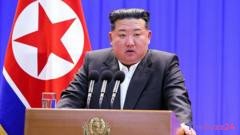
North Korean leader Kim Jong Un previously visited what was described as a “newly inaugurated nuclear materials production factory” at the Yongbyon enrichment facility, where he lauded the country’s “greatly expanded production capacity.” This expansion, he stated, would “offer the possibility of carrying out larger plans.” Despite governing one of the world’s poorest nations, Kim Jong Un allocates substantial resources annually to develop a clandestine nuclear arsenal, with a 2022 report estimating this figure at $640 million. Experts highlight that a major concern lies in the unknown and concealed nature of many of North Korea’s nuclear facilities, making them difficult to monitor and target.
Under Kim Jong Un’s leadership, North Korea’s nuclear program has accelerated dramatically, marked by a record number of missile tests, including numerous intercontinental ballistic missiles (ICBMs) since 2017. The nation has conducted six nuclear weapons tests, with the most recent occurring in September 2017. In response to these escalating capabilities, South Korea’s president, Lee Jae Myung, proposed talks aimed at officially ending the war between the two countries, suggesting such a forum could address “effective ways to halt the advancement of the North’s nuclear capabilities.” North Korea, which declared itself a nuclear power in 2022 and vowed never to relinquish its weapons (estimated to be in the dozens), has yet to respond to this diplomatic overture.
Key Takeaways
- North Korea has significantly expanded its uranium enrichment capabilities with a new two-story facility at Yongbyon and an annex at Kangson.
- The International Atomic Energy Agency (IAEA) views this expansion as a serious concern and a clear violation of UN Security Council resolutions, relying on satellite imagery for assessment.
- The development underscores North Korea's accelerating nuclear program under Kim Jong Un, despite international sanctions and calls for denuclearization, posing a significant challenge to regional and global security.
Editor’s Analysis & Impact
This latest revelation regarding North Korea’s expanded uranium enrichment capabilities signals a deepening challenge to global non-proliferation efforts. The continuous development of its nuclear infrastructure, despite stringent international sanctions, highlights Pyongyang’s unwavering commitment to its nuclear weapons program. This trajectory will likely intensify geopolitical tensions in East Asia, prompting increased defense spending and strategic realignments among regional powers like South Korea and Japan. For the broader international community, it underscores the limitations of current diplomatic and economic pressures, necessitating a re-evaluation of strategies to de-escalate the situation and prevent further proliferation. The lack of on-the-ground inspection also raises concerns about the true scale of North Korea’s nuclear ambitions.
Frequently Asked Questions
Q: Q: What is the significance of the new two-story uranium enrichment facility?
A: A: The new facility at the Yongbyon nuclear complex significantly expands North Korea's capacity to enrich uranium, a key component for nuclear weapons. Its design to house up to 28 centrifuge cascades indicates a substantial increase in potential production capability.
Q: Q: Why is the International Atomic Energy Agency (IAEA) concerned if it has no inspectors in North Korea?
A: A: The IAEA relies on satellite imagery and other intelligence to monitor North Korea's nuclear activities since its inspectors were expelled in 2009. Despite the lack of direct access, the evidence gathered indicates clear violations of UN Security Council resolutions and a dangerous expansion of the country's nuclear program.
Q: Q: How has North Korea's nuclear program progressed under Kim Jong Un?
A: A: Under Kim Jong Un, North Korea's nuclear program has accelerated significantly. This includes a record number of missile tests, development of intercontinental ballistic missiles (ICBMs), six nuclear weapons tests, and a declared status as a nuclear power in 2022, all while expanding its production facilities.
AI Disclosure: This article is based on verified data and official reports. Our Team and AI have cross-referenced every financial detail with primary sources to ensure total accuracy.
More from this Category