Unveiling Messier 33: The Triangulum Galaxy’s Cosmic Splendor
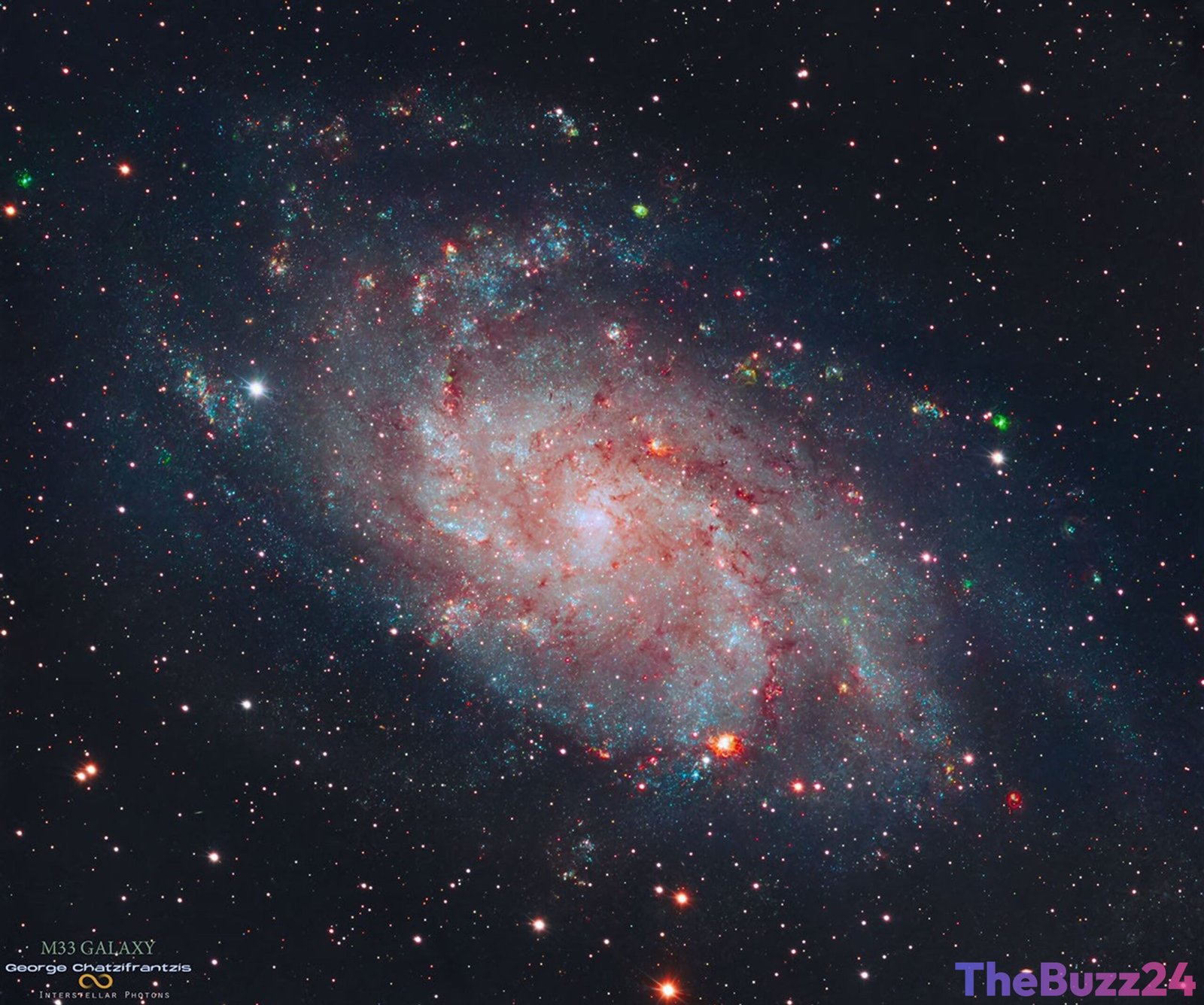
The northern constellation Triangulum hosts a magnificent celestial spectacle: Messier 33, popularly known as the Triangulum Galaxy or sometimes the Pinwheel Galaxy. This stunning face-on spiral galaxy offers astronomers a unique perspective into galactic structure and evolution, making it a focal point for deep-space observation. Its proximity and clear view allow for detailed studies of its intricate features, from vibrant star-forming regions to sprawling spiral arms.
Spanning over 50,000 light-years in diameter, Messier 33 holds the distinction of being the third-largest galaxy within our Local Group, a collection of galaxies that includes our own Milky Way and the colossal Andromeda Galaxy (M31). Situated approximately 3 million light-years from the Milky Way, M33 is gravitationally bound and is widely considered a satellite galaxy of the Andromeda Galaxy. This cosmic relationship suggests that observers within Andromeda would likely enjoy breathtaking views of M33’s grand spiral system, much as we observe it from Earth.
Telescopic observations reveal Messier 33’s striking characteristics, including brilliant blue star clusters indicative of young, hot stars, and expansive pinkish nebulae—regions where new stars are actively being born. Among these, the cavernous NGC 604 stands out as one of the brightest and most prominent star-forming regions within the galaxy. Beyond its aesthetic appeal, M33 plays a critical role in astrophysics. Like M31, its population of well-measured variable stars, particularly Cepheids, serves as a vital “cosmic yardstick,” enabling scientists to accurately determine distances to other galaxies and, consequently, establish the vast distance scale of the entire Universe.
Key Takeaways
- Messier 33 (Triangulum Galaxy) is a prominent face-on spiral galaxy and the third largest in our Local Group.
- It is located approximately 3 million light-years from the Milky Way and is believed to be a satellite of the Andromeda Galaxy.
- Observations of M33's variable stars are crucial for accurately measuring cosmic distances and establishing the Universe's distance scale.
Editor’s Analysis & Impact
The study of galaxies like Messier 33 is fundamental to advancing our understanding of cosmic evolution. For the scientific community, detailed observations of M33 contribute invaluable data on star formation rates, galactic dynamics, and the distribution of dark matter. Future missions utilizing advanced telescopes, such as the James Webb Space Telescope, will likely provide even higher-resolution insights into its stellar populations and gas clouds, refining our models of galaxy development. The continued use of M33’s variable stars as a cosmic distance calibrator is crucial for improving the accuracy of the Hubble Constant and understanding the expansion rate of the Universe. This research underpins much of modern cosmology, influencing theories on the universe’s origin and ultimate fate.
Frequently Asked Questions
Q: What is the Triangulum Galaxy?
A: The Triangulum Galaxy, also known as Messier 33 (M33), is a face-on spiral galaxy located in the constellation Triangulum. It is the third-largest galaxy in our Local Group, after the Andromeda Galaxy and the Milky Way.
Q: How far away is Messier 33 from Earth?
A: Messier 33 is approximately 3 million light-years away from the Milky Way galaxy.
Q: Why is the Triangulum Galaxy important to astronomers?
A: M33 is crucial for astronomers because its well-measured variable stars, particularly Cepheids, act as "cosmic yardsticks." By studying these stars, scientists can accurately determine distances to other galaxies, which is essential for establishing the overall distance scale of the Universe.
AI Disclosure: This article is based on verified data and official reports. Our Team and AI have cross-referenced every financial detail with primary sources to ensure total accuracy.
More from this Category