Spectacular Fireball Meteor Over the Dolomite Alps Captured in Rare European Sky Event
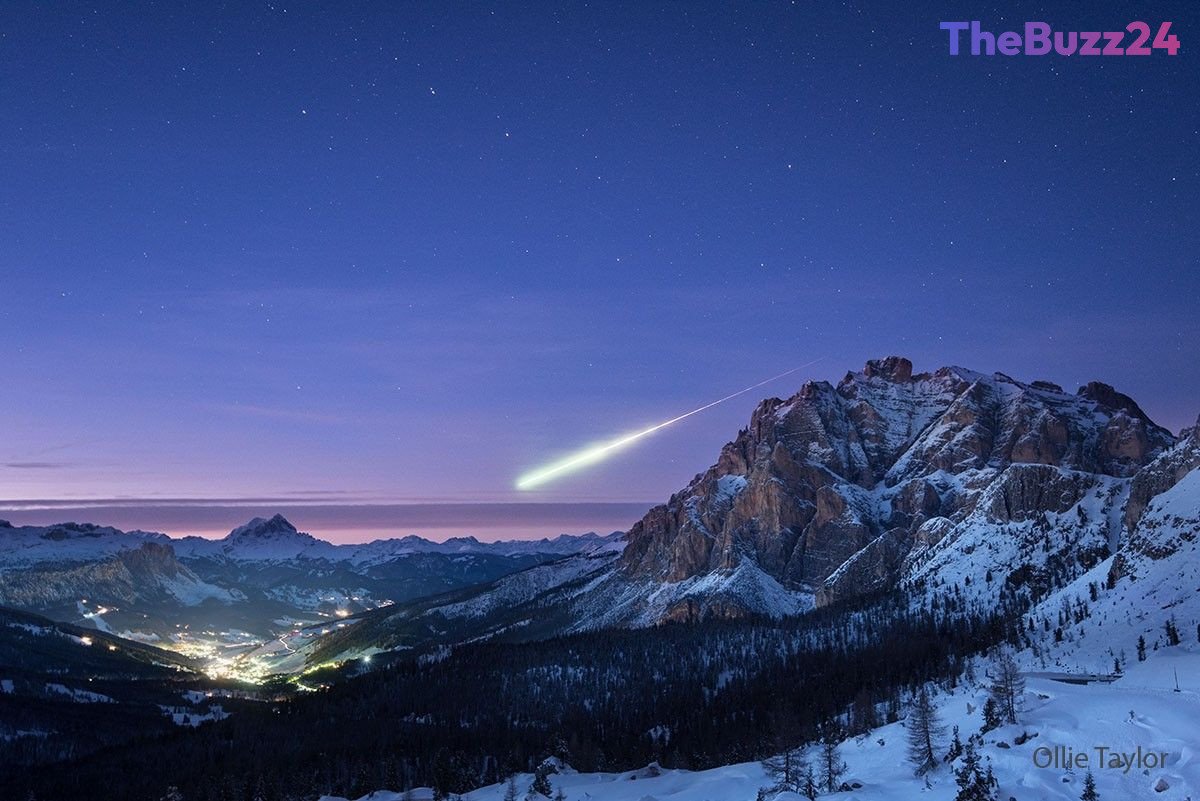
A striking astronomical photograph taken over the snow-covered peaks of Italy’s Dolomite Alps has captured a rare, intense fireball meteor illuminating the twilight sky. Taken from a mountain pass above the village of La Villa in Alta Badia, the serendipitous shot displays the glowing bolide streaking east to west beneath the iconic Big Dipper asterism within the constellation Ursa Major.
The celestial display, recorded during subfreezing weather conditions, coincided with a surge of public reports across European skies. The sheer number of witness submissions established the occurrence as one of the most heavily documented fireball events recorded by both the American Meteor Society and the International Meteor Organization, drawing widespread attention from researchers worldwide.
Subsequent tracking data analyzed the meteor’s trajectory as it traversed the skies over Germany. Researchers confirmed that its orbital vector aligns directly with the active radiant of the Northern Taurid Meteor Shower. This annual celestial stream is renowned for producing periodic, exceptionally bright fireballs originating from cosmic dust streams cast off by Comet Encke as it orbits the sun.
Beyond its scientific significance, the image stands out as a dramatic convergence of terrestrial landscapes and deep-space phenomena. Nestled beneath the celestial display, the warm glow of La Villa contrasts sharply with the frozen alpine wilderness, highlighting the unpredictable beauty of Earth’s atmospheric interactions.
Key Takeaways
- An exceptionally bright fireball meteor was captured in a rare twilight photograph over the Dolomite Alps in Italy.
- The event triggered widespread sightings across Europe, making it one of the most reported meteors tracked by major international meteor observatories.
- Trajectory analysis over Germany confirmed the meteor originated from the Northern Taurid Meteor Shower, linked to Comet Encke's dust trail.
Editor’s Analysis & Impact
Bright bolide events like this fireball offer vital real-world data points for planetary scientists studying the density and distribution of solar system debris. The extensive crowd-sourced reporting associated with this event underscores the increasing importance of citizen science in astronomy; public observations paired with photographic evidence allow orbital dynamicists to trace a meteor’s path back to its parent body with remarkable precision. In this instance, identifying the meteor as part of the Taurid complex—associated with Comet Encke—provides ongoing insights into how comet fragmentation affects Earth’s atmospheric entry risks over time.
Frequently Asked Questions
Q: What is a fireball meteor?
A: A fireball meteor is an exceptionally bright meteor that reaches a luminosity equal to or greater than the planet Venus as it burns up upon entering Earth's atmosphere.
Q: Which meteor shower produced this fireball?
A: Trajectory calculations indicate the meteor originated from the Northern Taurid Meteor Shower, an annual event caused by debris left behind by Comet Encke.
Q: Where was the famous photograph taken?
A: The photograph was taken from a high-altitude mountain pass looking over the village of La Villa, Alta Badia, located in the Dolomite Alps of northern Italy.
AI Disclosure: This article is based on verified data and official reports. Our Team and AI have cross-referenced every financial detail with primary sources to ensure total accuracy.
More from this Category