Unlocking Cosmic Mysteries: COSI Gamma-Ray Telescope Assembly Reaches Key Milestone
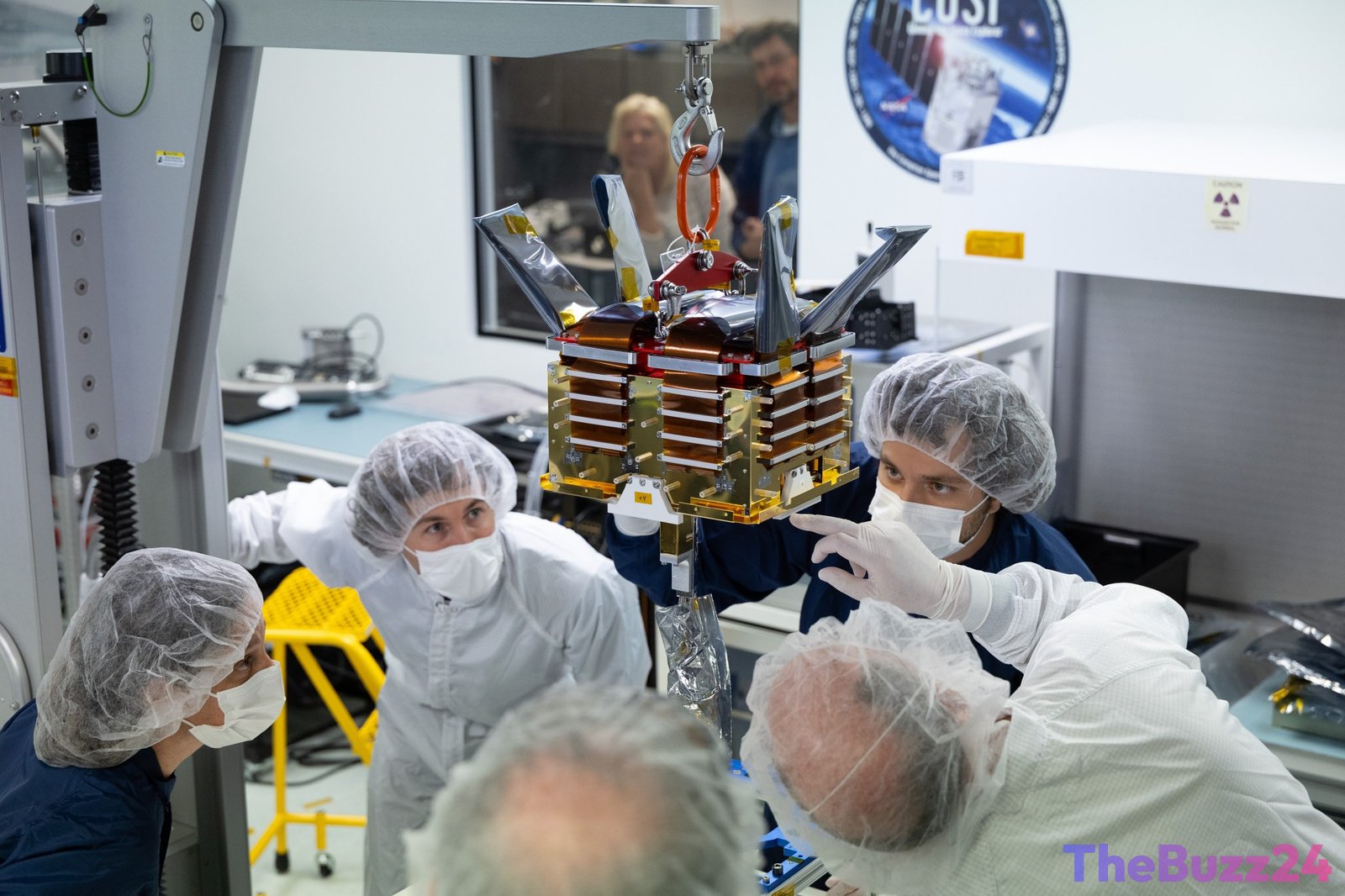
The assembly of the Compton Spectrometer and Imager (COSI), a cutting-edge wide-field gamma-ray telescope, has marked a significant milestone. Engineers and project managers recently oversaw the delicate process of raising the core detector assembly. This critical phase of construction brings the advanced space observatory one step closer to its mission of exploring the most energetic and violent phenomena in the universe.
At the heart of the COSI instrument is its specialized detector box. During the assembly process, teams successfully integrated the flex circuits, which are shielded by protective silver material on the top of the detector housing. These circuits play a vital role in the telescope’s operation, transmitting high-fidelity signals from the sensitive gamma-ray detectors directly to the onboard readout electronics. This setup ensures that the telescope can capture and process data from cosmic events with extreme precision.
Once launched, COSI will peer deep into the Milky Way and far-off galaxies to study the lifecycle of stars, the creation and destruction of matter and antimatter, and other extreme cosmic events. By analyzing gamma-ray emissions, the telescope will provide scientists with unprecedented insights into the chemical evolution of the universe and the fundamental laws of physics operating under extreme conditions.
The ambitious project represents a massive collaborative effort spanning multiple prestigious institutions and aerospace leaders. Key partners in the development of COSI include the University of California, Berkeley’s Space Sciences Laboratory, the University of California, San Diego, the Naval Research Laboratory, NASA’s Goddard Space Flight Center, Northrop Grumman, the Space Dynamics Laboratory, and the Italian Space Agency, alongside several other global research organizations.
Key Takeaways
- The Compton Spectrometer and Imager (COSI) has successfully progressed through a critical assembly phase, focusing on its core detector setup.
- COSI is designed as a wide-field gamma-ray telescope tasked with studying stellar lifecycles, matter-antimatter interactions, and cosmic evolution.
- The mission is a major international collaboration involving NASA, UC Berkeley, Northrop Grumman, and the Italian Space Agency.
Editor’s Analysis & Impact
The progress on the COSI telescope highlights a growing trend in modern astrophysics: the reliance on highly collaborative, multi-institutional frameworks to fund and execute complex space missions. By combining the academic expertise of institutions like UC Berkeley and UC San Diego with the industrial capabilities of Northrop Grumman and the resources of NASA and the Italian Space Agency, the project mitigates individual risk while maximizing scientific return. Gamma-ray astronomy remains one of the most challenging yet rewarding frontiers in space exploration, as it observes high-energy phenomena that are invisible to optical telescopes. Success with COSI will not only advance our understanding of stellar lifecycles and antimatter but will also validate advanced detector technologies that could be adapted for future deep-space exploration missions and national security applications.
Frequently Asked Questions
Q: What is the primary mission of the COSI telescope?
A: The Compton Spectrometer and Imager (COSI) is designed to study high-energy phenomena in the Milky Way and beyond. Its primary goals include investigating the creation and destruction of matter and antimatter, analyzing the final stages of stellar life, and mapping cosmic gamma-ray sources.
Q: Who is building the COSI telescope?
A: COSI is being developed through a collaborative effort led by the University of California, Berkeley’s Space Sciences Laboratory, in partnership with NASA’s Goddard Space Flight Center, Northrop Grumman, the Italian Space Agency, and several other academic and research institutions.
Q: How does the COSI detector work?
A: The telescope utilizes a specialized detector assembly equipped with flex circuits that transmit signals from the gamma-ray detectors to readout electronics, allowing scientists to capture and analyze high-energy cosmic data with high precision.
AI Disclosure: This article is based on verified data and official reports. Our Team and AI have cross-referenced every financial detail with primary sources to ensure total accuracy.
More from this Category