Capturing the Cosmic Glow: A Rare Look at Zodiacal Light Over Ladakh
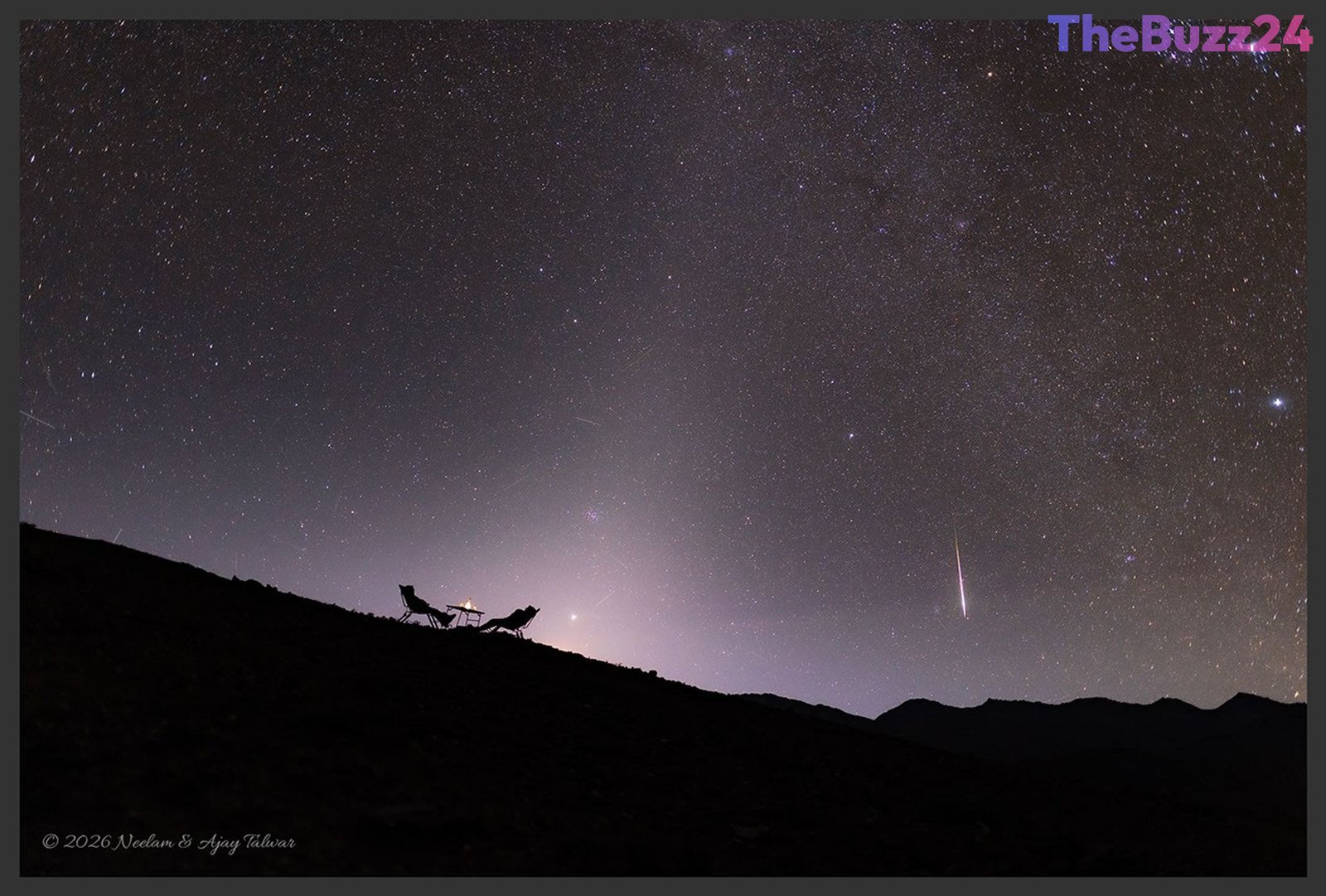
Stargazers and astrophotography enthusiasts have been treated to a breathtaking view of the night sky, highlighted by a luminous band of zodiacal light—often referred to as the false dawn. Captured at the remote Hanle Dark Sky Reserve in Ladakh, India, this serene skyscape reveals the cosmos in stunning detail just before the onset of astronomical twilight.
Situated at an altitude of approximately 4,500 meters, the high-altitude dark sky reserve offers an optimal sanctuary for capturing deep-space phenomena. In this remarkable frame, the bright planet Jupiter appears immersed in the faint zodiacal glow near the eastern horizon, while meteors streak through the upper atmosphere. Tracing the luminous zodiacal band toward the zenith uncovers the open star cluster M44, alongside a distinct yellowish-tinged Mars positioned near the center of the composition.
Recent insights into the origins of zodiacal light suggest a direct link to the Red Planet itself. Serendipitous detections of interplanetary dust gathered by spacecraft indicate that Mars acts as the primary source of the particulate matter responsible for backscattering sunlight, ultimately creating the glowing phenomenon observed in Earth’s night skies.
Key Takeaways
- A rare and luminous band of zodiacal light was captured over the Hanle Dark Sky Reserve in Ladakh, India.
- The high-altitude location, sitting at 4,500 meters, provides an ideal environment for astrophotography and stargazing.
- Spacecraft data suggests that interplanetary dust originating from Mars is the primary cause of the backscattered sunlight that creates zodiacal light.
Editor’s Analysis & Impact
The increasing popularity and technological accessibility of high-altitude astrophotography continue to shed light on transient celestial phenomena. Locations like the Hanle Dark Sky Reserve represent critical investments in dark sky preservation, safeguarding scientific research and public engagement alike. As imaging equipment becomes more sensitive and space missions continue to map interplanetary dust distributions, our understanding of the inner solar system’s dust environment deepens. This particular imagery not only bridges public appreciation of astronomy with professional research but also highlights the growing global movement to protect pristine night environments from light pollution, ensuring future generations can continue to study and marvel at the cosmos.
Frequently Asked Questions
Q: What is zodiacal light?
A: Zodiacal light is a faint, triangular glow that appears to extend upward from the vicinity of the sun along the zodiac, caused by sunlight scattered by interplanetary dust.
Q: Where was this specific photograph taken?
A: The photograph was captured at the Hanle Dark Sky Reserve located in Ladakh, India, at an altitude of about 4,500 meters.
Q: What is believed to be the source of the dust creating zodiacal light?
A: Interplanetary dust detections by spacecraft suggest that Mars is the primary source of the dust particles that backscatter sunlight to create the zodiacal glow.
AI Disclosure: This article is based on verified data and official reports. Our Team and AI have cross-referenced every financial detail with primary sources to ensure total accuracy.
More from this Category