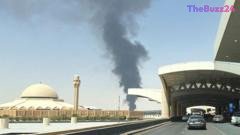
Escalating Tensions: Houthi Forces Target Riyadh and Saudi Energy Infrastructure
Yemen-based Houthi militants have launched a series of coordinated drone and ballistic missile strikes targeting the Saudi Arabian capital of Riyadh and critical energy infrastructure along the Red Sea coast. The assault triggered air raid sirens across the capital for the first time since the group intensified its regional offensive, causing temporary disruptions to flight operations at King Khalid International Airport. Saudi authorities confirmed that their air defense systems successfully intercepted a ballistic missile aimed at Riyadh, while also neutralizing hostile attempts to target civilian areas in cities including Yanbu, Taif, and Bish.
The Houthi military command claimed responsibility for the operation, stating that the strikes were a direct response to ongoing military actions in Yemen. The group specifically targeted facilities belonging to the state-owned oil giant Aramco, with reports of fires breaking out at fuel storage sites near the capital. While Saudi officials have focused on the successful interception of the projectiles, the scale of the attack has heightened regional anxiety, prompting the U.S. State Department to issue travel warnings for Americans in the Middle East, citing the potential for rapid escalation and further travel disruptions.
This latest surge in violence occurs against the backdrop of a protracted civil war in Yemen, where the Houthis continue to challenge the internationally recognized government supported by a Saudi-led coalition. The conflict has resulted in significant humanitarian consequences, with the International Organization for Migration reporting that over 100,000 people have been displaced by recent fighting. As both sides report mounting casualties, the strategic importance of the Red Sea shipping lanes remains a focal point of the struggle, with the Houthis attempting to leverage control over key maritime gateways to counter the Saudi-led blockade of northern Yemen.
Key Takeaways
- Houthi militants launched a coordinated drone and missile attack on Riyadh and Saudi energy facilities, including Aramco sites.
- Saudi air defenses intercepted the incoming projectiles, though the attack caused temporary flight disruptions and fires at fuel storage locations.
- The escalation has prompted international travel warnings and heightened concerns regarding the stability of global energy supply chains.
Editor’s Analysis & Impact
The recent escalation in Houthi-led attacks on Saudi Arabian soil represents a significant shift in the regional security landscape. By targeting critical energy infrastructure, the militants are effectively weaponizing global oil markets, creating a high-stakes environment for international investors and energy analysts. The inability of financial institutions to accurately model the ‘endgame’ of this conflict underscores the volatility inherent in the current geopolitical climate. If these strikes continue to disrupt major shipping routes or damage key production facilities, the resulting supply chain shocks could exert significant upward pressure on global oil prices. The broader implication is a move toward a more unpredictable conflict zone where non-state actors possess the technical capability to threaten the economic stability of major global powers, forcing a re-evaluation of regional defense strategies and energy security protocols.
Frequently Asked Questions
Q: Why are the Houthis targeting Saudi Arabia?
A: The Houthis state that their attacks are a retaliatory measure against the Saudi-led coalition's military involvement in the Yemeni civil war and the ongoing blockade of ports and airports in Houthi-controlled territories.
Q: What is the impact of these attacks on global oil markets?
A: The attacks target critical energy infrastructure, including Aramco facilities. Because the region is a major hub for oil exports, any threat to these facilities creates uncertainty and potential supply disruptions, which can lead to increased volatility and higher prices in global oil markets.
AI Disclosure: This article is based on verified data and official reports. Our Team and AI have cross-referenced every financial detail with primary sources to ensure total accuracy.
More from this Category