Ancient Stones Witness Earth’s Celestial Dance: A Year in the Sun’s Path
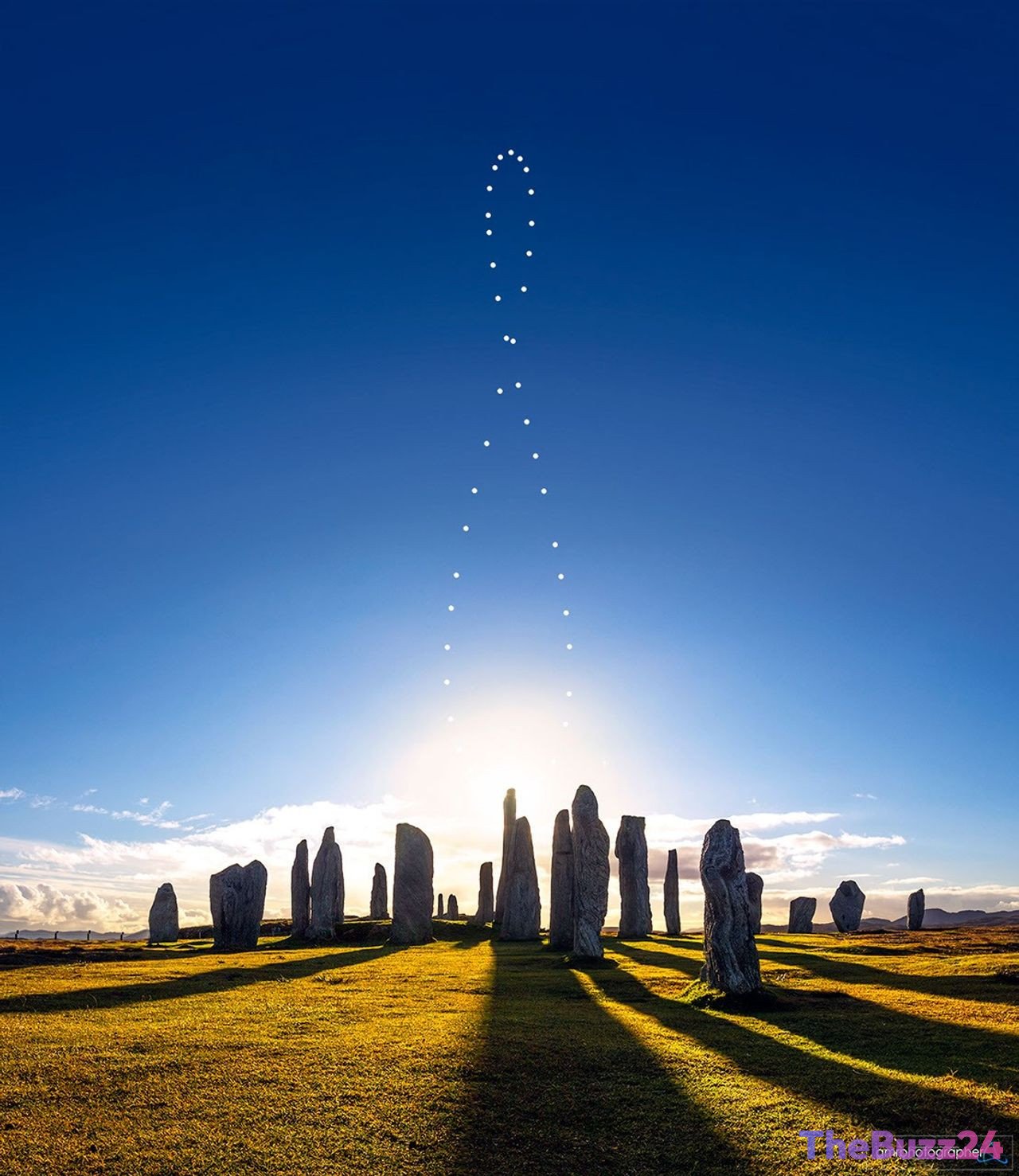
A stunning composite image captures the Sun’s apparent journey across the sky over a year, forming a distinctive figure-eight pattern known as an analemma. This particular celestial spectacle was meticulously assembled from photographs taken at the same time each day, near the village of Callanish in Scotland’s Outer Hebrides.
The foreground of the image is dominated by the ancient Callanish Stones, a Neolithic stone circle erected approximately 4,700 years ago during the Bronze Age. While the exact astronomical purpose of these megaliths remains a subject of historical debate, their presence adds a profound layer of human history to the cosmic display.
The characteristic figure-eight shape of the analemma is a direct consequence of two fundamental astronomical phenomena: the axial tilt of the Earth and the elliptical nature of its orbit around the Sun. The highest and lowest points of the figure-eight correspond to the summer and winter solstices, respectively. The image was captured near the December solstice, placing the Sun’s position at the lower extremity of the analemma. The equinoxes, marking periods of equal day and night across the globe, are represented by the middle points of the figure-eight, not the central intersection.
This visual representation of the Sun’s annual path serves as a powerful reminder of Earth’s predictable celestial mechanics and its connection to ancient human observations of the cosmos. As the planet approaches an equinox, a time celebrated by many cultures for its seasonal significance, this image offers a unique perspective on the enduring relationship between humanity, our planet, and the stars.
Key Takeaways
- A composite image reveals the Sun's annual path in the sky, forming a figure-eight analemma.
- The analemma was captured near the ancient Callanish Stones in Scotland, a Bronze Age monument.
- The shape of the analemma is caused by Earth's axial tilt and elliptical orbit, with solstices and equinoxes marking key points.
Editor’s Analysis & Impact
This astronomical image, juxtaposing ancient human history with fundamental celestial mechanics, highlights the enduring human fascination with the cosmos. The Callanish Stones, a testament to early astronomical understanding or perhaps spiritual connection to the sky, provide a grounding element to the abstract beauty of the analemma. Such visuals underscore the scientific principles governing our planet’s movement and its predictable relationship with the Sun. In an era of rapid technological advancement, this image serves as a reminder of the timeless natural phenomena that have guided and inspired civilizations for millennia, offering a unique perspective on both scientific discovery and our place within the universe.
Frequently Asked Questions
Q: What is an analemma?
A: An analemma is a diagram that shows the position of the Sun in the sky at the same time each day throughout the year. It typically forms a figure-eight shape due to the Earth's axial tilt and elliptical orbit.
Q: What are the Callanish Stones?
A: The Callanish Stones are a prehistoric stone circle located on the west coast of the island of Lewis in the Outer Hebrides of Scotland. They were erected around 2700 BC during the Bronze Age and are believed to have had astronomical or ritualistic significance.
Q: How do Earth's tilt and orbit create the analemma shape?
A: The Earth's axial tilt causes the Sun's apparent height in the sky to change throughout the year, while the elliptical orbit causes its apparent speed to vary. These two factors combine to create the figure-eight path of the analemma.
AI Disclosure: This article is based on verified data and official reports. Our Team and AI have cross-referenced every financial detail with primary sources to ensure total accuracy.
More from this Category