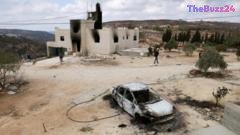
West Bank Family’s Court-Ordered Return Blocked by Violent Settler Attack, Homes Torched
A Palestinian family’s attempt to reclaim their homes in the occupied West Bank village of Jalud was violently obstructed by a large group of Israeli settlers, despite being escorted by Israeli security forces following a High Court ruling. More than 100 settlers reportedly descended upon the village, preventing the al-Tubasi family from re-entering properties they had been forced to abandon weeks prior. The incident, which occurred south of Nablus, saw two of the family’s houses set ablaze and security personnel targeted by the assailants.
Mahmoud al-Tubasi, 60, recounted the terrifying ordeal alongside his wife Aida, 51, and son Wael, 33. The family had returned under military protection after Israel’s High Court mandated their safe re-entry. However, upon their arrival, they discovered their homes extensively vandalized, with doors smashed, electrical fittings ripped out, and windows broken. As they attempted to inspect one property, settlers, reportedly coordinating via social media, began pelting them with stones. Despite Israeli forces deploying tear gas, the sheer number of attackers, estimated at over 150, overwhelmed the security detail. The family was eventually evacuated in an armored vehicle after settlers slashed the tires of their initial transport, while their car and both houses were set on fire.
The Israeli High Court had previously issued a strongly worded decision, criticizing authorities for their failure to curb settler violence and ordering the family’s safe return by September 20. The court described such actions as “a completely unacceptable phenomenon” that contradicts Israel’s foundational values. Following the incident, the Israel Defense Forces (IDF) confirmed the presence of over 100 “rioters” who blocked roads and threw stones, resulting in minor injuries to three police officers and damage to a security vehicle. The IDF labeled the al-Tubasi family as victims of “nationalist crime,” acknowledging that the mission to return them home was unsuccessful due to the violence. Prime Minister Benjamin Netanyahu condemned the attacks on security forces and called for the prosecution of those involved, yet he recently dismissed international concerns about settler violence at the UN General Assembly, characterizing perpetrators as a small group of “juvenile delinquents.”
Human rights organizations, including the Israeli group Yesh Din, highlight a systemic issue, noting that fewer than three percent of police investigations into settler violence over the past two decades have led to convictions. Yesh Din’s executive director, Ziv Stahl, suggests this lack of effective enforcement is part of a broader government policy aimed at expanding Israeli control in the West Bank and displacing Palestinians. The United Nations reports that settler violence has reached an all-time high this year, leading to the displacement of over 6,500 Palestinians since 2023. Settlements and outposts, which Netanyahu’s government has rapidly expanded, are considered illegal under international law.
Key Takeaways
- A Palestinian family's court-ordered return to their West Bank homes was violently blocked by over 100 Israeli settlers, who subsequently torched their properties and car.
- Despite being escorted by Israeli security forces, the family's return mission failed due to the overwhelming settler violence, which also targeted security personnel.
- Human rights groups and the UN point to a systemic failure in enforcing laws against settler violence, with convictions being rare, and report record high levels of such attacks leading to Palestinian displacement.
Editor’s Analysis & Impact
This incident underscores the escalating volatility in the occupied West Bank and the profound challenges to the rule of law. The blatant disregard for an Israeli High Court ruling by a large group of settlers, coupled with the inability of security forces to ensure the family’s safe return, signals a dangerous erosion of authority and judicial effectiveness. The broader implications include a further entrenchment of the conflict, increased humanitarian concerns for Palestinian communities, and a significant blow to any prospects for de-escalation. The international community’s condemnation of settlements and settler violence is likely to intensify, placing greater diplomatic pressure on Israel. Without decisive action to enforce court orders and curb extremist actions, the cycle of violence and displacement is set to continue, further destabilizing the region and complicating future peace efforts.
Frequently Asked Questions
Q: What was the Israeli High Court's ruling regarding the al-Tubasi family?
A: The Israeli High Court ruled that the al-Tubasi family must be allowed to safely return to their homes in Jalud village by September 20, criticizing Israeli authorities for their failure to address settler violence.
Q: How widespread is settler violence in the West Bank?
A: According to the United Nations, settler violence has reached an all-time high this year, leading to the displacement of over 6,500 Palestinians since 2023. Human rights groups also report a very low conviction rate for such attacks.
Q: What is the international legal status of Israeli settlements in the West Bank?
A: Under international law, Israeli settlements and outposts in the occupied West Bank are considered illegal.
AI Disclosure: This article is based on verified data and official reports. Our Team and AI have cross-referenced every financial detail with primary sources to ensure total accuracy.
More from this Category