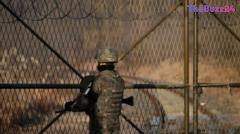
Escalating Tensions: South Korea Demands Apology from Pyongyang Over Border Landmine Blasts
South Korea’s military has formally demanded an apology from North Korea following landmine explosions earlier this month along their heavily fortified shared border, which resulted in injuries to three South Korean soldiers. The incidents, which occurred on September 21 within the Demilitarized Zone (DMZ) – a critical buffer separating the two Koreas – have significantly heightened already strained inter-Korean relations.
Seoul stated on Tuesday that the blasts, which took place on its side of the DMZ, were “highly likely” caused by North Korean mines. The South Korean government has vowed to implement “corresponding measures,” asserting that the act constitutes a clear violation of the decades-old armistice agreement. In response, Pyongyang has vehemently denied any involvement, dismissing Seoul’s accusations as “groundless” and a “farce” designed to escalate tensions on the peninsula.
Kim Yo Jong, the influential sister of North Korean leader Kim Jong Un, publicly accused South Korea of fabricating the claims for “political and military provocation.” She refuted suggestions that North Korean personnel had crossed the border to plant the mines, labeling the assertion as “a deliberate and planned strained assertion to shift the responsibility for escalating tension” onto North Korea. Her statement, released via state media, also issued a stern warning to the South, advising them to “be prepared for paying price for the farce of their own making.”
South Korea maintains that the mines were likely laid by Pyongyang as part of efforts to fortify its border. Defence Minister Kang Shin-chul previously emphasized that the blasts represented a “clear” breach of the 1953 armistice, which brought a halt to active combat in the Korean War and established the 4km-wide DMZ. The United Nations Command, which conducted an on-site investigation with the South Korean military, has indicated it will address the armistice violation through established mechanisms, reaffirming its commitment to maintaining stability and preventing escalation in the region.
Key Takeaways
- South Korea has accused North Korea of planting landmines in the Demilitarized Zone (DMZ) on September 21, injuring three South Korean soldiers, and has demanded an apology.
- North Korea, through Kim Yo Jong, has strongly denied responsibility, calling the accusations a "farce" and a "political and military provocation" by Seoul.
- The incident is considered a violation of the 1953 armistice agreement, further exacerbating already tense relations between the two Koreas and raising concerns about regional stability.
Editor’s Analysis & Impact
This incident underscores the persistent fragility of peace on the Korean Peninsula. While direct economic impacts are likely minimal, the heightened geopolitical risk could subtly deter foreign investment in the region and potentially influence defense sector spending. The immediate outlook suggests continued high tensions, with a low probability of direct military confrontation but an increased risk of further low-level provocations or miscalculations, especially given the lack of robust communication channels between Seoul and Pyongyang. The broader implication is a further erosion of trust and a challenge to the efficacy of the 1953 armistice, highlighting the urgent need for diplomatic engagement to prevent accidental escalation in one of the world’s most militarized borders.
Frequently Asked Questions
Q: What is the Demilitarized Zone (DMZ)?
A: The Demilitarized Zone (DMZ) is a 4-kilometer-wide (2.5-mile) buffer strip that runs across the Korean Peninsula, separating North Korea and South Korea. It was established as part of the 1953 armistice agreement to create a neutral area between the two sides.
Q: What is the 1953 armistice agreement?
A: The 1953 armistice agreement is a ceasefire that halted active combat in the Korean War. It established the DMZ and a Military Demarcation Line, but it was not a peace treaty, meaning the two Koreas are technically still at war.
Q: Why are relations between North and South Korea so tense?
A: Relations are tense due to a long history of conflict, ideological differences, North Korea's nuclear weapons program, and frequent provocations from both sides. The absence of a formal peace treaty and limited communication channels contribute to a volatile environment.
AI Disclosure: This article is based on verified data and official reports. Our Team and AI have cross-referenced every financial detail with primary sources to ensure total accuracy.
More from this Category