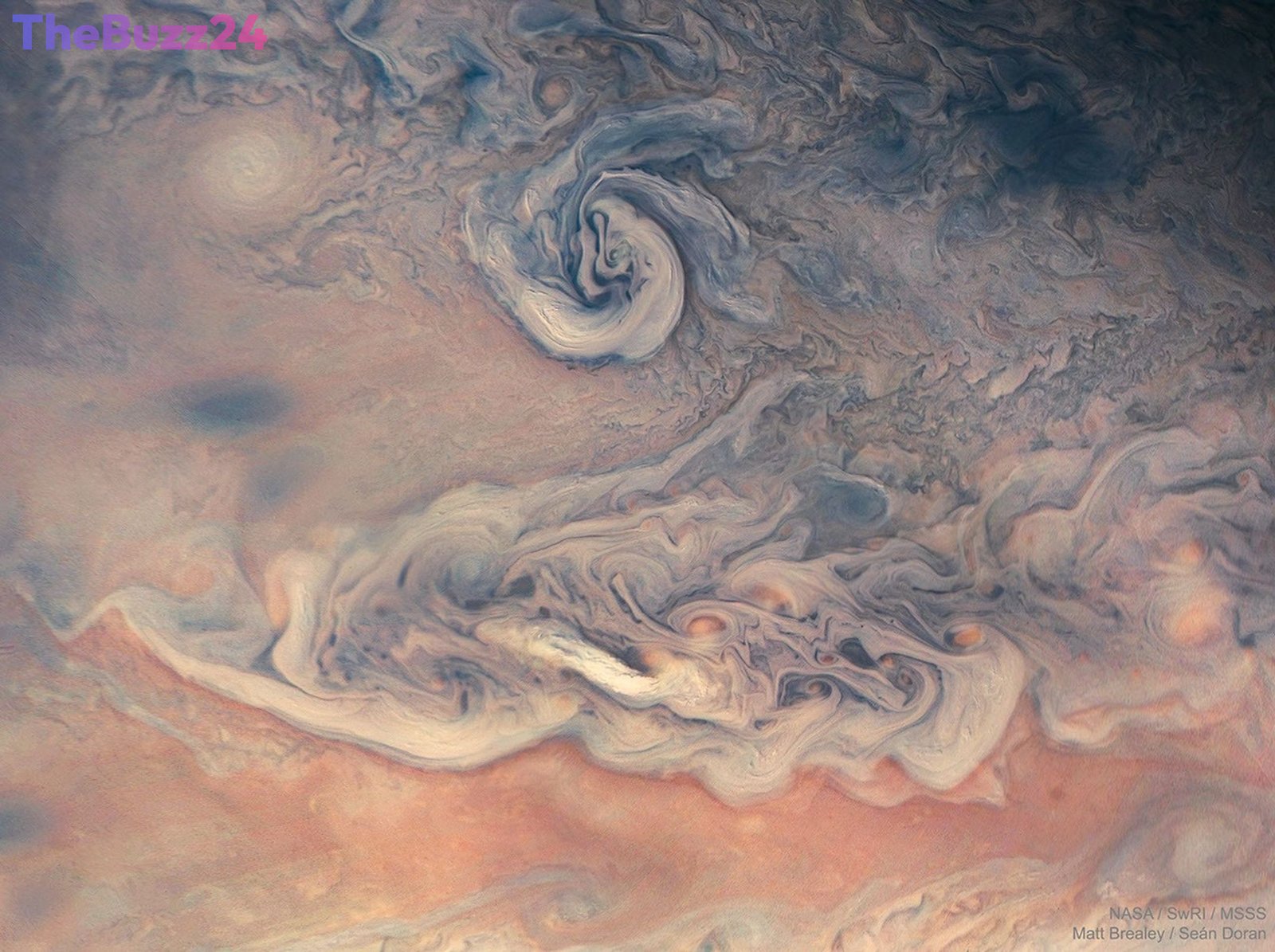
Jupiter’s Mysterious Hues: Juno Captures Swirling Cloud Colors
The Juno spacecraft, on its mission to explore Jupiter, has captured a stunning, color-enhanced image revealing the intricate swirling patterns and vibrant colors within the gas giant’s clouds. While the exact source of these striking hues remains a scientific puzzle, researchers are actively investigating the trace molecules that might be responsible.
The planet’s thick atmosphere, predominantly composed of hydrogen and helium, typically appears colorless at the frigid temperatures found at its cloud tops. Leading theories suggest that compounds like ammonium hydrosulfide could contribute to the observed coloration. The image, taken during Juno’s 14th close pass in 2018, clearly illustrates a dynamic atmospheric landscape where lighter clouds appear to sit atop darker ones. These lighter formations are seen swirling around reddish regions, while also obscuring darker areas in other parts of the frame.
Juno continues its journey in a looping, elliptical orbit around Jupiter, making a close approach to the colossal planet approximately every 33 days. With each pass, the spacecraft surveys a different section of Jupiter’s atmosphere, gradually building a more comprehensive understanding of its complex weather systems and chemical composition. The ongoing data collection promises to shed further light on the phenomena behind Jupiter’s captivating visual display.
Key Takeaways
- The Juno spacecraft has captured new images of Jupiter's clouds, highlighting their swirling patterns and vibrant colors.
- The exact cause of Jupiter's cloud colors is still under investigation, with ammonium hydrosulfide being a leading candidate.
- Juno's ongoing mission continues to provide valuable data on Jupiter's atmosphere with each close orbital pass.
Editor’s Analysis & Impact
This latest imagery from the Juno mission underscores the enduring mysteries of planetary atmospheres. The vibrant, yet unexplained, colors on Jupiter highlight the complex chemical processes occurring in its upper atmosphere. Understanding these phenomena is crucial not only for Jupiter research but also for comparative planetology, offering insights into atmospheric dynamics on other gas giants, including exoplanets. As Juno continues its detailed observations, the data gathered will be instrumental in refining atmospheric models and potentially revealing new chemical compounds or interactions, pushing the boundaries of our knowledge in planetary science.
Frequently Asked Questions
Q: What is the Juno spacecraft?
A: The Juno spacecraft is a NASA probe designed to study Jupiter's composition, gravity field, magnetic field, and polar magnetosphere. It entered Jupiter's orbit in 2016.
Q: What are the main components of Jupiter's atmosphere?
A: Jupiter's atmosphere is primarily composed of hydrogen and helium, similar to the Sun. Trace amounts of other molecules, such as water, ammonia, and methane, are also present and are thought to contribute to its visible features.
Q: Why are Jupiter's cloud colors a mystery?
A: While hydrogen and helium are colorless, scientists believe that trace chemicals, possibly sulfur and carbon compounds like ammonium hydrosulfide, react with sunlight or other atmospheric elements to produce the observed colors. However, the precise mechanisms and specific compounds responsible are still subjects of ongoing research.
AI Disclosure: This article is based on verified data and official reports. Our Team and AI have cross-referenced every financial detail with primary sources to ensure total accuracy.
More from this Category