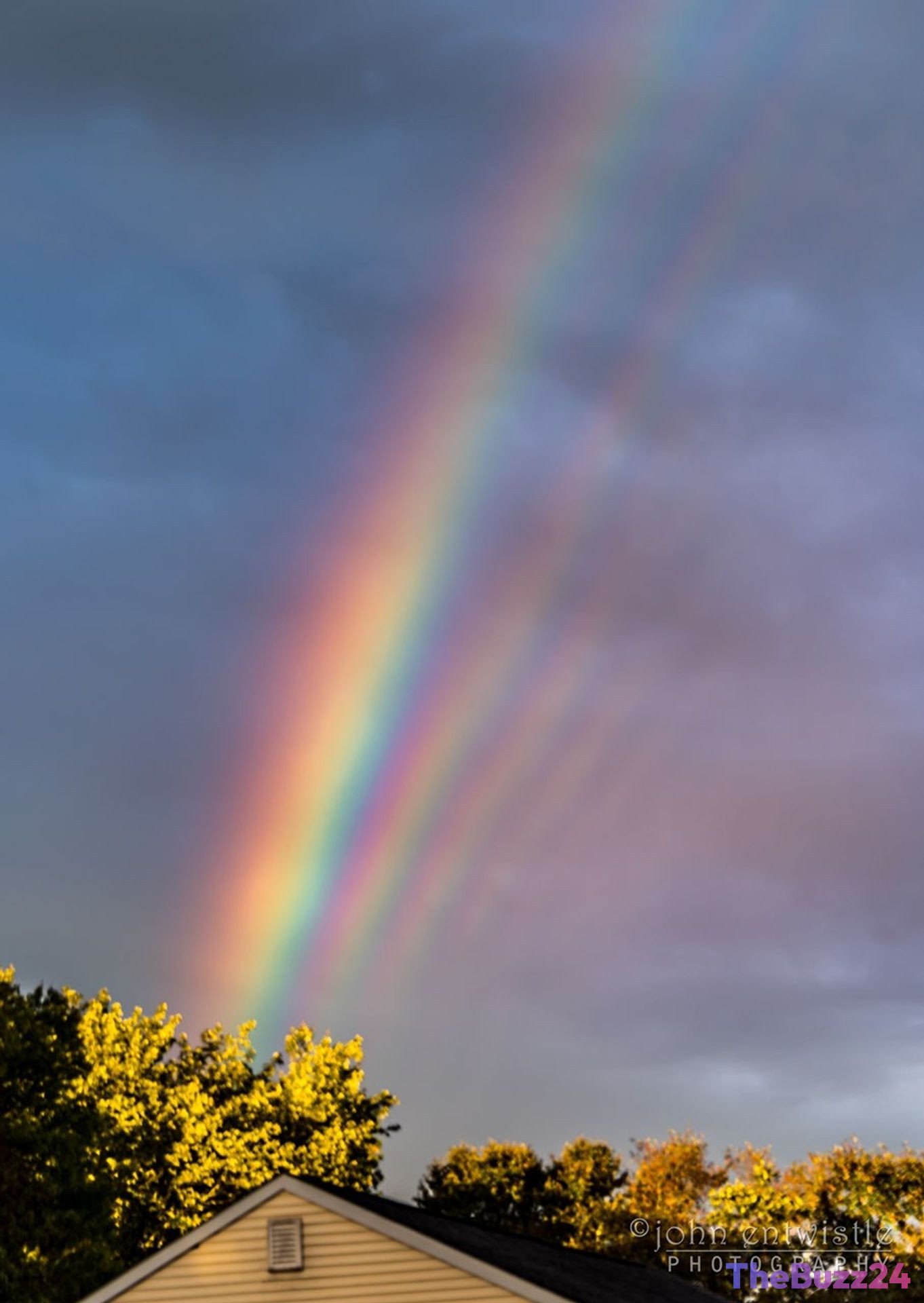
Spectacular Supernumerary Rainbows Dazzle After Hurricane Florence
Following the passage of Hurricane Florence over the Jersey Shore in 2018, an extraordinary atmospheric phenomenon graced the skies of New Jersey, USA. As the sun emerged, a breathtaking display of supernumerary rainbows appeared in the opposite direction, captivating onlookers.
Over a period of approximately thirty minutes, at least five distinct and vibrant supernumerary rainbows were observed fading in and out. This rare event provided a moment of wonder for those present, including the photographer and his daughter who captured the stunning visuals. The appearance of these intricate rainbow patterns is contingent on specific meteorological conditions.
Supernumerary rainbows form when falling raindrops are remarkably uniform in size, generally measuring less than a millimeter in diameter. Under these precise conditions, sunlight not only reflects within the water droplets but also undergoes interference. This wave phenomenon is analogous to the ripples created when a stone is dropped into a pond. The existence of supernumerary rainbows, first documented in the early 1800s, was instrumental in providing early scientific evidence for the wave nature of light, a concept that revolutionized our understanding of physics.
Key Takeaways
- Supernumerary rainbows appeared over the Jersey Shore after Hurricane Florence in 2018.
- These rainbows form when raindrops are nearly uniform in size, causing sunlight interference.
- The phenomenon provides evidence for the wave nature of light.
Editor’s Analysis & Impact
This celestial event, while localized, highlights the intricate beauty and scientific principles governing atmospheric optics. The formation of supernumerary rainbows underscores the importance of specific microphysical conditions within weather systems, demonstrating how even post-storm environments can yield spectacular natural displays. For the scientific community, such occurrences serve as tangible reminders of fundamental physics, reinforcing the wave theory of light. The event also emphasizes the public’s enduring fascination with natural phenomena, offering opportunities for engagement and education in science.
Frequently Asked Questions
Q: What are supernumerary rainbows?
A: Supernumerary rainbows are faint, iridescent bands that appear just inside the primary rainbow. They are caused by the interference of light waves within raindrops of very similar sizes.
Q: What conditions are needed for supernumerary rainbows to form?
A: Supernumerary rainbows require sunlight and falling raindrops that are all nearly the same size, typically less than a millimeter in diameter. This uniformity allows for constructive and destructive interference of light waves.
Q: When was the wave nature of light first evidenced?
A: The existence of supernumerary rainbows, noted in the early 1800s, was considered early evidence supporting the wave nature of light.
AI Disclosure: This article is based on verified data and official reports. Our Team and AI have cross-referenced every financial detail with primary sources to ensure total accuracy.
More from this Category