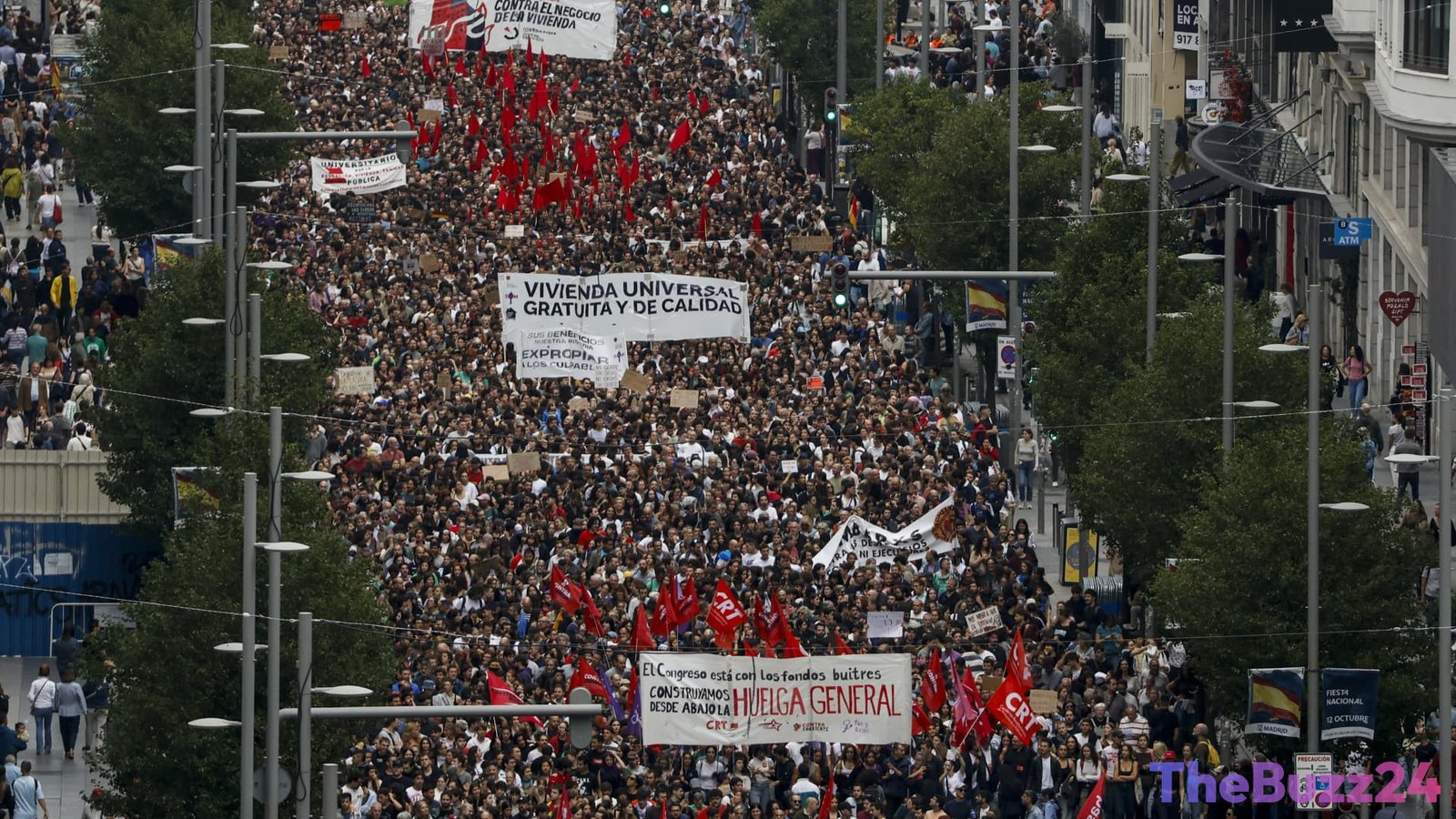
Spain Erupts in Mass Protests Over Housing Crisis as Political Tensions Flare
Tens of thousands of demonstrators took to the streets across Spain on Saturday to voice their outrage over the country’s escalating housing crisis, leading to clashes with police and political instability. In Madrid, the demonstrations turned volatile when police arrested three members of a far-right group who attempted to confront housing activists camped out in the central Puerta del Sol square. Authorities deployed rubber bullets to disperse the crowds as tensions boiled over in the capital.
The nationwide unrest was catalyzed by the recent eviction of an 87-year-old woman in Madrid and the subsequent rejection of a housing reform bill in parliament. The legislative failure has left Prime Minister Pedro Sanchez considering a snap election for November, with administration officials closely monitoring the scale of public anger. Protesters expressed deep frustration with the political establishment, accusing lawmakers of prioritizing party politics over the urgent needs of citizens struggling with soaring living costs.
While demonstrations in approximately 50 Spanish cities remained peaceful, the southeastern city of Valencia experienced severe clashes. Police there used tear gas and rubber bullets to disperse crowds, some of whom briefly occupied the landmark City of Arts and Sciences cultural complex. In response to the government’s inaction, Valeria Racu, spokesperson for the Tenants Union, announced that organizers are coordinating with labor unions to plan a nationwide general strike.
Government estimates placed the turnout in Madrid alone at around 70,000 people. Although major demonstrations were also planned for Barcelona and the neighboring city of Hospitalet de Llobregat, severe rainfall forced organizers to call off those specific gatherings. Nevertheless, the sheer scale of the nationwide mobilization underscores a deepening social crisis that threatens to reshape Spain’s political landscape.
Key Takeaways
- Tens of thousands of Spaniards protested in over 50 cities against the housing crisis, with Madrid seeing around 70,000 attendees.
- Clashes erupted in Madrid and Valencia, leading to arrests of far-right counter-protesters and police deploying rubber bullets and tear gas.
- The failure of housing reform legislation in parliament has prompted talks of a nationwide general strike and potential snap elections in November.
Editor’s Analysis & Impact
The escalating housing protests in Spain highlight a critical intersection of economic distress and political gridlock that is increasingly common across Southern Europe. As inflation and tourism-driven real estate speculation drive up rental prices, local populations are being priced out of major urban centers. The failure of the Spanish parliament to pass meaningful housing reform not only exacerbates public frustration but also threatens the stability of Prime Minister Pedro Sanchez’s coalition government. If a snap election is called for November, housing accessibility and cost-of-living metrics will undoubtedly serve as the central battlegrounds. For the broader European market, Spain’s unrest serves as a warning sign of how systemic housing shortages can rapidly transition from localized economic grievances into national security and political crises, potentially deterring foreign real estate investment in the short term.
Frequently Asked Questions
Q: What triggered the massive housing protests in Spain?
A: The protests were sparked by a severe nationwide housing crisis, exacerbated by the high-profile eviction of an 87-year-old woman in Madrid and the subsequent failure of parliament to pass legislative reforms aimed at addressing housing insecurity.
Q: What political consequences could arise from these protests?
A: Prime Minister Pedro Sanchez is reportedly considering calling a snap election for November following the defeat of the housing bill. Additionally, activist groups like the Tenants Union are planning a potential nationwide general strike.
Q: Were the protests peaceful?
A: While demonstrations in about 50 cities were peaceful, major clashes occurred in Madrid and Valencia, where police used tear gas and rubber bullets to control crowds and counter-protesters.
AI Disclosure: This article is based on verified data and official reports. Our Team and AI have cross-referenced every financial detail with primary sources to ensure total accuracy.
More from this Category