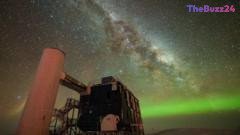
Pioneering Physicist Awarded Nobel Prize for Deep Antarctic ‘Ghost Particle’ Observatory
The prestigious Nobel Prize in Physics has been awarded to Belgian-born physicist Professor Francis Halzen in recognition of his groundbreaking contributions to astrophysics and his leadership in developing a revolutionary deep-ice observatory. Halzen spearheaded the creation of the IceCube Neutrino Observatory located at the geographic South Pole, a massive scientific instrument that utilizes a cubic kilometer of pristine Antarctic ice equipped with advanced light sensors to capture elusive cosmic particles.
Often referred to as ghost particles, neutrinos are subatomic messengers produced by extreme and violent events far beyond our solar system, such as exploding stars and environments surrounding giant black holes. Because neutrinos possess no electric charge and rarely interact with matter, they travel unhindered across the universe without being deflected by magnetic fields or blocked by dense cosmic regions. When a rare neutrino interacts with the Antarctic ice, it generates a faint flash of blue light detected by the embedded sensors, allowing researchers to trace the exact trajectory and origin of these cosmic signals.
First conceptualized by Halzen in the late 1980s, the realization of the IceCube project was initially met with widespread skepticism regarding its feasibility. However, his steadfast vision and decades of international collaboration successfully transformed the vast natural ice sheet into a window for high-energy astronomy. Physics experts have lauded the achievement as a monumental leap forward, enabling humanity to observe deep-space phenomena that remain completely invisible to conventional light-based telescopes.
Key Takeaways
- Professor Francis Halzen won the Nobel Prize in Physics for leading the development of the IceCube Neutrino Observatory.
- The observatory uses a cubic kilometer of Antarctic ice embedded with sensors to detect high-energy cosmic neutrinos.
- Neutrinos act as unhindered cosmic messengers, allowing scientists to study violent deep-universe phenomena invisible to traditional telescopes.
Editor’s Analysis & Impact
The recognition of Professor Francis Halzen and the IceCube Neutrino Observatory marks a transformative milestone for multi-messenger astronomy. For decades, humanity relied primarily on electromagnetic radiation—such as visible light, radio waves, and X-rays—to observe the cosmos. The ability to harness neutrinos as a primary observation tool opens an entirely new scientific frontier, bypassing cosmic dust and magnetic interference. This breakthrough paves the way for deeper investigations into dark matter, black hole mechanics, and the high-energy engines of distant galaxies. As funding and international cooperation in neutrino astronomy continue to expand, we can anticipate a surge in next-generation detectors that will profoundly reshape our cosmological models and deepen our comprehension of the universe’s most violent origins.
Frequently Asked Questions
Q: What is a neutrino?
A: Neutrinos are subatomic, nearly massless particles that carry no electric charge and rarely interact with ordinary matter, allowing them to travel straight across the universe from distant cosmic sources.
Q: How does the IceCube observatory detect neutrinos?
A: IceCube uses thousands of sensitive light sensors embedded deep within a cubic kilometer of Antarctic ice. When a rare neutrino collides with an atomic nucleus in the ice, it produces a flash of blue light that the sensors capture and measure.
Q: Why are neutrinos important to astronomers?
A: Because neutrinos are not deflected by magnetic fields and pass through dense matter without obstruction, their arrival paths point directly back to their high-energy cosmic sources, offering data that standard telescopes cannot capture.
AI Disclosure: This article is based on verified data and official reports. Our Team and AI have cross-referenced every financial detail with primary sources to ensure total accuracy.
More from this Category