Macron Slams Foreign Leaders for Exploiting French Riots, Citing AI Disinformation
French President Emmanuel Macron has publicly accused unnamed foreign leaders of exploiting recent widespread riots across France for their own electoral gain. Speaking during a visit to the Middle East, Macron suggested these leaders, whom he described as being “in campaign mode” both regionally and “across the Atlantic,” were making comments about the civil unrest “at France’s expense.” This statement appeared to be a direct critique of Israeli Prime Minister Benjamin Netanyahu, who is facing upcoming parliamentary elections, and former U.S. President Donald Trump, whose mid-term polls are approaching. Macron also highlighted that these foreign figures might have been influenced by fabricated videos, potentially generated by artificial intelligence, circulating about the disturbances.
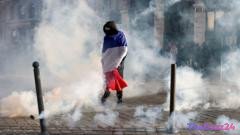
The unrest, which saw nearly 150 individuals jailed and over 800 brought before courts in cities like Paris, Lyon, Marseille, and Nice, initially erupted on the fringes of cost-of-living protests and later involved student grievances. While Macron stated there was no “visible foreign interference” in the events themselves, he firmly asserted that there was “foreign manipulation of information afterwards,” leading to “unacceptable and stupid comments” from various individuals, including foreign leaders. He specifically refuted claims of France being “invaded by hordes of migrants and Islamists,” a narrative echoed by Netanyahu, who, in an interview, linked the French situation to an “invasion of extremist Islam.” Similarly, Trump attributed the riots to mass immigration, advising France to “close your borders.”
The concerns about foreign manipulation are further underscored by ongoing investigations. European Union regulators are reportedly examining potential foreign online interference and disinformation campaigns surrounding the French riots and similar recent unrest within EU member states. Security officials have indicated that pro-Russian and far-right social media accounts, previously linked to disinformation efforts, have actively spread violent videos to exacerbate chaos. Iran and Algeria are also suspected of involvement in some messaging. Researchers, such as David Colon from France’s Sciences Po university, have identified “pro-Kremlin influencers” associated with the Russian campaign Storm-1516 as amplifying events and disseminating false narratives.
The pervasive nature of AI-generated content in these narratives is evident. For instance, a highly viral AI-generated image, purportedly showing an elderly couple being robbed in Paris, was traced to Infos-Israel.News, which confirmed its creation using ChatGPT without a reference image. Although initially labeled as AI content on some platforms, it was later widely shared without disclaimers, garnering millions of views. The alleged incident itself remains unconfirmed by French prosecutors. This highlights the challenge of distinguishing authentic information from sophisticated fakes in a rapidly evolving digital landscape, contributing to the spread of misinformation and potentially influencing public and political discourse.
Key Takeaways
- French President Macron accused foreign leaders, implicitly Benjamin Netanyahu and Donald Trump, of exploiting recent French riots for electoral purposes.
- Macron highlighted the role of foreign manipulation of information and AI-generated fake videos in influencing these leaders and spreading false narratives about the unrest.
- Investigations are underway into foreign online interference, with pro-Russian, far-right, Iranian, and Algerian accounts suspected of spreading disinformation, exemplified by viral AI-generated images.
Editor’s Analysis & Impact
The French riots and the subsequent accusations of foreign exploitation underscore a critical intersection of geopolitics, domestic unrest, and the burgeoning threat of digital disinformation. The explicit mention of AI-generated content influencing political discourse highlights the escalating challenge for governments and media in maintaining public trust and factual integrity. This incident signals a growing trend where advanced AI tools can be weaponized to amplify social divisions and interfere with national affairs, potentially impacting future elections and international relations. The EU’s investigation into foreign online interference suggests a recognition of this systemic threat, likely leading to increased regulatory scrutiny on social media platforms and AI content generation. The broader implication is a further erosion of trust in information sources, demanding more robust verification mechanisms and media literacy initiatives to counter sophisticated manipulation tactics.
Frequently Asked Questions
Q: Who did President Macron accuse of exploiting the French riots?
A: While not naming them directly, President Macron's comments were widely interpreted as referring to Israeli Prime Minister Benjamin Netanyahu and former U.S. President Donald Trump, both of whom have upcoming elections or political campaigns.
Q: How did AI-generated content play a role in the French riots narrative?
A: Macron stated that foreign leaders were influenced by fake, AI-generated videos about the riots. Additionally, specific AI-generated images, like one depicting an elderly couple being robbed, went viral and were shared without disclaimers, contributing to the spread of unconfirmed narratives.
Q: Are there investigations into foreign interference related to the French riots?
A: Yes, EU regulators are reportedly examining possible foreign online interference and disinformation campaigns. Pro-Russian, far-right, Iranian, and Algerian social media accounts are suspected of spreading violent videos and false narratives to sow chaos.
AI Disclosure: This article is based on verified data and official reports. Our Team and AI have cross-referenced every financial detail with primary sources to ensure total accuracy.
More from this Category