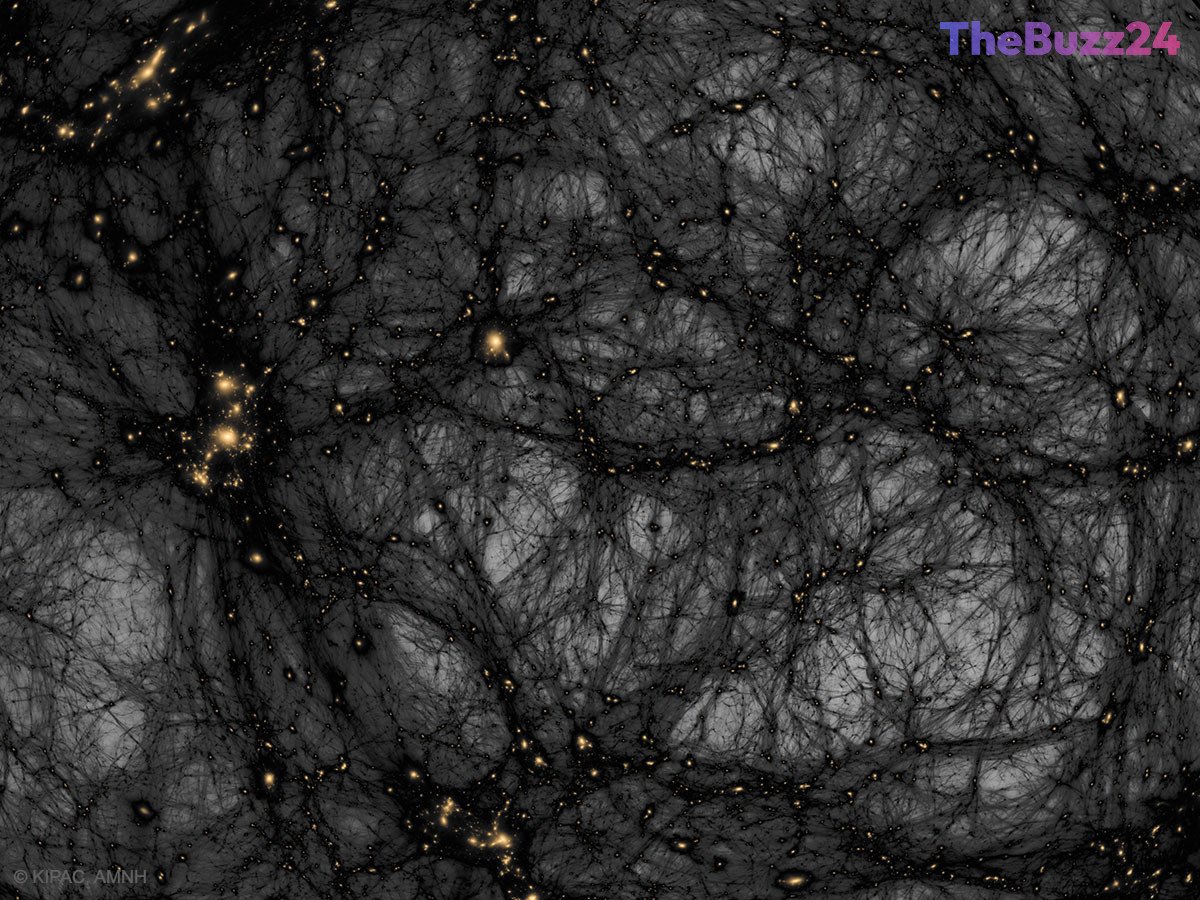
Visualizing the Invisible: New Simulations Reveal the Cosmic Web of Dark Matter
Modern astrophysics continues to grapple with the mysterious nature of dark matter, a substance that remains invisible yet exerts a profound influence on the structure of the cosmos. Recent computer simulations, featured by the American Museum of Natural History’s Hayden Planetarium, provide a striking visual representation of how dark matter acts as the scaffolding for the universe. In these models, dark matter appears as a complex, web-like network of filaments, dictating the distribution of visible matter throughout space.
The presence of dark matter is essential to explaining several astronomical phenomena that defy conventional physics. Without the additional gravitational pull provided by this unseen mass, galaxies would not rotate at their observed speeds, and galaxy clusters would lack the cohesion necessary to maintain their structure. Furthermore, the way dark matter bends light—a process known as gravitational lensing—confirms its pervasive influence across the vast reaches of the universe.
While dark matter remains a central focus of study, researchers are increasingly turning their attention to an even more enigmatic force: dark energy. Unlike dark matter, which acts as a gravitational anchor, dark energy functions as a repulsive force driving the accelerated expansion of the universe. As scientists refine these simulations, the interplay between the structural filaments of dark matter and the expansive pressure of dark energy continues to reshape our understanding of cosmic evolution.
Key Takeaways
- Dark matter forms a complex, filament-like web that serves as the gravitational framework for the distribution of visible matter in the universe.
- The gravitational effects of dark matter are necessary to explain galaxy rotation speeds and the phenomenon of gravitational lensing.
- Dark energy is now considered a more dominant and mysterious force than dark matter, as it drives the ongoing expansion of the universe.
Editor’s Analysis & Impact
The visualization of dark matter through high-fidelity computer simulations represents a significant milestone in computational astrophysics. By bridging the gap between theoretical models and observational data, these simulations allow researchers to test hypotheses regarding the large-scale structure of the cosmos. The shift in focus toward dark energy highlights a broader trend in modern science: moving from understanding the ‘glue’ that holds the universe together to understanding the ‘engine’ that pushes it apart. As observational technology improves, the ability to map these invisible structures will be critical for future cosmological research. The implications are profound, as they challenge our fundamental understanding of gravity and the ultimate fate of the universe, suggesting that the most significant components of our reality are those we cannot directly observe.
Frequently Asked Questions
Q: Why is dark matter considered 'invisible'?
A: Dark matter does not emit, absorb, or reflect light or any other form of electromagnetic radiation, making it impossible to detect with traditional telescopes.
Q: What is the difference between dark matter and dark energy?
A: Dark matter acts as an attractive gravitational force that helps hold galaxies and structures together, while dark energy acts as a repulsive force that accelerates the expansion of the universe.
AI Disclosure: This article is based on verified data and official reports. Our Team and AI have cross-referenced every financial detail with primary sources to ensure total accuracy.
More from this Category