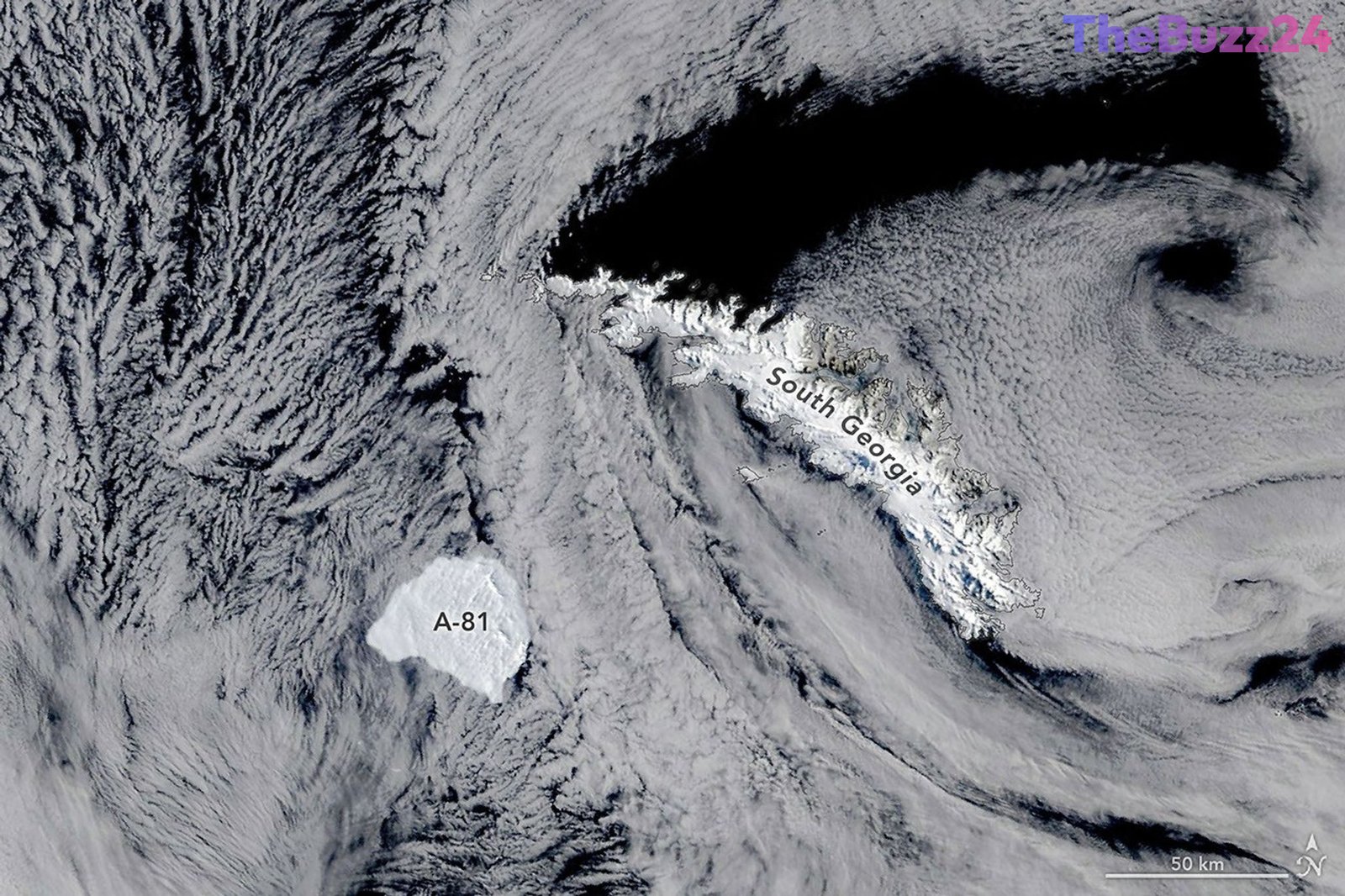
Massive Antarctic Iceberg A-81 Reaches South Georgia Island
Iceberg A-81, a colossal mass of frozen water measuring approximately 1,550 square kilometers, has reached the remote island of South Georgia in the South Atlantic Ocean. Satellite imagery captured on October 20, 2026, shows the iceberg slowing its northward trajectory as it encounters the shallow underwater shelf surrounding the island. Experts monitoring the berg’s movement suggest that the shallow topography is causing it to bump along the seafloor, a phenomenon previously observed with other large icebergs in the region.
The iceberg originated from the Brunt Ice Shelf in Antarctica, breaking away in January 2023 after years of structural instability. Following its separation, A-81 spent over three years navigating the Weddell Sea, propelled by the clockwise-flowing Weddell Gyre. By May 2026, it had cleared the Antarctic Peninsula and entered the Scotia Sea, eventually covering a distance of roughly 2,300 kilometers from its point of origin.
The calving of A-81 is part of a broader trend of increased activity at the Brunt Ice Shelf, which has shed multiple large icebergs in recent years, including A-74 and A-83. These events are closely monitored by the scientific community, particularly due to the proximity of the British Antarctic Survey’s Halley Research Station. While the shelf remains a focal point for atmospheric and space science, the departure of these massive icebergs highlights the dynamic and ever-changing nature of the Antarctic coastline.
Key Takeaways
- Iceberg A-81, spanning 1,550 square kilometers, has arrived at South Georgia island after a three-year journey from the Brunt Ice Shelf.
- The iceberg's movement has slowed significantly as it interacts with the shallow underwater shelf surrounding South Georgia.
- The Brunt Ice Shelf has experienced a series of major calving events recently, including the release of icebergs A-74, A-81, and A-83.
Editor’s Analysis & Impact
The arrival of Iceberg A-81 at South Georgia serves as a stark reminder of the ongoing structural changes within the Antarctic ice shelves. While calving is a natural process, the frequency of these events at the Brunt Ice Shelf warrants continued observation. The potential for these massive icebergs to ground themselves on shallow shelves poses significant implications for local marine ecosystems and navigation. Furthermore, as these ice masses drift into warmer northern waters, they contribute to the broader study of ocean currents and climate-driven ice loss. The future of the Brunt Ice Shelf remains a critical area of research, as the loss of such large sections of ice influences both regional stability and the long-term monitoring of the nearby Halley Research Station.
Frequently Asked Questions
Q: How large is Iceberg A-81?
A: Iceberg A-81 covers an area of approximately 1,550 square kilometers (600 square miles).
Q: Why do icebergs often slow down near South Georgia?
A: Icebergs often slow down or stop near South Georgia because they encounter the island's shallow underwater shelf, which causes them to run aground.
AI Disclosure: This article is based on verified data and official reports. Our Team and AI have cross-referenced every financial detail with primary sources to ensure total accuracy.
More from this Category