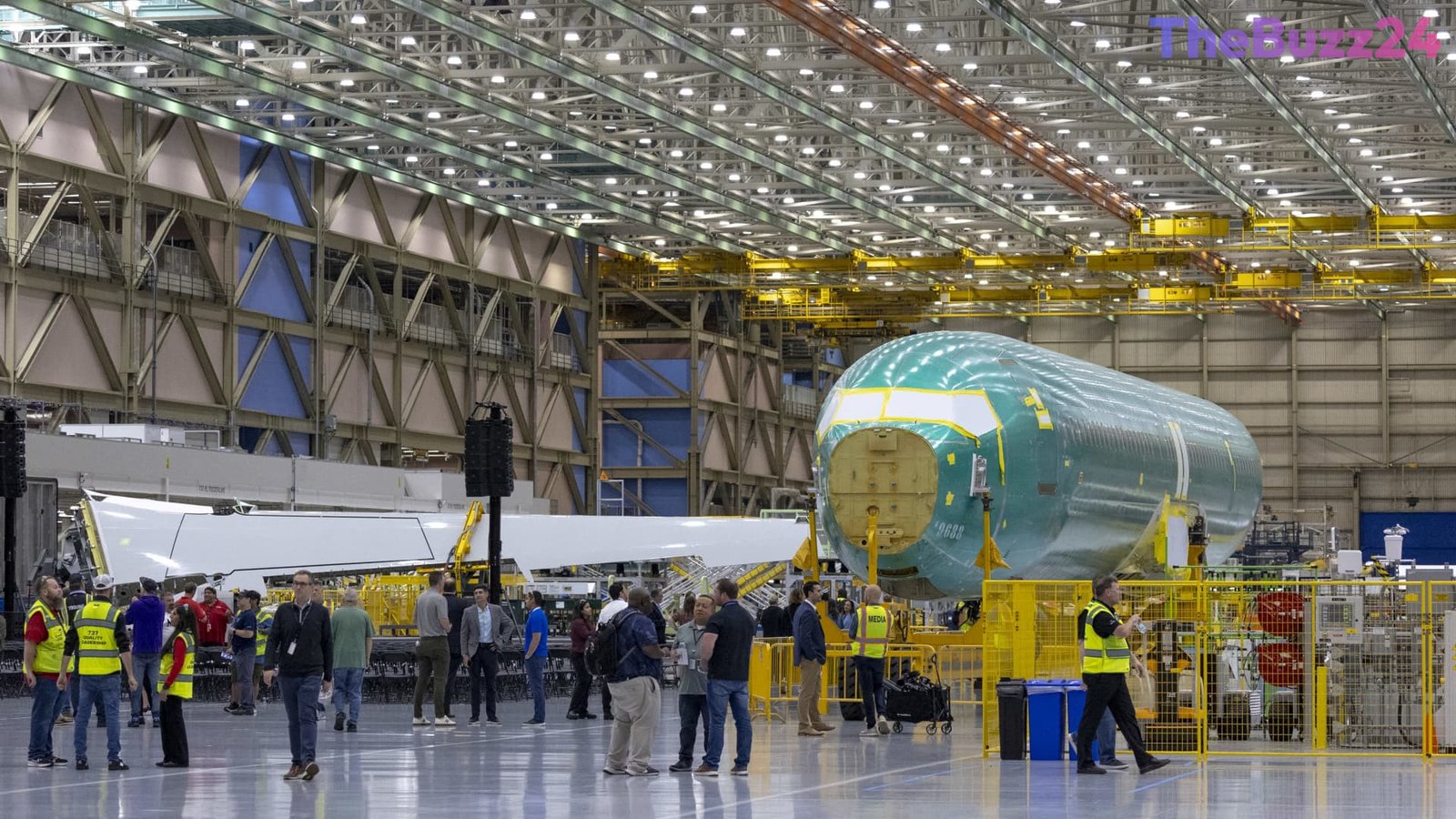
Boeing Narrows Q3 Losses as Defense Sales Soar Amidst 737 Max Production Push
Boeing has reported a significantly reduced net loss for the third quarter, largely propelled by a robust performance in its defense sector. The aerospace giant posted a net loss of $116 million, or 26 cents per share, a substantial improvement compared to the $5.34 billion loss, or $7.14 per share, recorded in the same period last year. When adjusted for one-time items, the company’s loss stood at 34 cents per share, reflecting a year-ago charge of nearly $5 billion related to its 777X aircraft program.
Overall revenue for the quarter climbed 4% year-over-year, reaching $24.19 billion, exceeding Wall Street expectations. This financial uplift was significantly bolstered by Boeing’s defense unit, which saw its revenue jump 15% from the previous year to $7.94 billion. Free cash flow also demonstrated positive momentum, rising to $464 million from $238 million in the third quarter of the prior year.
Despite the positive financial indicators, the commercial aircraft business faced headwinds, with revenue declining 3% to $10.72 billion. This segment experienced a negative operating margin of 6.5%, attributed to a less favorable delivery mix, anticipated higher costs from future production rate adjustments, and increased supply chain expenses. Boeing delivered 161 commercial airplanes during the quarter, a slight increase of one jet compared to the previous year.
Company leadership, including CEO Kelly Ortberg, emphasized the ongoing efforts to stabilize production of the best-selling 737 Max aircraft, a process expected to continue through the current year. Ortberg reiterated the commitment to prioritizing quality and safety over speed in production. In a positive development for the commercial division, the Federal Aviation Administration recently granted certification for the 737 Max 10, the largest variant in the Max family, following the approval of the 737 Max 7 in August. Additionally, Boeing secured a significant win with the U.S. Navy, which selected the company to develop its next-generation fighter jet.
Key Takeaways
- Boeing significantly narrowed its third-quarter net loss to $116 million, a substantial improvement from the previous year, primarily driven by a 15% increase in defense sales.
- Total revenue climbed 4% to $24.19 billion, surpassing analyst expectations, while free cash flow also saw a healthy increase.
- Despite a decline in commercial aircraft revenue, Boeing is focused on stabilizing 737 Max production and recently secured key FAA certifications for the 737 Max 7 and Max 10, alongside a new U.S. Navy fighter jet contract.
Editor’s Analysis & Impact
Boeing’s latest earnings report paints a complex but cautiously optimistic picture for the aerospace giant. The significant reduction in net loss and the strong performance of its defense unit provide a crucial financial cushion, demonstrating resilience in a key segment. However, the commercial aircraft division continues to face challenges, with declining revenue and negative operating margins highlighting the ongoing impact of production adjustments and supply chain issues. The emphasis on stabilizing 737 Max production, coupled with recent FAA certifications, is critical for restoring market confidence and improving future cash flow, as aircraft payments are largely tied to delivery. The U.S. Navy contract further solidifies Boeing’s long-term strategic position in defense. The market will closely watch how effectively Boeing can ramp up commercial deliveries while maintaining quality, as this will be the primary driver for sustained recovery and growth.
Frequently Asked Questions
Q: What were Boeing's key financial results for the third quarter?
A: Boeing reported a net loss of $116 million, or 26 cents per share, a significant improvement from a $5.34 billion loss a year prior. Revenue increased 4% to $24.19 billion, exceeding analyst expectations, and free cash flow rose to $464 million.
Q: How did Boeing's defense and commercial segments perform?
A: The defense unit saw a strong performance, with revenue jumping 15% to $7.94 billion. In contrast, the commercial aircraft business experienced a 3% decline in revenue to $10.72 billion, facing challenges related to delivery mix, production costs, and supply chain issues.
Q: What is the current status of the 737 Max aircraft program?
A: Boeing is actively working to stabilize the production of its 737 Max aircraft, prioritizing quality over speed. The company recently achieved significant milestones with the Federal Aviation Administration (FAA) certifying both the 737 Max 7 and the largest variant, the 737 Max 10.
AI Disclosure: This article is based on verified data and official reports. Our Team and AI have cross-referenced every financial detail with primary sources to ensure total accuracy.
More from this Category