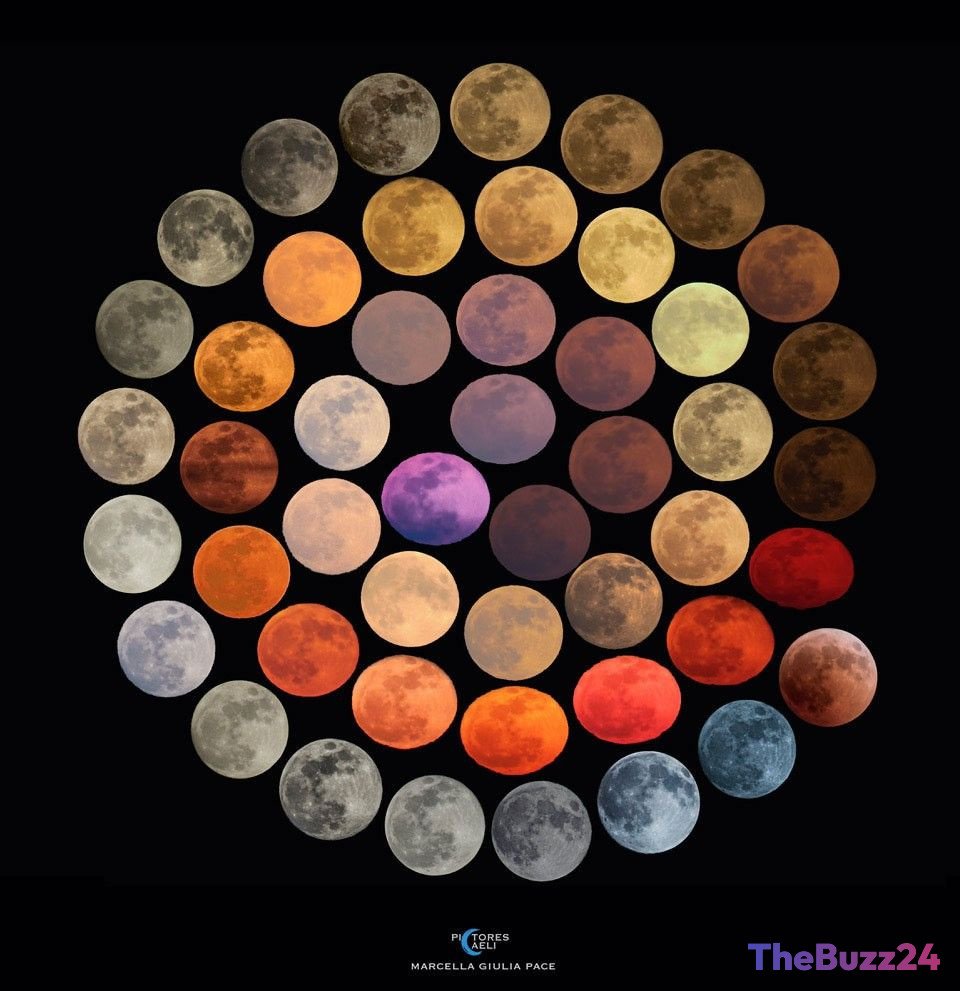
The Many Hues of the Moon: How Earth’s Atmosphere Transforms Our Celestial Neighbor
When observed from the airless vacuum of space, the Moon shines under direct sunlight with a relatively uniform, brown-tinged gray tone. Yet to viewers standing on Earth, the lunar disk frequently masquerades in an astonishing spectrum of colors, ranging from fiery reds and deep ambers to faint purples and unexpected blues. These dramatic shifts in appearance are not caused by changes on the Moon itself, but rather by the dynamic, layered atmosphere through which lunar light must travel to reach human eyes.
A decadelong observational project by astrophotographer Marcella Giulia Pace across Italy illustrates this kaleidoscopic phenomenon. The most familiar color shifts occur when the Moon is situated close to the horizon. In this low position, reflected moonlight must traverse a significantly thicker path of Earth’s atmosphere before reaching an observer. Shorter blue wavelengths are scattered outward by gas molecules and fine airborne dust, allowing longer red and yellow wavelengths to pass through largely unobstructed, tinting the lunar orb with warm hues.
More atypical appearances require specialized environmental conditions. A visibly blue Moon, for example, typically occurs when the atmosphere is laden with larger particulate matter, such as high-altitude smoke from severe forest fires or plumes of volcanic ash, which preferentially scatter reddish tones instead. Enigmatic purple phases are believed to result from an intricate confluence of distinct scattering effects and high-altitude optical variables.
Astronomical alignments also create dramatic color events, notably during total lunar eclipses. When the Moon passes completely into Earth’s shadow, it does not disappear from the night sky. Instead, it glows with a dim, copper-red radiance—illuminated entirely by the collective light of all the world’s sunrises and sunsets bent and refracted through Earth’s atmosphere onto the lunar surface.
Key Takeaways
- While the Moon is naturally a brown-tinged gray, Earth's atmosphere significantly alters its apparent color to ground-based observers.
- Horizon sightings scatter blue light away through atmospheric depth and dust, producing intense red, orange, and golden hues.
- Rare blue appearances are driven by larger airborne particles like smoke or volcanic ash, while eclipses produce deep copper tones through refracted sunlight.
Editor’s Analysis & Impact
Long-term photographic surveys like this highlight the intersection of observational astronomy and atmospheric science. Beyond their aesthetic appeal, records of lunar coloration serve as visual indicators of atmospheric composition, documenting how particulate levels, wildfire smoke, and air quality alter incoming light. As advanced digital imaging becomes more accessible to citizen scientists, systematic sky monitoring can support public awareness of local environmental conditions. These visual chronicles remind observers that celestial viewing is as much a study of our own planet’s delicate atmospheric blanket as it is an examination of deep space.
Frequently Asked Questions
Q: What is the true color of the Moon's surface?
A: Seen directly from outer space without atmospheric interference, the Moon's surface reflects sunlight as a dusty, brown-tinged gray.
Q: Why does the Moon turn reddish near the horizon?
A: Near the horizon, moonlight travels through a thicker layer of Earth's atmosphere, which scatters shorter blue wavelengths and allows longer red and orange wavelengths to dominate.
Q: Can the Moon ever actually appear blue in the sky?
A: Yes. When the upper atmosphere carries specific concentrations of larger particles, such as smoke from major wildfires or volcanic ash, red light can be scattered away, leaving the Moon with a faint bluish tint.
AI Disclosure: This article is based on verified data and official reports. Our Team and AI have cross-referenced every financial detail with primary sources to ensure total accuracy.
More from this Category