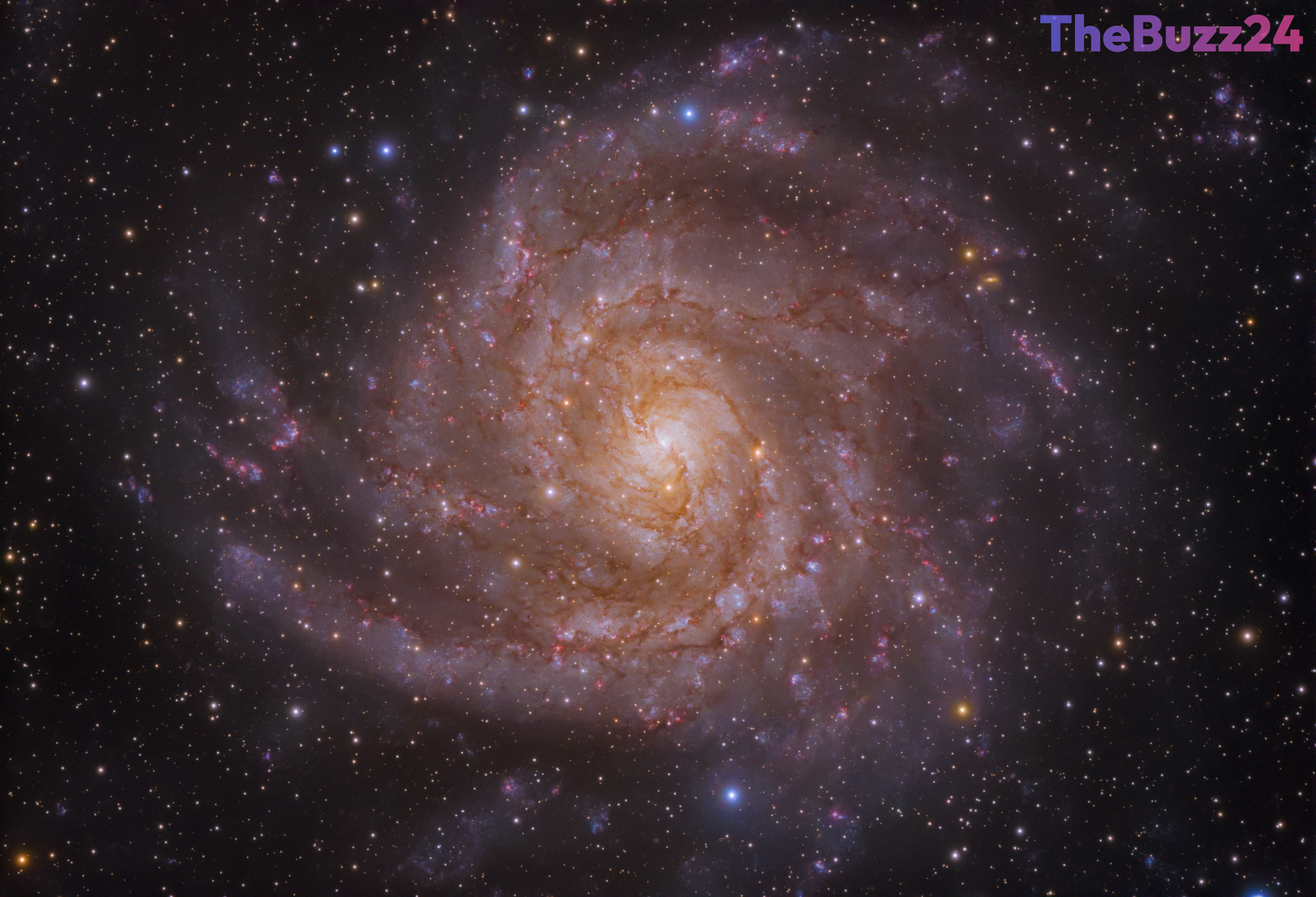
Peering Through the Milky Way: Astronomers Reveal the Hidden Wonders of Galaxy IC 342
Deep space observation has once again captured the imagination of stargazers and researchers alike, offering a breathtaking look at IC 342, often referred to as the Hidden Galaxy. By peering directly through the dense plane of our own Milky Way—navigating thick veils of cosmic dust, gas, and stars—astronomers have been able to study this remarkable spiral structure in unprecedented detail. Located approximately 10 million light-years away, IC 342 holds a prominent place as one of the brightest members of the nearby IC 342/Maffei galaxy group.
For years, studying IC 342 proved uniquely challenging due to the heavy foreground interference of the Milky Way. This obstructed view previously led to historical misconceptions regarding the galaxy’s dynamics, including a now-debunked theory suggesting it may have been forcefully ejected from our immediate cosmic neighborhood. Furthermore, internal obstacles within IC 342 itself—such as intermittent dust clouds masking the luminous glow of hydrogen gas—highlight active regions teeming with young, bright stars.
Recent scientific investigations have gone beyond visual observations, incorporating detailed magnetic field mappings of the galaxy. These advanced studies suggest that galactic magnetic fields play a critical role in one of astrophysics’ enduring mysteries: the precise mechanisms behind the formation of spiral arms. As technology and observational techniques continue to evolve, unlocking the secrets of objects obscured by cosmic dust brings researchers closer to understanding the complex architecture of the universe.
Key Takeaways
- Galaxy IC 342, located 10 million light-years away, is successfully imaged through the dense foreground dust of the Milky Way.
- Historical misunderstandings about the galaxy's trajectory and origin have been clarified through advanced observation.
- New magnetic field mapping of IC 342 provides vital clues regarding how galactic spiral arms are formed.
Editor’s Analysis & Impact
The ongoing study of obscured galaxies like IC 342 represents a significant leap forward in observational astronomy. As infrared and radio astronomy techniques improve, researchers are increasingly able to pierce through galactic planes that have historically blinded optical instruments. This capability not only refines our understanding of galactic distribution in our local cosmic neighborhood but also sheds light on fundamental astrophysical processes, such as magnetic field dynamics and star formation. In the broader context of space science, these insights bridge the gap between theoretical models of galaxy evolution and empirical reality, paving the way for more accurate cosmological simulations in the future.
Frequently Asked Questions
Q: What is IC 342 and where is it located?
A: IC 342, also known as Caldwell 5 or the Hidden Galaxy, is a spiral galaxy situated roughly 10 million light-years away from Earth. It belongs to the IC 342/Maffei galaxy group, which is located relatively close to our own Local Group.
Q: Why is IC 342 called the 'Hidden Galaxy'?
A: It earned this moniker because it is positioned directly behind the plane of the Milky Way, forcing astronomers to look through dense layers of cosmic dust, gas, and stars to observe it clearly.
Q: What do magnetic field maps of IC 342 help scientists understand?
A: Magnetic field maps help researchers investigate one of astrophysics' greatest puzzles: the exact mechanisms that drive the formation of spiral arms in galaxies.
AI Disclosure: This article is based on verified data and official reports. Our Team and AI have cross-referenced every financial detail with primary sources to ensure total accuracy.
More from this Category