Key Jet Plane Components Found Miles from Florida Crash Site, NTSB Investigates
Investigators have discovered critical components of a private jet, including a significant portion of its left elevator, scattered up to nearly four miles away from the main crash site in Palm Beach, Florida. The National Transportation Safety Board (NTSB) revealed that these detached parts, found in multiple pieces, suggest they may have separated from the aircraft before the catastrophic Sunday incident that claimed the lives of all nine individuals on board.
NTSB board member Tom Chapman stated that the discovery of the majority of the Learjet’s left elevator, a crucial control surface responsible for managing the aircraft’s pitch, located on the tail, is a pivotal piece of evidence. The considerable distance of these fragments from the primary wreckage led investigators to conclude they detached prior to impact. “Knowing that it was lost is a very important piece of evidence in terms of pointing us towards other things to investigate,” Chapman explained.
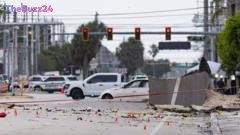
The focus now shifts to determining the sequence of events: whether the loss of the elevator directly caused the plane to nosedive, or if extreme forces encountered during flight led to its separation. The NTSB is examining whether the control surface was rendered ineffective due to the aircraft’s speed at the time. The Learjet 60 was en route to the Bahamas from Austin, Texas, when it tragically plunged into a highway, resulting in a massive explosion upon impact.
Recordings of air traffic control communications revealed the flight crew reported encountering moderate turbulence and managing icing conditions. The pilots also indicated the plane was accumulating precipitation and expressed a need to ascend. Shortly after, the audio captured a rapid descent of approximately 10,000 feet per minute, escalating to an alarming 20,000 feet per minute, with the crew declaring an overspeed condition before acknowledging an imminent crash. The NTSB plans to thoroughly investigate the role of weather in this devastating accident, while the extreme force of the impact has complicated efforts to access the main wreckage, which created a large crater on the road.
Key Takeaways
- Crucial aircraft components, including the left elevator, were found several miles from the main crash site of a Learjet in Florida.
- Investigators believe these parts detached before impact, suggesting a potential pre-existing mechanical issue or structural failure.
- Air traffic control recordings indicate the flight crew reported turbulence, icing, and a rapid descent before the crash.
Editor’s Analysis & Impact
The discovery of detached aircraft components miles from the crash site significantly complicates the investigation into the Learjet disaster. This finding shifts the focus towards potential structural integrity issues or aerodynamic failures that may have occurred mid-flight, rather than solely attributing the cause to external factors like weather. The NTSB’s detailed analysis of these parts will be crucial in understanding whether they failed due to stress or if their detachment triggered the subsequent loss of control. This incident underscores the critical importance of rigorous aircraft maintenance and the potential cascading effects of even seemingly minor component failures at high speeds and altitudes, impacting aviation safety protocols and regulatory oversight.
Frequently Asked Questions
Q: What is the left elevator of an airplane?
A: The left elevator is a control surface located on the horizontal stabilizer of an aircraft's tail. It is used to control the aircraft's pitch, which is the upward or downward movement of the nose.
Q: What does 'overspeed condition' mean for an aircraft?
A: An overspeed condition occurs when an aircraft exceeds its maximum allowable speed. This can lead to structural damage, loss of control, or other dangerous situations.
Q: What is the role of the NTSB in aviation accidents?
A: The National Transportation Safety Board (NTSB) is an independent U.S. government agency responsible for investigating civil aviation accidents. Its primary goal is to determine the probable cause of accidents and issue safety recommendations to prevent future occurrences.
AI Disclosure: This article is based on verified data and official reports. Our Team and AI have cross-referenced every financial detail with primary sources to ensure total accuracy.
More from this Category