New Zealand Faces Political Stalemate After Tight General Election Results
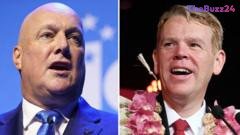
New Zealand’s recent general election has concluded without a definitive winner, setting the stage for complex coalition negotiations as major political parties vie to secure a parliamentary majority. Prime Minister Christopher Luxon’s centre-right National Party emerged as the largest faction, capturing 42 seats in preliminary tallies. However, this falls notably short of the threshold required to govern independently, forcing the administration to seek alliances to establish a stable government under the nation’s proportional representation framework.
Meanwhile, the opposition Labour Party, led by Chris Hipkins, secured 36 seats, refusing to concede defeat immediately as vote counts continue to finalize. The political landscape is further complicated by strong performances from smaller factions, including the Greens, ACT, and New Zealand First, alongside the Opportunity Party, which managed to cross the parliamentary threshold. Analysts point to economic pressures, particularly the rising cost of living and voter dissatisfaction, as key drivers behind the fragmentation of traditional party loyalty and the historically low combined vote share for the two dominant political entities.
With official results scheduled to be released later in November following the processing of special and overseas votes, the country remains under a caretaker government. Both major party leaders have emphasized the necessity of compromise and dialogue to navigate the upcoming legislative term. As minor parties position themselves as potential kingmakers, the final composition of the governing coalition will rely heavily on delicate political maneuvering and the resolution of fine vote margins across various electorates.
Key Takeaways
- New Zealand's general election ended without a clear majority for any single party, leading to a hung parliament.
- Prime Minister Christopher Luxon's National Party won the most seats but requires coalition partners to form a government.
- Economic pressures and cost-of-living concerns contributed to a fragmented vote and lower support for traditional major parties.
Editor’s Analysis & Impact
The political stalemate in New Zealand highlights a broader global trend of voter disillusionment with traditional two-party systems, driven largely by persistent economic anxieties and cost-of-living crises. The rise of minor parties as decisive kingmakers indicates that future governance in the region will increasingly rely on fragile coalitions and inter-party compromise. For investors and market watchers, this uncertainty could temporarily delay key legislative reforms, particularly regarding fiscal policy and infrastructure spending. Over the long term, the incoming administration will face intense pressure to address social cohesion and economic mobility to reverse emigration trends and restore confidence in the nation’s financial trajectory.
Frequently Asked Questions
Q: Why did New Zealand's election result in a hung parliament?
A: The election resulted in a hung parliament because neither the National Party nor the Labour Party secured enough seats to win a simple majority, which is typical under New Zealand's mixed-member proportional voting system.
Q: When will the official election results be announced?
A: The electoral commission is scheduled to announce the official results following the processing and counting of special and overseas votes.
Q: What role do minor parties play in the current political situation?
A: Minor parties such as ACT, New Zealand First, and the Opportunity Party act as kingmakers. Because major parties lack a standalone majority, they must negotiate with these smaller groups to form a viable coalition government.
AI Disclosure: This article is based on verified data and official reports. Our Team and AI have cross-referenced every financial detail with primary sources to ensure total accuracy.
More from this Category