Cosmic Mystery Solved: Hidden Companion Discovered Triggering Periodic Stellar Eruptions in Deep Space
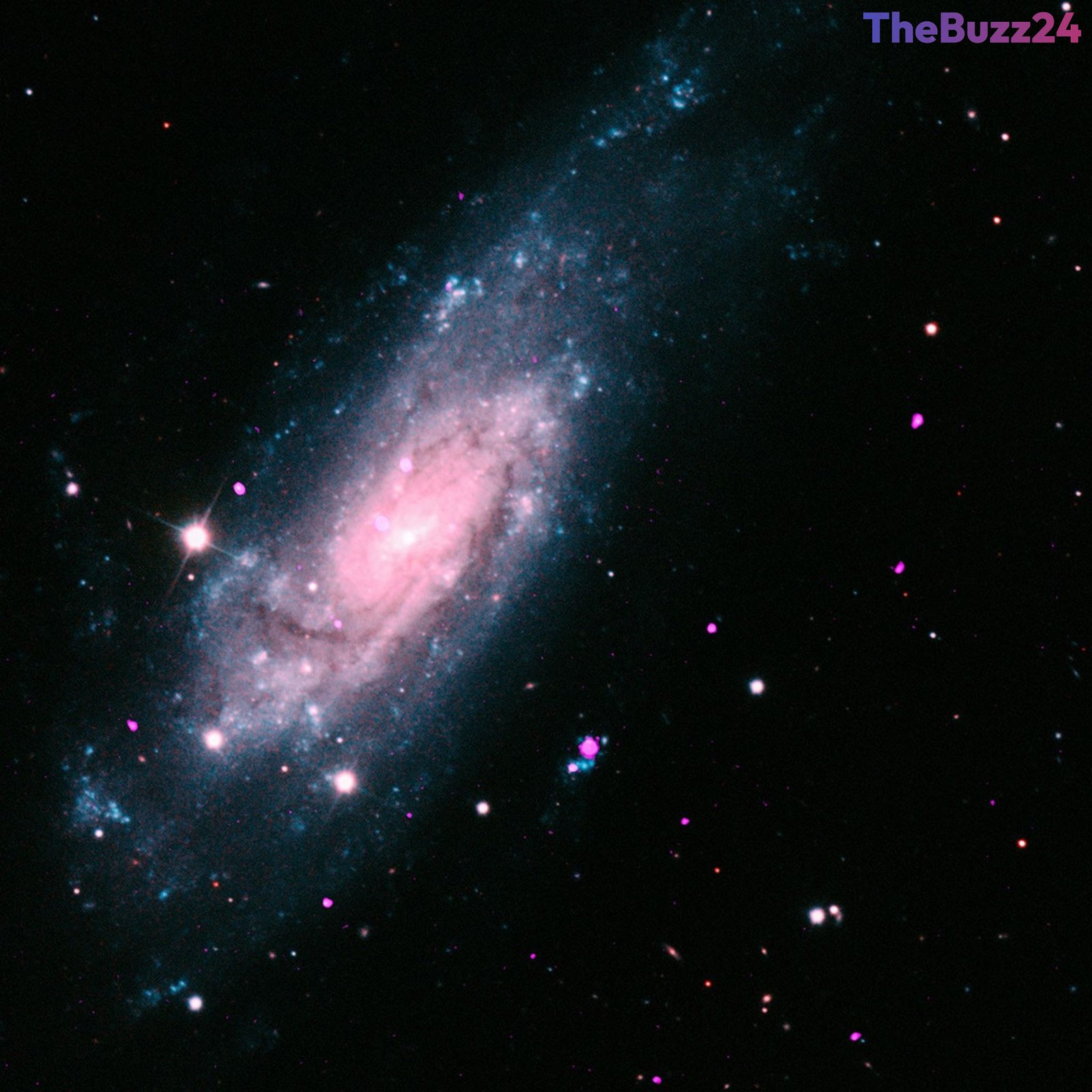
Astronomers have resolved a long-standing cosmic puzzle by identifying the hidden mechanism behind the dramatic, recurring outbursts of a massive star located 30 million light-years away. Situated within the spiral galaxy NGC 4559, the volatile star known as AT 2016blu has routinely brightened and dimmed on a precise 113-day cycle, mimicking the violence of a supernova without actually destroying itself. Targeted X-ray observations captured during a recent flare-up have now confirmed that the star is closely orbiting a dense companion object—either a stellar-mass black hole or a neutron star.
The massive primary star, estimated to weigh at least 33 times the mass of our Sun, belongs to a rare class of luminous blue variables often referred to as “supernova impostors.” Over the past decade and a half, monitoring efforts recorded at least 27 distinct optical flare-ups. The critical breakthrough occurred when high-resolution X-ray tracking revealed that AT 2016blu surged in X-ray intensity by more than a hundredfold during its outburst phase compared to quiescent baseline levels. This massive energy release occurs whenever the primary star reaches its closest point of orbit, allowing its dense partner to pull away vast streams of stellar material at near-light speeds, superheating the gas until it glows intensely in X-rays.
This landmark detection marks the first time X-rays have been captured from this specific variety of erupting star system, as well as the first verified pairing of a supernova impostor with a black hole or neutron star. Given its extreme X-ray output during outburst phases, AT 2016blu is now recognized as a prime candidate for an ultraluminous X-ray source—a enigmatic category of bright astronomical phenomena that scientists have struggled to fully classify for years.
Beyond solving the mystery behind AT 2016blu’s regular 113-day rhythm, the findings provide critical insight into pre-supernova star behavior and binary dynamics. Researchers believe similar gravitational interactions involving compact stellar remnants could explain pre-explosion brightness fluctuations observed in other giant stars across the universe before their final collapse.
Key Takeaways
- Astronomers identified a hidden black hole or neutron star orbiting the giant star AT 2016blu every 113 days in the galaxy NGC 4559.
- The intense gravitational pull of the compact companion strips material from the star, triggering violent X-ray and visible light eruptions.
- This discovery represents the first X-ray detection of a 'supernova impostor' paired with a compact remnant, helping explain ultraluminous X-ray sources.
Editor’s Analysis & Impact
This discovery represents a significant milestone in high-energy astrophysics, providing concrete observational evidence of how binary gravitational interactions drive violent stellar behavior. By establishing a direct link between periodic ‘supernova impostor’ eruptions and compact companions like black holes or neutron stars, researchers have unlocked a key mechanism explaining ultraluminous X-ray sources (ULXs), which have long challenged existing stellar models. From a broader scientific perspective, these insights will refine predictive theories regarding the final evolutionary stages of massive stars, helping astronomers better understand the signals giant stars emit prior to undergoing true supernova explosions. Future deep-space survey missions will likely leverage these findings to identify similar binary systems across nearby galaxies.
Frequently Asked Questions
Q: What is AT 2016blu and why is it called a supernova impostor?
A: AT 2016blu is a massive star roughly 33 times the mass of the Sun located 30 million light-years away in galaxy NGC 4559. It is called a supernova impostor because its sudden, violent spikes in brightness resemble supernova explosions, yet the star survives the event intact.
Q: What causes the star's periodic outbursts every 113 days?
A: The outbursts are caused by a nearby, compact companion object—either a stellar-mass black hole or a neutron star. Every 113 days, at their point of closest approach, the companion pulls gas away from AT 2016blu, heating the material to extreme temperatures and creating bright X-ray and optical flashes.
Q: Why were X-ray observations necessary to solve this mystery?
A: While optical telescopes tracked the star's visible brightening for years, only targeted X-ray observations during an active outburst could detect the superheated, high-energy gas created as material fell toward the hidden black hole or neutron star.
AI Disclosure: This article is based on verified data and official reports. Our Team and AI have cross-referenced every financial detail with primary sources to ensure total accuracy.
More from this Category