Cosmic Vanishing Act: How the Moon Obscured Saturn in a Rare Celestial Alignment
In a striking demonstration of orbital mechanics, skygazers recently witnessed a captivating celestial phenomenon known as a lunar occultation, where Saturn temporarily vanished behind Earth’s Moon. Rather than disappearing into deep space, the ringed planet was simply masked from view as the Moon moved directly between Saturn and terrestrial observers along a narrow viewing corridor stretching across Greenland, central Europe, and northern Africa.
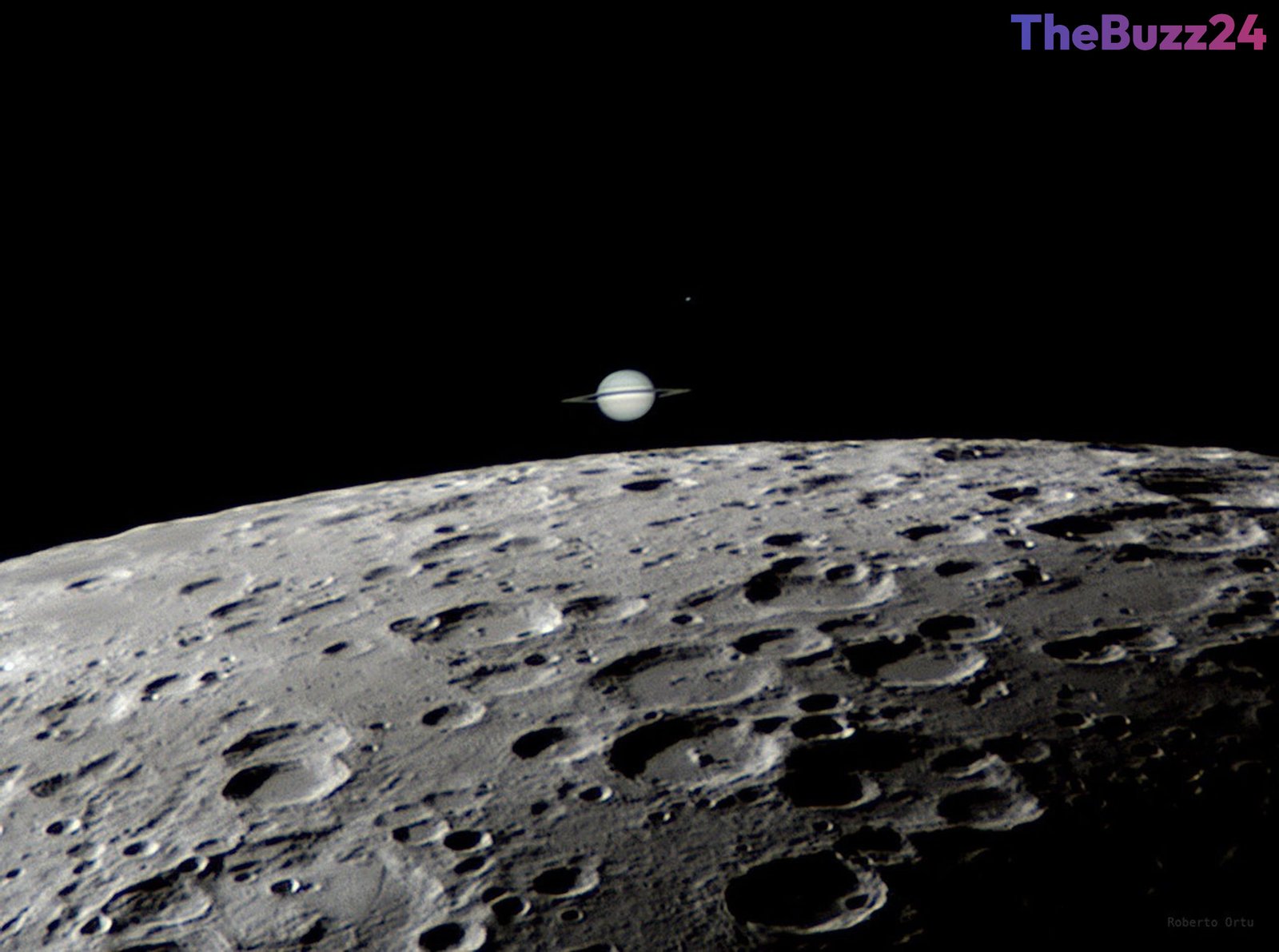
Captured in vibrant detail from Sardinia, Italy, a composite image reveals the precise moments leading up to the concealment. To achieve the breathtaking visual, astrophotographers utilized a digital fusion of three separate exposures. The image captures Saturn just before its descent behind the lunar limb, while contrasting exposure lengths highlight the textured topography of the Moon’s surface and the delicate brightness of Saturn’s iconic ring system.
Adding further complexity to the night sky view, a luminous point near Saturn was revealed not to be one of its many moons, but rather 85 Aquarii—a background star situated vast light-years beyond the solar system. This foreground-background alignment created a layered prospective on deep-space positioning, contrasting a nearby planet with a far-off star system.
Events of this nature offer both amateur stargazers and professional astronomers a vivid reminder of the dynamic nature of our solar system. For those who missed this rare planetary overlap, patience will be required: the next lunar occultation of Saturn visible from Earth is not expected to occur until 2031.
Key Takeaways
- A rare lunar occultation temporarily blocked Saturn from view across regions including Greenland, Europe, and northern Africa.
- A detailed composite image taken in Sardinia, Italy, captured Saturn, the Moon, and the distant background star 85 Aquarii.
- The next visible lunar occultation of Saturn from Earth will not take place until the year 2031.
Editor’s Analysis & Impact
Lunar occultations provide rare, valuable opportunities for public outreach and astronomical observation. Beyond their stunning visual appeal, these events allow researchers to precise-tune orbital calculations and refine models of planetary movement. Capturing these moments requires sophisticated imaging techniques, such as multi-exposure composite photography, demonstrating how advances in digital imaging enable ground-based astrophotographers to generate high-precision astronomical imagery. As public interest in space science continues to rise, events like planetary occultations serve as powerful tools for educational engagement and scientific curiosity. Looking forward to 2031, improved camera technology and global observer networks will likely deliver even more detailed insights into these temporary cosmic alignments.
Frequently Asked Questions
Q: What is a lunar occultation?
A: A lunar occultation occurs when the Moon passes directly between Earth and another celestial body, such as a star or planet, temporarily blocking it from view.
Q: Was Saturn actually affected during the event?
A: No, Saturn remained in its normal orbit. Its disappearance was strictly a optical perspective effect caused by the Moon's movement across the sky relative to Earth observers.
Q: When will the next lunar occultation of Saturn happen?
A: The next alignment where the Moon passes in front of Saturn, visible from locations on Earth, is predicted to occur in 2031.
AI Disclosure: This article is based on verified data and official reports. Our Team and AI have cross-referenced every financial detail with primary sources to ensure total accuracy.
More from this Category