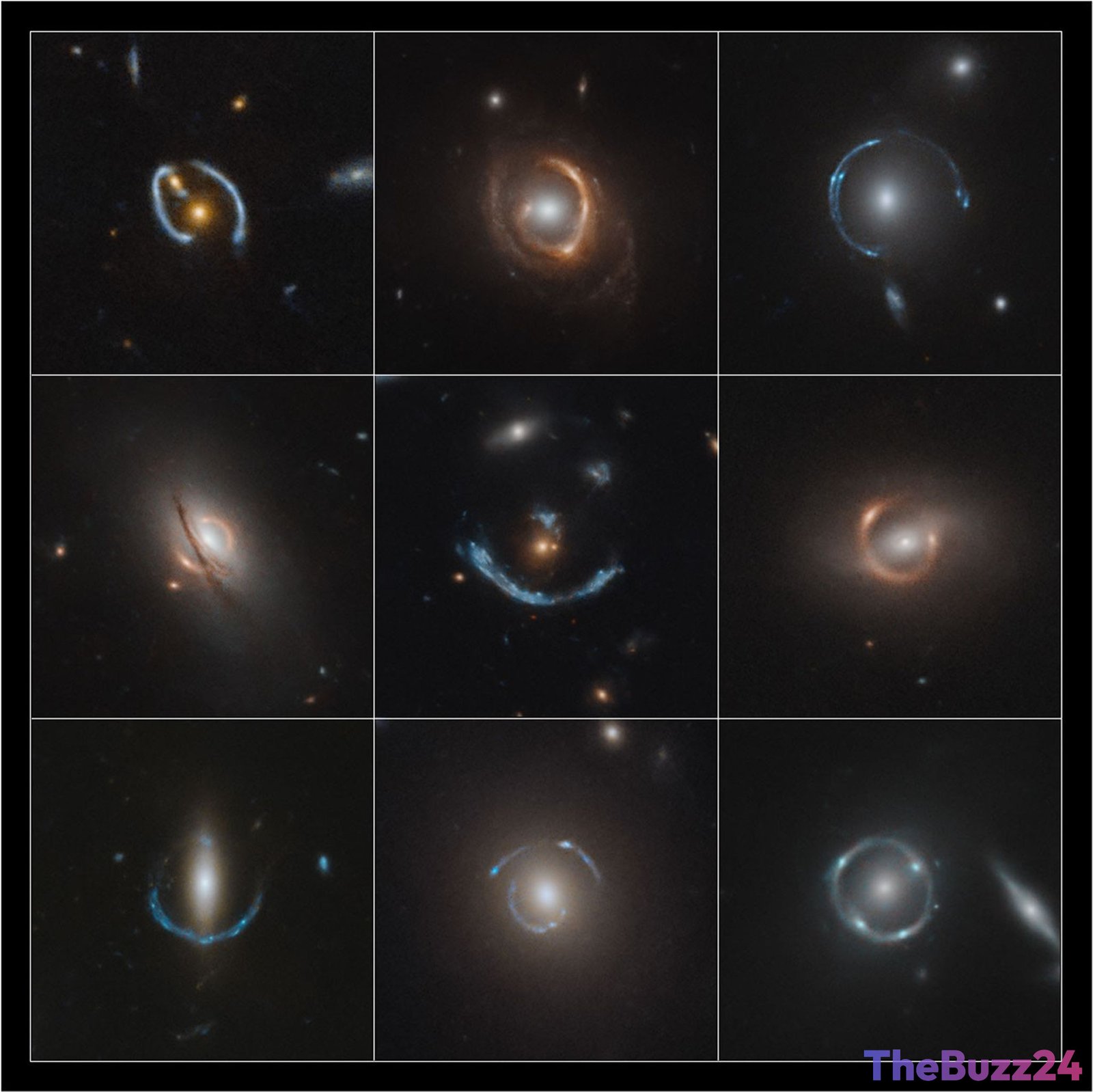
Hubble’s Cosmic Lenses Pave Way for Roman Telescope’s Dark Matter Hunt
A stunning collection of gravitational lenses captured by the Hubble Space Telescope is providing invaluable insights, setting the stage for the upcoming Nancy Grace Roman Space Telescope. This celestial gallery not only showcases the diverse nature of this cosmic phenomenon but also establishes a critical foundation for future observations by Roman, which is anticipated to launch in August 2026.
Gravitational lensing, a phenomenon first theorized by Albert Einstein, occurs when the immense gravity of a massive foreground object, such as a galaxy or a cluster of galaxies, distorts and magnifies light from a more distant background object. This effect acts like a colossal natural lens in space, enabling astronomers to peer at objects far beyond the reach of any single telescope. The lenses featured in these images are formed by the precise alignment of a distant background galaxy with the mass of a foreground galaxy, resulting in magnified and distorted images of the background galaxy appearing as luminous arcs around the foreground object.
Astronomers are leveraging these extensive observations of gravitational lenses to develop sophisticated models. These models are vital for determining the total mass within the foreground lensing systems, offering a unique opportunity to test and potentially validate or refute theories concerning dark matter. By meticulously analyzing the distortion of the lensed background galaxies, researchers can quantify and map the distribution of mass within the foreground galaxies, including their elusive, invisible dark matter components. While Hubble excels at providing high-resolution views of individual objects primarily in visible and ultraviolet light, Roman will specialize in infrared light with a much wider field of view, capturing vast panoramas of the universe. This complementary approach means Hubble can offer detailed follow-up on particularly intriguing lenses identified by Roman’s broader surveys.
Crucially, Hubble’s high-resolution imaging capabilities, combined with precise models, are expected to reveal subtle imperfections within these gravitationally lensed galaxy arcs. These minute distortions could indicate the presence of small, previously undetected clumps of dark matter. Such discoveries would provide strong evidence for the cold dark matter theory, which posits the existence of numerous small dark matter clumps ranging from a million to a billion solar masses. For context, the Milky Way’s dark matter halo is estimated at 1.3 trillion solar masses. Furthermore, detailed analysis of Hubble’s lens images is intended to inform the development of advanced artificial intelligence tools, designed to efficiently identify similar arcs within the much larger datasets anticipated from Roman. This collaborative strategy ensures that Hubble’s current findings will not only yield independent results on dark matter but also significantly streamline the analysis of Roman’s extensive sample of lenses.
The diverse array of lenses observed, including arc-counterarc configurations, perfect Einstein Rings, and quadruply lensed galaxies, each offers unique insights. Variations in color, from bluish arcs indicating young stars to reddish arcs suggesting older stellar populations, will help astronomers understand galaxy evolution in the early universe. While most foreground lensing galaxies are older, denser ellipticals, some exhibit spiral arms or dust lanes, providing clues about their evolutionary paths. The synergy between observatories like Hubble, Roman, the Chandra X-ray Observatory, and the James Webb Space Telescope promises to unlock new cosmic vistas, expanding humanity’s understanding of the universe.
Key Takeaways
- Hubble's observations of gravitational lenses are crucial for preparing the Nancy Grace Roman Space Telescope's mission.
- Gravitational lensing allows astronomers to study the distribution of mass, including dark matter, in distant galaxies.
- The combined efforts of Hubble and Roman will enhance our understanding of galaxy evolution and could confirm the cold dark matter theory by detecting small dark matter clumps.
Editor’s Analysis & Impact
This collaborative approach between the Hubble and Roman space telescopes marks a significant advancement in astrophysics. The detailed gravitational lens data from Hubble provides an essential training ground for Roman’s broader surveys, optimizing its search for dark matter clumps and distant galaxies. This synergy is poised to revolutionize our understanding of the universe’s fundamental composition and evolution. Confirming the cold dark matter theory through the detection of small clumps would have profound implications for cosmology, potentially solidifying our current model of the universe. Furthermore, the development of AI tools for astronomical data analysis, driven by Hubble’s insights, represents a crucial technological leap, enabling more efficient processing of the vast datasets expected from future observatories. This inter-observatory cooperation exemplifies the future of large-scale scientific discovery.
Frequently Asked Questions
Q: What is gravitational lensing?
A: Gravitational lensing is a phenomenon where the gravity of a massive foreground object, like a galaxy or galaxy cluster, bends and magnifies light from a more distant background object. This acts like a natural cosmic lens, allowing astronomers to observe objects that would otherwise be too far or faint to see.
Q: How will the Nancy Grace Roman Space Telescope complement Hubble's observations?
A: While Hubble provides high-resolution, detailed views of individual objects primarily in visible and ultraviolet light, Roman will specialize in infrared light with a much wider field of view, capturing vast panoramas. Roman can identify numerous potential gravitational lenses, and Hubble can then conduct detailed follow-up observations on the most interesting ones, leveraging its superior resolution for specific targets.
Q: What is the significance of detecting small dark matter clumps?
A: Detecting small clumps of dark matter would provide strong evidence supporting the cold dark matter theory, a leading model for the universe's structure. This theory predicts the existence of many such clumps, and their discovery would significantly advance our understanding of dark matter's nature and its role in galaxy formation and evolution.
AI Disclosure: This article is based on verified data and official reports. Our Team and AI have cross-referenced every financial detail with primary sources to ensure total accuracy.
More from this Category