Cosmic Symphony: NASA Translates X-Ray Data of Newborn Stars into Audio Tracks
Astronomers and sound designers have transformed observational data capturing active star formation into a series of sonifications, creating an auditory journey through the galaxy. Utilizing X-ray observations from the Chandra X-ray Observatory alongside multi-spectral data from other space telescopes, the project converts electromagnetic radiation from infant stars into distinct musical textures and tones. This innovative approach allows both scientists and the public to experience cosmic phenomena through sound, offering fresh perspectives on how stellar nurseries evolve across the universe.
Among the newly released audio tracks is data from Messier 82 (M82), a starburst galaxy where stars form at a rate vastly outpacing the Milky Way. In this sonification, high-frequency X-rays are translated into upper-range musical pitches, while infrared views from the James Webb Space Telescope and Spitzer Space Telescope provide deep, droning bass notes and plucked textures. Similarly, the iconic Orion Nebula—one of the closest star-forming regions to Earth—has been rendered into sound, mapping energetic X-ray emissions from over a thousand infant stars into delicate, twinkling tones paired with digital harp sounds that represent surrounding cosmic dust.
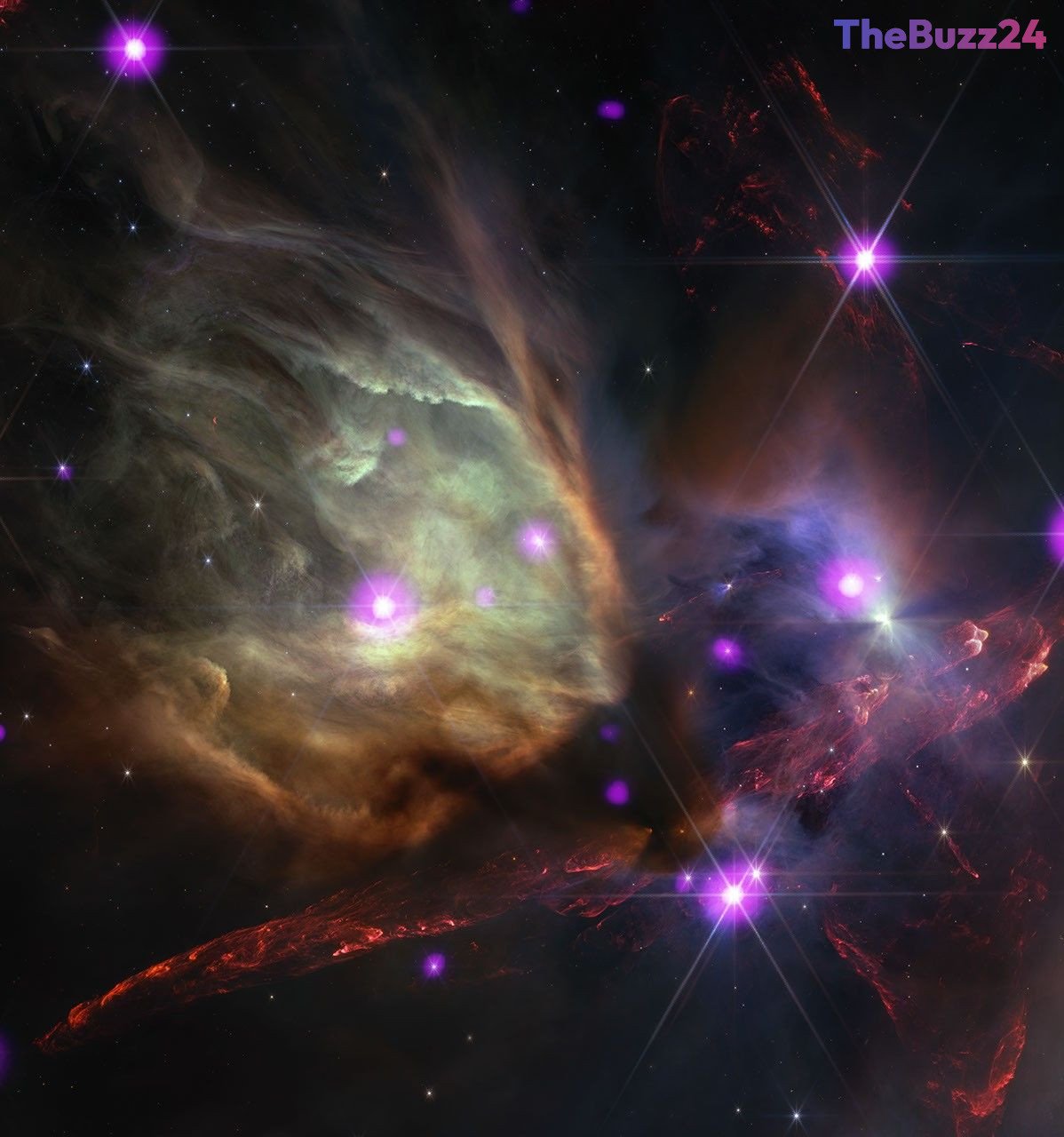
The project also highlights the dramatic structural features of the Carina Nebula and the dense cloud complex Rho Ophiuchi. In Carina, individual baby stars detected beneath thick dust layers resonate as short string notes, while the diffuse background X-ray glow creates sustained melodic backgrounds. In Rho Ophiuchi, violent X-ray flares emitted by turbulent young stars are mapped as high-pitched glassy tones, punctuated by metallic plucks that represent individual stellar objects. Together, these audio interpretations provide a novel dimension to space exploration, turning complex scientific datasets into an engaging, multi-sensory experience.
Key Takeaways
- Observational data from the Chandra X-ray Observatory and partner telescopes have been converted into four distinct audio sonifications of star-forming regions.
- Data from Messier 82, the Orion Nebula, Carina Nebula, and Rho Ophiuchi were assigned specific audio frequencies and instruments based on light types.
- The sonification initiative provides an accessible method for public engagement and offers a multi-sensory tool for analyzing complex astronomical datasets.
Editor’s Analysis & Impact
Translating multi-spectral astronomical data into auditory experiences represents a growing trend in modern scientific communication and analytical visualization. Sonification effectively bridges the gap between high-level astrophysical research and public accessibility, creating inclusive educational content for visually impaired individuals and non-experts. Beyond outreach, multi-sensory data interpretation allows researchers to identify subtle patterns or anomalies within massive datasets that might be missed through visual observation alone. As space observatories generate increasingly complex multi-wavelength datasets, combining visual mapping with acoustic modeling will likely become an integral tool in data processing, fostering ongoing collaboration between scientists, software developers, and audio professionals.
Frequently Asked Questions
Q: What is astronomical sonification?
A: Sonification is the process of translating scientific information—such as light, X-rays, and infrared wavelengths gathered by space telescopes—into audible sound waves and musical tones based on intensity and frequency.
Q: Which space observatories contributed data to these sonifications?
A: The audio tracks primarily utilize X-ray data from the Chandra X-ray Observatory, combined with optical and infrared observations from the Hubble Space Telescope, James Webb Space Telescope, and Spitzer Space Telescope.
Q: Why do scientists study star-forming regions like the Orion Nebula?
A: Studying regions actively generating new stars allows astronomers to better understand the lifecycles, chemical compositions, and evolutionary stages of stars throughout the universe, including our own Sun.
AI Disclosure: This article is based on verified data and official reports. Our Team and AI have cross-referenced every financial detail with primary sources to ensure total accuracy.
More from this Category