Dragonfly Mission Equips Rotorcraft with Advanced Imaging Suite for Titan Exploration
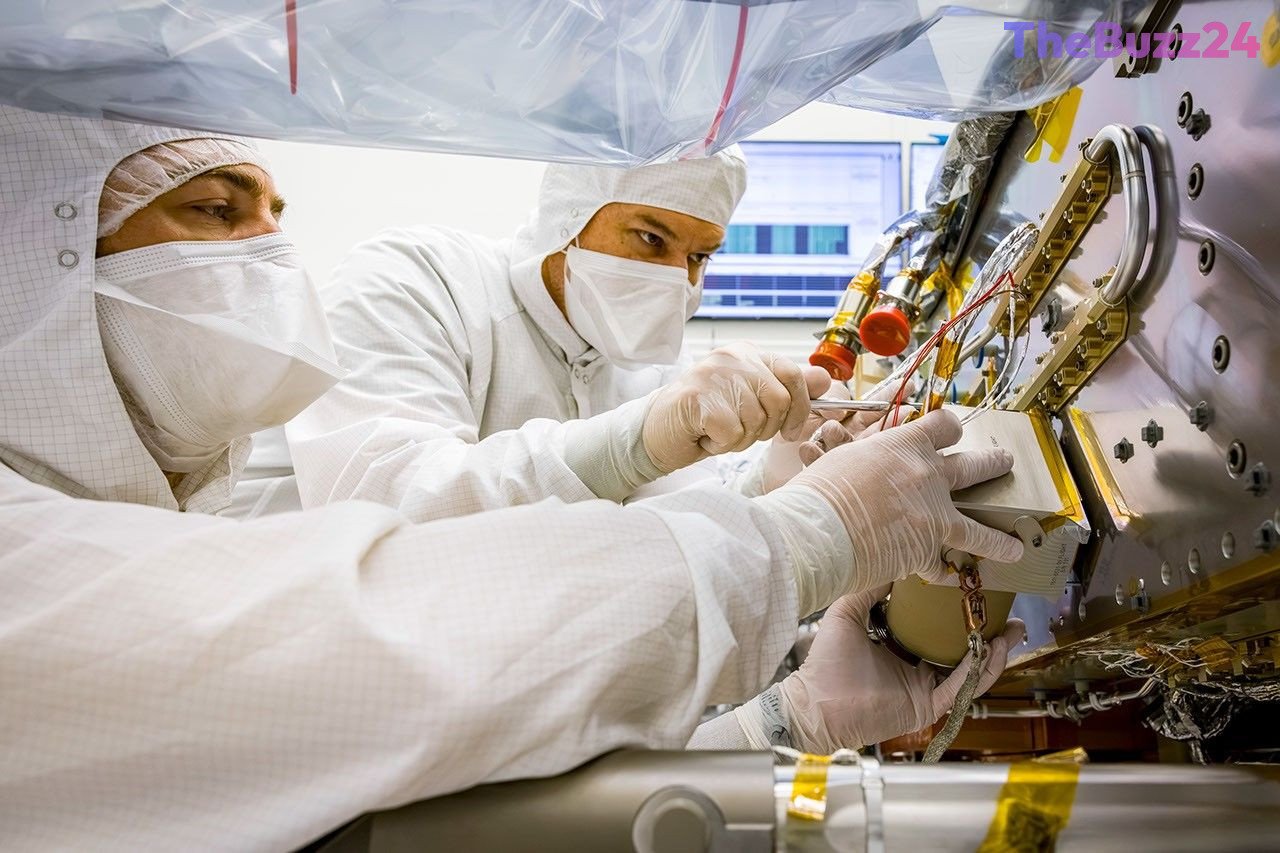
The ambitious Dragonfly mission, designed to explore Saturn’s largest moon, Titan, has reached a significant milestone with the integration of its primary imaging system, DragonCam. This car-sized rotorcraft is currently undergoing assembly at the Johns Hopkins Applied Physics Laboratory (APL) in Laurel, Maryland, as it prepares for an unprecedented journey to an ocean world with a dense atmosphere and complex organic chemistry. The arrival and installation of DragonCam mark a crucial step in equipping the vehicle with the “eyes” it will need to navigate and study Titan’s enigmatic surface.
Developed and built by Malin Space Science Systems, DragonCam comprises a sophisticated suite of seven cameras engineered to characterize Titan’s diverse landscape at various scales, both during flight and while on the ground. By mid-November, all cameras were securely housed, tested, and integrated into the rotorcraft. Each camera peers out through a specialized window within a foam enclosure, providing vital insulation against Titan’s extreme cryogenic environment, where temperatures plummet to approximately minus 290 degrees Fahrenheit. An integrated LED array, spanning infrared to ultraviolet light, will illuminate sampling sites, providing data on surface material color and composition. Crucially, during Titan’s nearly eight-Earth-day-long night, this illumination could enable DragonCam to identify organic molecules that fluoresce under ultraviolet light, offering clues to the moon’s astrobiological potential.
DragonCam’s comprehensive design includes a variety of lenses tailored for different observational needs. Two forward-mounted cameras—a wide-angle camera (WAC) and a medium-angle camera (MAC)—will capture stereoscopic views of the terrain ahead, aiding navigation. Complementing these, two side-mounted WACs will provide expansive panoramic views of Titan’s vast landscape. For safe landings and detailed surface analysis, two downward-facing WACs will survey the ground beneath the rotorcraft, helping the mission team select optimal sites for deploying the DrACO (Drill for Acquisition of Complex Organics) sample-collecting tool and its seismometer. A high-resolution microscopic imager will then focus on DrACO’s drill site, revealing intricate details of millimeter-sized sand grains and other materials. This visual context is essential for understanding the geological story behind the samples collected across multiple sites on Titan.
Other critical instrument packages, including DraGNS (Gamma-ray and Neutron Spectrometer), DraGMet (Geophysics and Meteorology), DraMS (Mass Spectrometer), and DrACO, are slated for delivery and integration in the coming months. The Dragonfly mission is scheduled for launch in July 2028, with its arrival at Titan anticipated in late 2034, promising a revolutionary exploration of one of our solar system’s most intriguing destinations.
Key Takeaways
- NASA's Dragonfly rotorcraft has successfully integrated its primary imaging system, DragonCam, at the Johns Hopkins Applied Physics Laboratory.
- DragonCam features seven cameras designed for multi-scale imaging of Titan's surface, including an LED array capable of detecting fluorescing organic molecules in cryogenic conditions.
- The mission is scheduled to launch in July 2028 and arrive at Titan in late 2034, aiming to explore the moon's unique environment and potential for habitability.
Editor’s Analysis & Impact
The successful integration of DragonCam onto the Dragonfly rotorcraft represents a significant leap forward in planetary science and robotic exploration. This development underscores the growing capability to design and deploy complex autonomous systems in extreme extraterrestrial environments. The mission’s focus on Titan, with its unique organic chemistry and potential for subsurface oceans, holds profound implications for astrobiology and the search for life beyond Earth. From an industry perspective, the advanced imaging and navigation technologies developed for Dragonfly could find applications in terrestrial autonomous vehicles, remote sensing, and even deep-sea exploration. The mission’s long timeline, culminating in a 2034 arrival, highlights the sustained commitment required for ambitious space endeavors and promises to inspire a new generation of scientists and engineers, pushing the boundaries of what’s possible in space exploration.
Frequently Asked Questions
Q: What is the primary goal of NASA's Dragonfly mission?
A: The Dragonfly mission aims to explore Titan, Saturn's largest moon, to study its organic chemistry, methane cycle, and potential for habitability. It will investigate the moon's surface and atmosphere using a rotorcraft.
Q: What is DragonCam and what are its main functions?
A: DragonCam is the primary imaging suite for the Dragonfly rotorcraft, consisting of seven cameras. Its main functions include characterizing Titan's surface at multiple scales during flight and on the ground, aiding navigation, identifying landing sites, and providing context for collected samples, including detecting fluorescing organic molecules.
Q: When is Dragonfly scheduled to launch and arrive at Titan?
A: The Dragonfly mission is scheduled to launch in July 2028 and is anticipated to reach Titan in late 2034, after an approximately six-year journey.
AI Disclosure: This article is based on verified data and official reports. Our Team and AI have cross-referenced every financial detail with primary sources to ensure total accuracy.
More from this Category