Unveiling Cosmic Secrets: Webb Telescope Uncovers Final Hours of Cassiopeia A Star
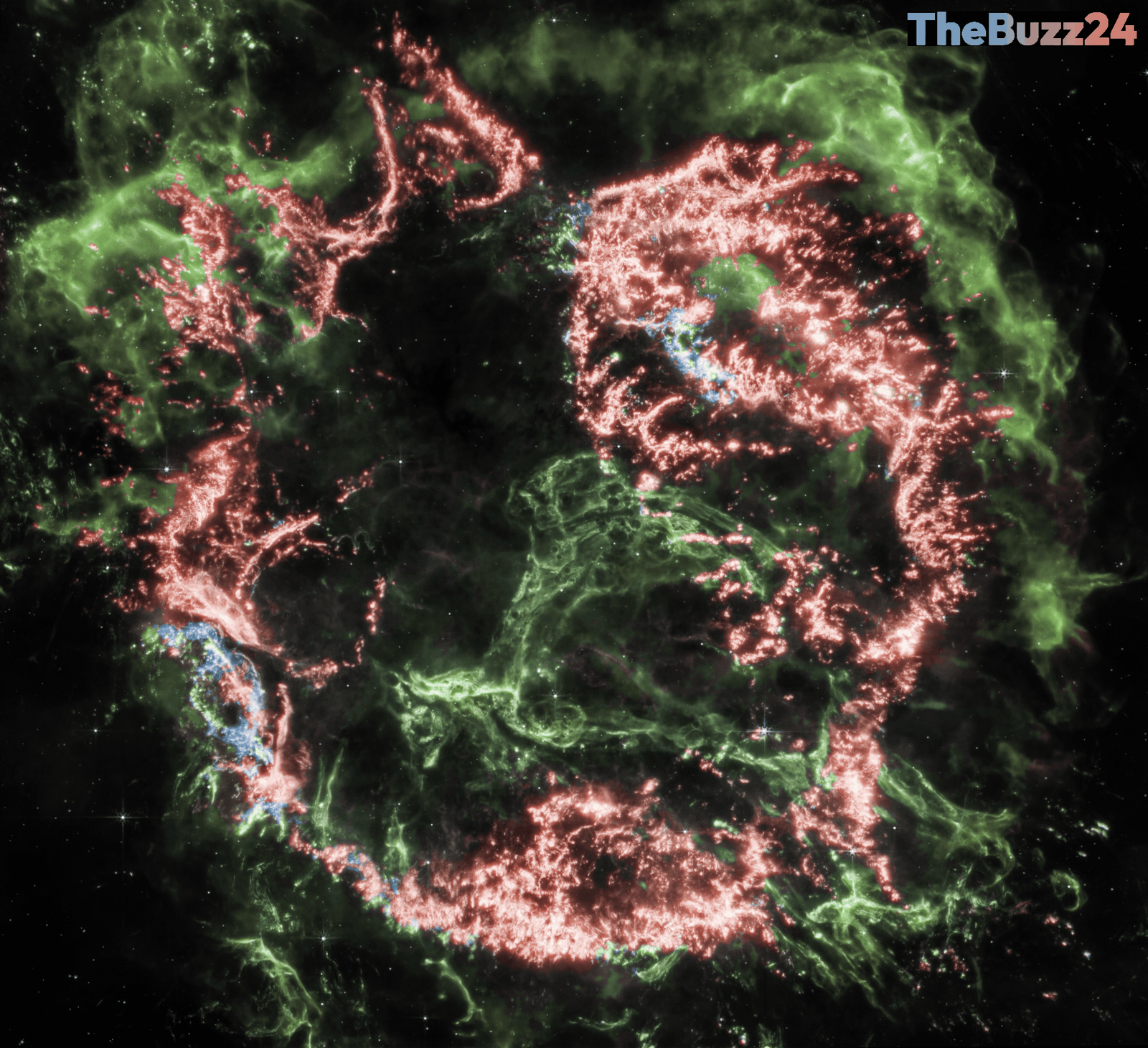
High-resolution mid-infrared observations from the James Webb Space Telescope have revealed groundbreaking details about Cassiopeia A (Cas A), one of the most studied supernova remnants in the night sky. The latest imagery highlights the thermal characteristics of hot cosmic dust within the expanding cloud, offering researchers unprecedented clarity into the structural composition of the progenitor star prior to its catastrophic explosion.
Analysis of the dust distribution suggests that the interior of the massive star experienced dramatic structural changes shortly before its death—potentially just hours before the core collapsed. These chaotic final moments left a distinct imprint on the expanding material, enabling astronomers to reconstruct the internal dynamics and shifting chemical layers of a star on the brink of destruction.
Beyond shedding light on stellar mortality, the findings emphasize the vital role supernova remnants play in the evolution of the cosmos. The vast clouds of gas and dust produced by such cataclysms eventually cool and condense, supplying the essential heavy elements needed to seed future generations of stars, planetary systems, and the foundations of rocky planets.
Key Takeaways
- Mid-infrared observations from the James Webb Space Telescope reveal new structural details of the hot dust within the Cassiopeia A supernova remnant.
- Data indicates the progenitor star underwent rapid, dramatic interior alterations mere hours before its stellar explosion.
- The expanding dust and gas clouds provide crucial insights into how supernovas distribute heavy elements to form future planetary systems.
Editor’s Analysis & Impact
The latest findings on Cassiopeia A highlight the revolutionary diagnostic capabilities of the James Webb Space Telescope’s mid-infrared instrumentation. By probing through dense cosmic debris, researchers are gaining direct access to the pre-supernova dynamics of massive stars—a phase of stellar evolution that was previously difficult to model. Understanding these final chaotic hours helps refine theoretical models of stellar physics, nucleosynthesis, and core-collapse mechanisms. Furthermore, tracking how hot dust and heavy elements disperse into the interstellar medium provides crucial data for astrophysics models predicting galaxy evolution, chemical enrichment, and planet formation across cosmic time.
Frequently Asked Questions
Q: What is Cassiopeia A?
A: Cassiopeia A is a famous supernova remnant located approximately 11,000 light-years away in the constellation Cassiopeia, consisting of expanding gas and dust left behind when a massive star exploded.
Q: Why are the new observations from the James Webb Space Telescope significant?
A: The telescope's high-resolution mid-infrared imaging allows scientists to analyze hot dust patterns, revealing that the star's interior underwent sudden, dramatic changes just hours before it exploded.
Q: How do supernova remnants contribute to the creation of new celestial bodies?
A: Supernovae eject heavy elements into space, enriching surrounding gas clouds with the raw materials necessary to form new generations of stars, planets, and complex chemistry.
AI Disclosure: This article is based on verified data and official reports. Our Team and AI have cross-referenced every financial detail with primary sources to ensure total accuracy.
More from this Category