Hubble’s Latest Gaze Reveals Intricate Barred Galaxy NGC 4394, Mirroring the Milky Way
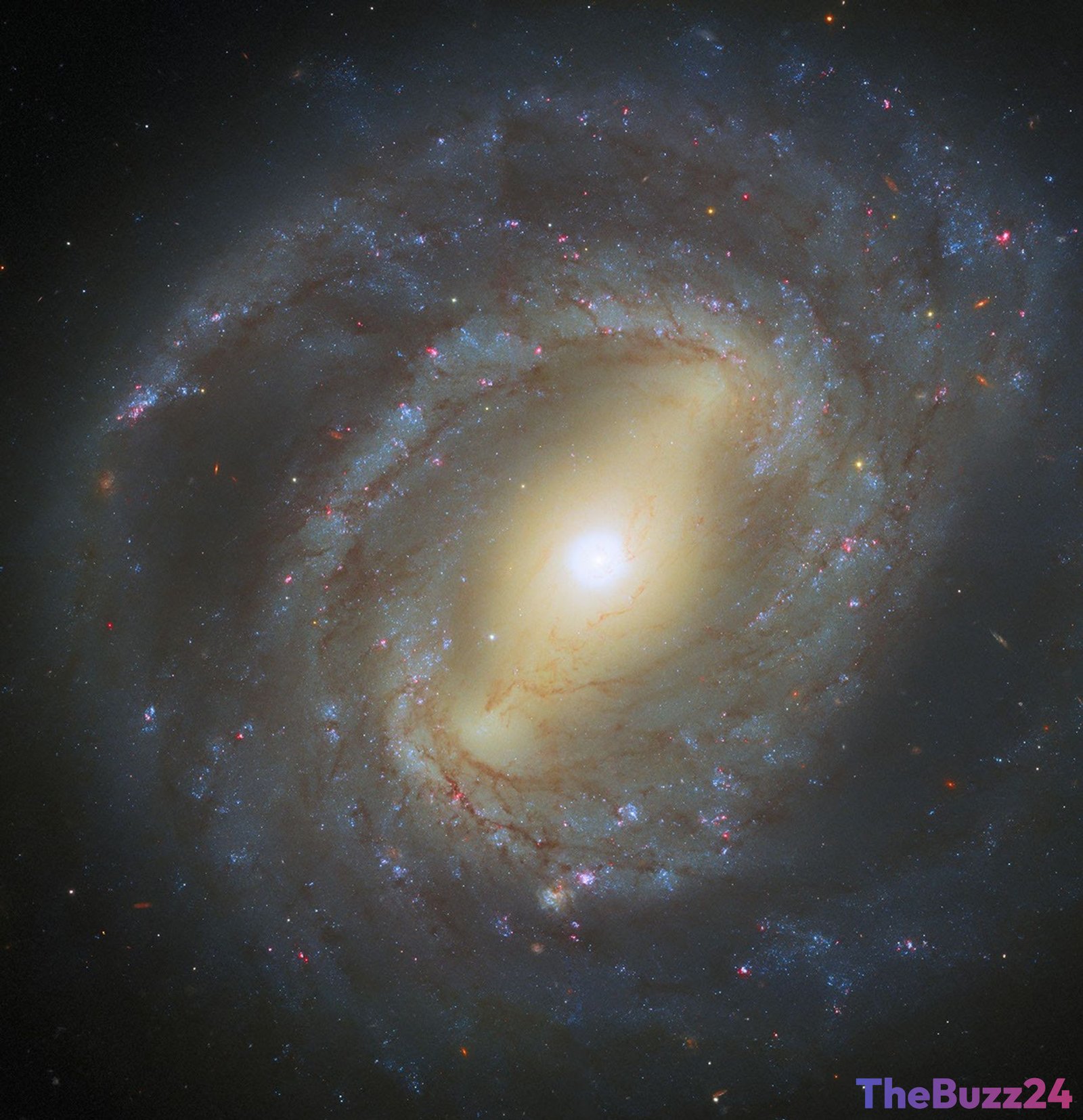
The Hubble Space Telescope has delivered a breathtaking new perspective on NGC 4394, a brilliant barred spiral galaxy located approximately 55 million light-years away in the constellation Coma Berenices. This celestial body is a member of the vast Virgo Cluster, a collection of over a thousand galaxies that represents the closest galaxy cluster to our own. With its elegantly winding spiral arms and a prominent central bar of stars, NGC 4394 offers astronomers a striking visual parallel to what our own Milky Way galaxy might look like if observed from a similar face-on vantage point.
Galactic bars, like the distinct feature seen in NGC 4394, are surprisingly common across the cosmos, with estimates suggesting they are present in about 65 percent of nearby spiral galaxies. These straight streaks of stars, which contrast with the more common arcing spirals, are believed to form when a galaxy’s disk of stars becomes gravitationally unstable. This instability can be triggered by various factors, including gravitational interactions with neighboring galaxies or internal dynamics among stars. While these stellar bars are prevalent in the universe today, research indicates they are not permanent fixtures; as they accumulate mass, they can eventually become unstable themselves, suggesting a dynamic and evolving role in galactic structure.
Beyond their shared barred morphology, NGC 4394 and the Milky Way may also share another intriguing characteristic: the presence of a low-ionization nuclear emission-line region, or LINER. A LINER is a specific area near a galaxy’s core characterized by unique spectral emissions from ionized or neutral elements. The precise mechanisms behind LINER formation remain an active area of research, with leading hypotheses pointing to either the intense activity of supermassive black holes at the galactic center or vigorous star formation processes as potential drivers.
This latest image of NGC 4394 is not Hubble’s first encounter with this region of the sky. The telescope previously captured the galaxy a decade ago as part of an observational program primarily focused on its galactic neighbor, Messier 85. While one of Hubble’s instruments studied Messier 85’s unusual star clusters, another simultaneously imaged NGC 4394. The current, enhanced view also integrates data from a more recent program designed to investigate how star formation ceases in galaxies within dense cluster environments, contrasting this with processes in more isolated galaxies. For this study, Hubble’s Wide Field Camera 3 was utilized to determine the ages of individual star clusters within NGC 4394, one of 40 galaxies examined in this comprehensive survey.
Key Takeaways
- Hubble's new image showcases NGC 4394, a barred spiral galaxy resembling the Milky Way, located 55 million light-years away in the Virgo Cluster.
- Galactic bars, common features in spiral galaxies, are thought to form from disk instability and are a temporary phase in galactic evolution.
- Both NGC 4394 and the Milky Way may host a LINER, a central region with specific spectral emissions, whose origin is still under investigation.
Editor’s Analysis & Impact
This new Hubble observation of NGC 4394 significantly contributes to our understanding of galaxy evolution and morphology. By providing a detailed view of a barred spiral galaxy that closely resembles our own Milky Way, it offers invaluable comparative insights into the formation and dynamics of such structures. The prevalence of galactic bars, and their temporary nature, suggests a continuous process of cosmic restructuring, impacting star formation rates and the distribution of matter within galaxies. The ongoing mystery surrounding LINERs, potentially linked to supermassive black holes or intense star formation, highlights areas for future research, possibly involving next-generation telescopes like the James Webb Space Telescope. Such discoveries reinforce the critical role of long-duration space observatories in unraveling the universe’s complex mechanisms, driving scientific inquiry and inspiring public interest in space exploration.
Frequently Asked Questions
Q: What is a barred spiral galaxy?
A: A barred spiral galaxy is a type of spiral galaxy that features a central bar-shaped structure composed of stars. This bar extends from the nucleus of the galaxy, and the spiral arms typically emanate from the ends of the bar rather than directly from the core.
Q: What is a LINER, and why is its presence in NGC 4394 significant?
A: A LINER (low-ionization nuclear emission-line region) is a region near the center of a galaxy characterized by specific spectral emissions from weakly ionized or neutral atoms. Its presence in NGC 4394 is significant because the exact cause of LINERs is still debated, with theories pointing to either active supermassive black holes or intense star formation. Sharing this feature with the Milky Way provides a comparative study opportunity.
Q: How does the Hubble Space Telescope contribute to our understanding of galaxies like NGC 4394?
A: The Hubble Space Telescope provides unparalleled high-resolution optical and ultraviolet images, allowing astronomers to observe distant galaxies like NGC 4394 in exquisite detail. Its observations help scientists study galactic morphology, star formation processes, the dynamics of galactic bars, and the characteristics of central regions like LINERs, thereby advancing our knowledge of galaxy evolution and the universe's structure.
AI Disclosure: This article is based on verified data and official reports. Our Team and AI have cross-referenced every financial detail with primary sources to ensure total accuracy.
More from this Category