Unlocking the Volcanic Secrets of the Eastern Sierra Nevada
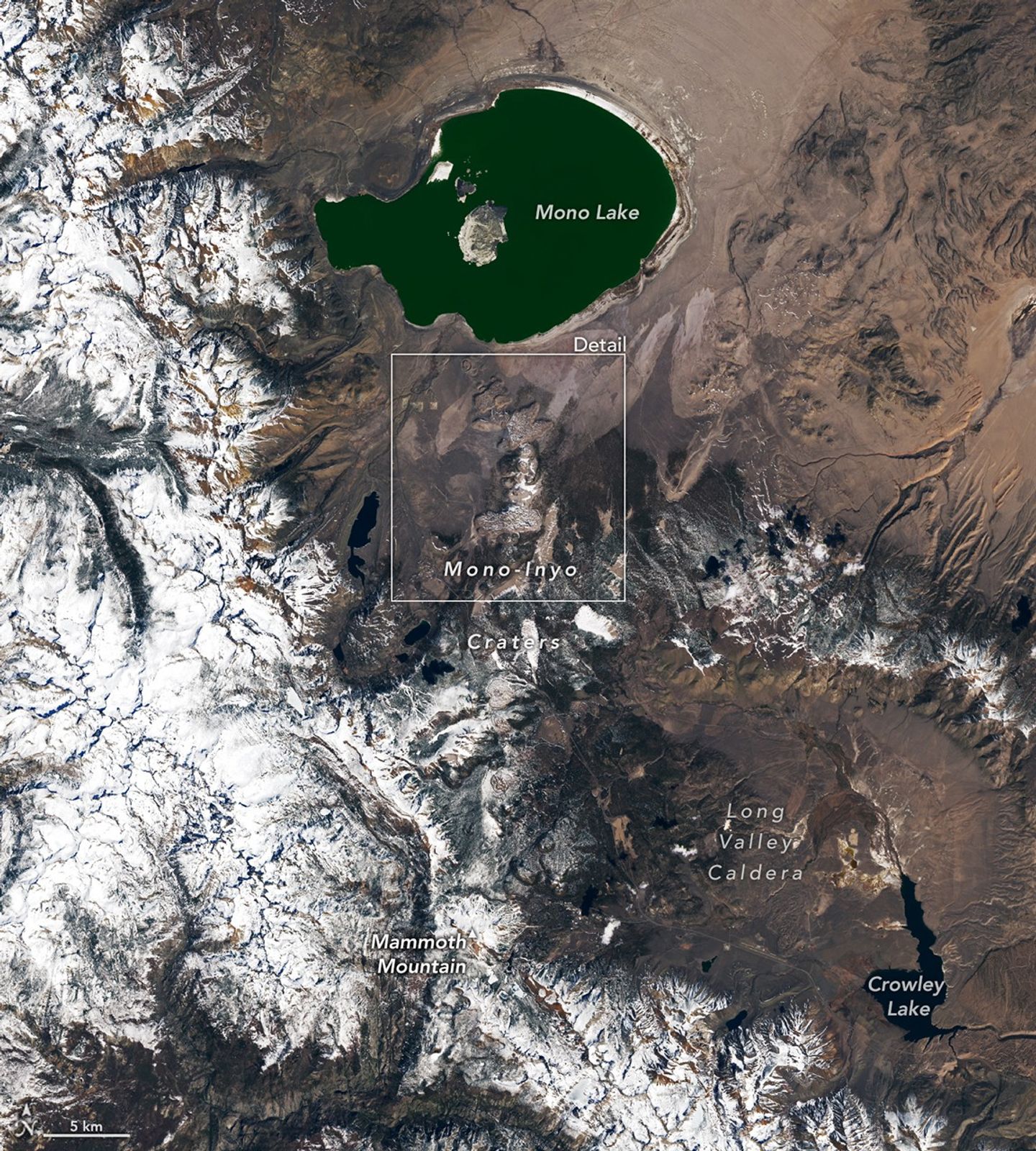
The eastern Sierra Nevada, centered around the town of Mammoth Lakes, California, stands as one of the most geologically dynamic regions in North America. Characterized by a rugged landscape of granite peaks and expansive basins, the area serves as a natural laboratory for studying volcanic processes. Recent high-resolution satellite imagery has provided scientists with unprecedented views of the region’s complex network of craters, lava domes, and calderas, offering new insights into both terrestrial history and planetary geology.
Among the most prominent features is the Mono-Inyo Craters chain, a series of approximately three dozen lava domes and tephra rings that have emerged within the last 10,000 years. Panum Crater, a notable formation dating back roughly 700 years, exemplifies the explosive nature of the region’s recent past with its distinct central lava dome and obsidian-rich surroundings. Meanwhile, Mammoth Mountain continues to demonstrate geological activity; although its primary magmatic eruptions ended over 50,000 years ago, the peak remains a site of ongoing seismic tremors and carbon dioxide emissions that continue to influence the local environment.
The most monumental event in the region’s history occurred 760,000 years ago with the creation of the Long Valley Caldera. This massive depression, spanning 10 by 20 miles, was the result of a catastrophic eruption that released 150 cubic miles of volcanic material, causing the earth to collapse thousands of feet. Today, this basin—which houses Crowley Lake—is a vital site for researchers. By studying the caldera’s formation and structure, scientists are gaining a better understanding of large-scale volcanic events, which serves as a terrestrial analog for analyzing volcanic landscapes on Mars and other planets.
Key Takeaways
- The Mammoth Lakes region contains a diverse volcanic history, ranging from the ancient Long Valley Caldera to the relatively young Mono-Inyo Craters.
- Mammoth Mountain remains geologically active, with persistent seismic activity and CO2 emissions that require ongoing environmental monitoring.
- The Long Valley Caldera serves as a crucial research site for scientists to model volcanic processes on Earth and compare them to geological features found on other planets.
Editor’s Analysis & Impact
The study of the Long Valley Caldera and the surrounding Sierra Nevada volcanic chain represents a vital intersection between Earth science and planetary exploration. By analyzing these massive, ancient volcanic systems, researchers are developing more sophisticated predictive models for volcanic hazards, such as gas emissions and seismic shifts, which have direct implications for local infrastructure and environmental management. Furthermore, the use of this region as an analog for Martian geology underscores the importance of terrestrial field research in advancing space exploration. As satellite monitoring technology continues to evolve, the ability to detect subtle volcanic unrest in real-time will likely become a standard for disaster mitigation, while simultaneously providing deeper insights into the evolutionary history of volcanic terrains across our solar system.
Frequently Asked Questions
Q: Is Mammoth Mountain still considered an active volcano?
A: Yes. While its last major magmatic eruption occurred over 50,000 years ago, the mountain remains geologically active, exhibiting periodic seismic tremors and ongoing volcanic gas emissions.
Q: How was the Long Valley Caldera formed?
A: The caldera was formed approximately 760,000 years ago during a massive volcanic eruption that ejected 150 cubic miles of material, causing the ground above the magma chamber to collapse and create the current basin.
AI Disclosure: This article is based on verified data and official reports. Our Team and AI have cross-referenced every financial detail with primary sources to ensure total accuracy.
More from this Category