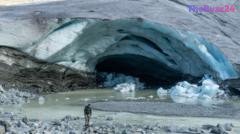
Alps on the Brink: Swiss Glaciers Suffer Catastrophic Ice Loss Amid Record Heatwaves
Swiss glaciers have experienced a devastating year of ice depletion, shedding over five percent of their remaining volume within a mere 12-month period. Driven by a combination of unusually mild winter conditions and severe summer heatwaves, the unprecedented melt rate has alarmed researchers who monitor the Alpine region. Scientists point out that while shrinking glaciers are an anticipated symptom of a warming planet, the sheer velocity of the recent loss far exceeds historical expectations.
The compounding crisis began early in the year, as scant winter snowfall left glaciers vulnerable. When intense heatwaves arrived in May and June, this protective snow layer rapidly vanished, exposing the darker, less reflective glacial ice underneath. Consequently, the exposed ice absorbed significantly more solar radiation, accelerating the melting process during subsequent summer temperature spikes. Researchers observed that even at extreme elevations reaching 3,500 meters above sea level, normally snow-capped measurement sites were entirely stripped of snow by the end of the season.
This rapid degradation carries severe long-term consequences for surrounding ecosystems, agriculture, hydropower generation, and regional transportation. Although the massive runoff temporarily replenished water levels in strained waterways like the River Rhine during dry spells, experts stress that this reliance on centuries-old stored ice is entirely unsustainable. As smaller glaciers disappear entirely and higher elevations fail to accumulate new ice, future heatwaves will lack this crucial hydrological buffer, threatening critical supplies for farming and commercial navigation.
While the current trajectory indicates that many lower-altitude Alpine glaciers are beyond saving, climate scientists emphasize that aggressive reductions in global carbon emissions remain vital. Stabilizing remaining ice masses in larger mountain ranges and polar regions can still mitigate catastrophic global sea-level rise and protect vulnerable coastal populations worldwide. The ongoing transformation of the Alpine landscape serves as a stark reminder of the accelerating pace of global environmental change.
Key Takeaways
- Swiss glaciers lost over 5% of their remaining ice volume in a single year, far exceeding traditional definitions of extreme melting.
- Early heatwaves stripped away protective winter snow, exposing dark glacial ice that rapidly absorbed solar energy.
- While the massive melt temporarily eased summer water shortages, it severely depleted long-term reserves relied upon for agriculture and hydropower.
Editor’s Analysis & Impact
The alarming acceleration of glacial melt in the Swiss Alps underscores the immediate vulnerabilities facing European infrastructure, energy production, and agriculture. As historical ice reserves dwindle, industries reliant on consistent meltwater—such as hydroelectric power generation and commercial river transport—face mounting economic pressures and structural risks. Beyond the immediate regional impact, this event serves as a bellwether for global climate trends, reinforcing the urgent need for long-term adaptation strategies and aggressive carbon mitigation policies. The economic costs of safeguarding vulnerable Alpine communities and replacing lost natural water storage systems will require substantial capital investment from governments in the coming decades.
Frequently Asked Questions
Q: Why is the loss of Swiss glacier ice happening so quickly?
A: The rapid loss is primarily driven by a combination of mild winters with below-average snowfall and intense, early summer heatwaves. When the protective snow cover melts away prematurely, it exposes darker glacial ice that absorbs significantly more solar radiation, accelerating the melting process.
Q: What are the long-term consequences of rapid glacier melting?
A: In the short term, melting glaciers provide runoff that helps ease dry spells, but this depletes the stored water supply. In the long term, smaller glaciers will be unable to replenish water levels for agriculture, hydropower, and river transport during future heatwaves, while also destabilizing mountain slopes and increasing landslide risks.
Q: Can anything be done to save the glaciers?
A: While many lower-altitude Alpine glaciers have already disappeared or are too far gone to save, researchers stress that sharp and immediate cuts to carbon emissions can still protect massive ice sheets in polar regions and the Himalayas, thereby limiting global sea-level rise.
AI Disclosure: This article is based on verified data and official reports. Our Team and AI have cross-referenced every financial detail with primary sources to ensure total accuracy.
More from this Category