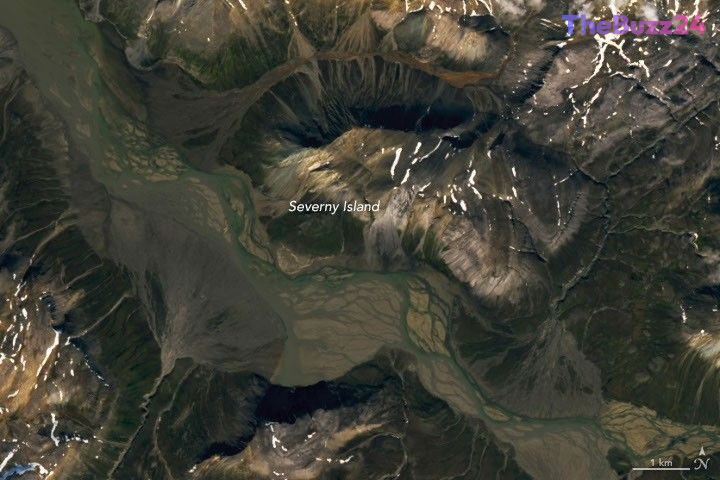
Arctic Landscapes: The Formation of Alluvial Fans on Severny Island
High-resolution satellite imagery has captured a striking geological phenomenon on Severny Island, located within the remote Novaya Zemlya archipelago of the Russian Arctic. The images reveal a series of alluvial fans—cone-shaped sediment deposits—forming along a braided river channel. These features emerge where fast-moving mountain streams transition into flatter valley floors, causing the water to slow and deposit the sediment it has carried from the rugged, ice-covered terrain above.
Severny Island is characterized by its mountainous, uninhabited landscape, much of which remains under glacial cover. The formation of these alluvial fans is heavily influenced by the island’s unique hydrology. Seasonal snowmelt and glacial runoff provide the necessary energy and material to transport sediment from the mountains to the valleys. As glaciers grind downslope, they produce significant amounts of eroded material, which is then flushed through the river systems during the warmer months when river flows are at their peak.
Scientific observation of this region is critical for understanding the broader impacts of climate change on Arctic environments. While the island remains largely understudied due to its extreme isolation, satellite data has allowed researchers to monitor the health of its glaciers. Recent analyses indicate that land-terminating glaciers across the Novaya Zemlya archipelago have experienced thinning over the past two decades, particularly at lower elevations. These changes in glacial stability directly influence the sediment supply and the ongoing development of the alluvial fans observed in the region.
Key Takeaways
- Alluvial fans on Severny Island are formed by sediment deposits where mountain rivers reach flatter valley terrain.
- Glacial meltwater and seasonal snowmelt are the primary drivers for the transport of sediment that builds these geological features.
- Satellite data indicates that glaciers on the Novaya Zemlya archipelago have been thinning over the last twenty years, impacting the local landscape.
Editor’s Analysis & Impact
The study of remote Arctic landforms like those on Severny Island provides a vital proxy for monitoring climate-driven environmental shifts. As global temperatures rise, the accelerated thinning of land-terminating glaciers alters the sediment flux and hydrological patterns of high-latitude regions. These alluvial fans serve as physical records of glacial activity and erosion rates. From a broader perspective, the ability to monitor these inaccessible areas via satellite technology is essential for filling gaps in our understanding of the cryosphere. The future outlook suggests that as Arctic warming continues, we can expect further changes in glacial runoff and sediment deposition, which will fundamentally reshape the topography of these isolated islands. This research highlights the importance of remote sensing in tracking the health of the planet’s most vulnerable and least-explored ecosystems.
Frequently Asked Questions
Q: What is an alluvial fan?
A: An alluvial fan is a cone-shaped deposit of sediment that forms when a fast-flowing stream or river slows down as it reaches a flatter area, such as a valley floor.
Q: Why is Severny Island significant for climate research?
A: Severny Island is significant because its glaciers are sensitive indicators of climate change. Monitoring their thinning and melt patterns helps scientists understand how warming temperatures are affecting the Arctic cryosphere.
AI Disclosure: This article is based on verified data and official reports. Our Team and AI have cross-referenced every financial detail with primary sources to ensure total accuracy.
More from this Category