Arctic Sea Ice Hits 2026 Annual Minimum, Continuing Long-Term Decline
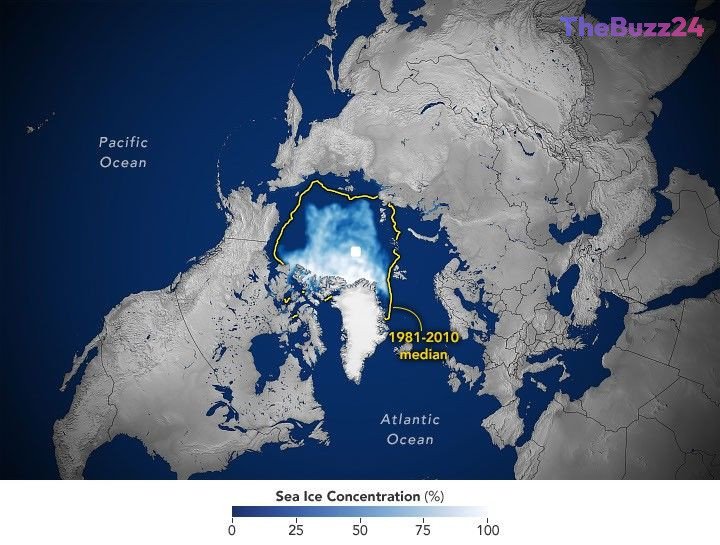
The frozen seawater capping the Arctic Ocean reached its annual minimum extent on September 12, covering approximately 4.6 million square kilometers. This measurement ties with several prior years, specifically 2008, 2010, and 2025, marking the 10th-lowest minimum recorded since satellite observations began in the late 1970s. While polar ice naturally expands during the freezing winter and contracts through the warmer summer months, the overall surface area covered by ice continues to track significantly below historical averages.
Over the past two decades, the downward trajectory of Arctic sea ice has remained pronounced, with the lowest summer minimum on record occurring in September 2012. Although recent years have experienced a relative plateau in the summer melt rate—partially aided by regional weather patterns such as increased cloud cover—the remaining ice is notably younger and thinner. Multiyear ice, which typically survives multiple melt seasons, has diminished, leaving the region increasingly dominated by vulnerable first-year ice. Furthermore, the winter maximum extent has also suffered, setting or tying record lows.
While natural climate oscillations like the Arctic Oscillation influence short-term fluctuations, researchers emphasize that natural variability alone cannot account for the sustained multi-decade retreat. Combined with rising global temperatures, the shrinking ice pack points toward projections of an essentially ice-free Arctic summer occurring at least once before the middle of the 21st century. Scientists continue to monitor these shifts using advanced satellite microwave sensors capable of penetrating cloud cover to accurately gauge ice extent and thickness year-round.
Key Takeaways
- Arctic sea ice reached its 2026 annual minimum of 4.6 million square kilometers on September 12.
- The 2026 minimum ties with 2008, 2010, and 2025 as the 10th-lowest in the satellite observation record.
- Remaining Arctic ice is increasingly composed of thinner, younger first-year ice rather than resilient multiyear ice.
Editor’s Analysis & Impact
The continued contraction of Arctic sea ice underscores the accelerating pace of global climate shifts, carrying profound economic, environmental, and geopolitical implications. As the polar cap thins and retreats, previously inaccessible shipping lanes open up, altering global trade routes and sparking international interest in northern resource extraction. However, these changes simultaneously disrupt indigenous livelihoods, destabilize marine ecosystems, and weaken critical planetary cooling mechanisms. For industries ranging from maritime logistics to insurance and commodities, understanding these shifting baselines is vital for long-term risk management. Looking ahead, the projected emergence of ice-free Arctic summers within the coming decades will demand robust international policy frameworks and adaptive infrastructure to navigate an increasingly volatile environmental landscape.
Frequently Asked Questions
Q: When does Arctic sea ice typically reach its annual minimum?
A: Arctic sea ice usually reaches its annual minimum extent in September after melting throughout the summer polar months.
Q: How do scientists measure Arctic sea ice extent?
A: Scientists utilize satellites equipped with passive microwave sensors that measure natural microwave energy emitted by Earth, allowing them to track ice coverage regardless of weather conditions.
Q: What is the difference between multiyear ice and first-year ice?
A: Multiyear ice has survived at least one summer melt season, making it thicker and more resilient, whereas first-year ice forms during a single winter and is generally thinner and more vulnerable.
AI Disclosure: This article is based on verified data and official reports. Our Team and AI have cross-referenced every financial detail with primary sources to ensure total accuracy.
More from this Category