Artemis II Crew Documents Lunar Impact Flashes in Historic Moon Mission Data Release
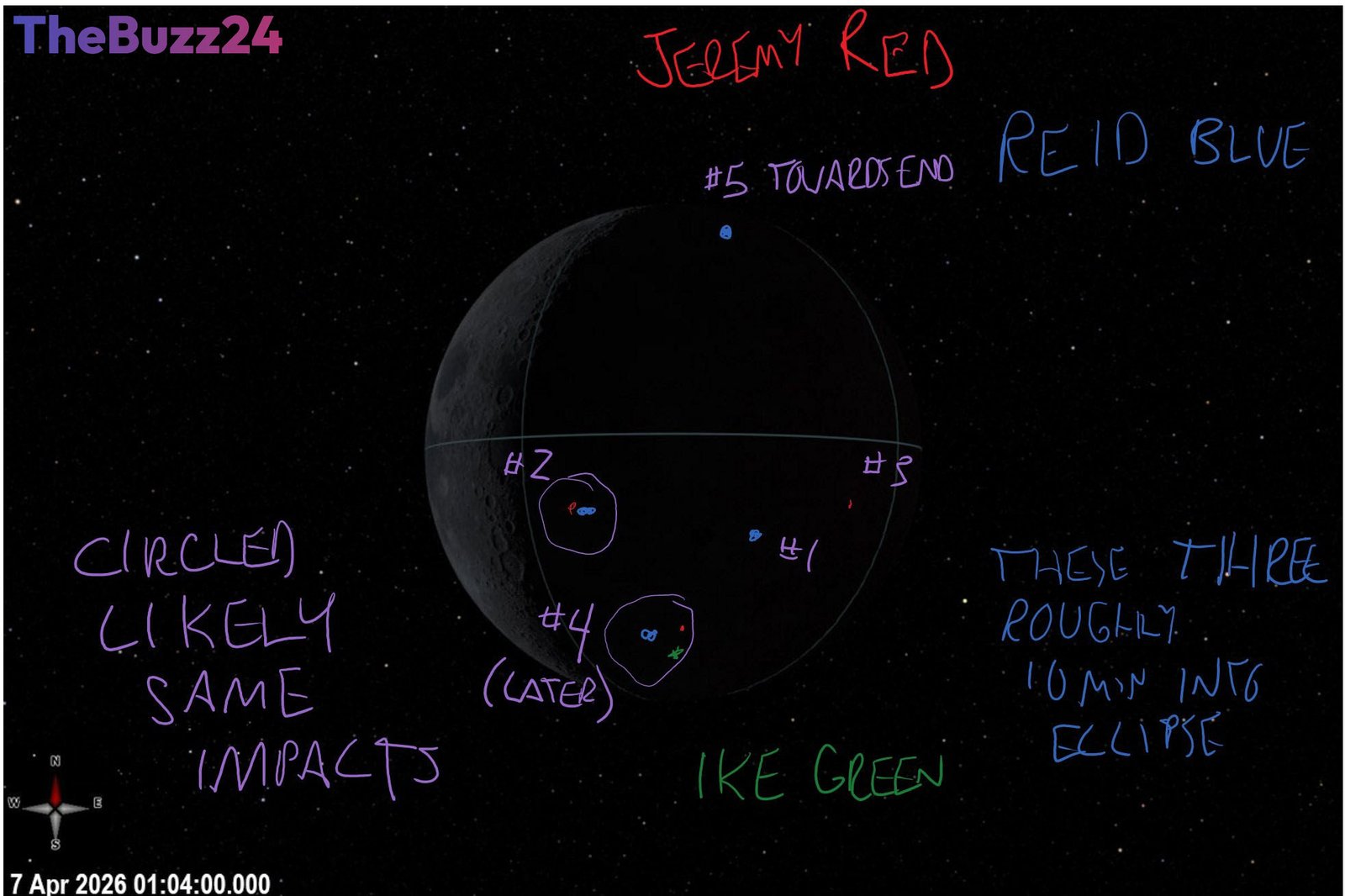
NASA has released a comprehensive dataset from the Artemis II mission, offering the public and scientific community unprecedented insights into the Moon. Among the newly available data are detailed annotations made by the crew during their historic journey around the Moon. These annotations, captured on a tablet, highlight specific observations of impact flashes on the lunar surface.
During their April 2026 mission, astronauts Reid Wiseman, Victor “Ike” Glover, and Jeremy Hansen observed and documented five faint, “pinprick” bursts of light originating from the Moon. These flashes, noted with handwritten markings on a visualization of the Moon, are attributed to small rocky fragments impacting the lunar surface. The crew made these observations from the Orion spacecraft when it was approximately 46,000 miles from the Moon, providing a unique perspective on these transient lunar phenomena.
The Artemis II mission, which saw the crew travel to the Moon and back between April 1 and April 10, 2026, was a critical step in NASA’s lunar exploration program. The release of the full lunar science dataset, including the crew’s annotated observations, allows for further in-depth study of the Moon’s environment and geological activity. This data is expected to contribute significantly to our understanding of the Moon and pave the way for future lunar missions.
Key Takeaways
- NASA's Artemis II mission data, including crew annotations, is now publicly available.
- Astronauts observed and documented five faint impact flashes on the Moon's surface.
- The released data provides valuable scientific insights into lunar phenomena and supports future space exploration.
Editor’s Analysis & Impact
The release of the Artemis II mission data, particularly the crew’s annotated observations of lunar impact flashes, marks a significant milestone in lunar science accessibility. This granular data, captured from a unique vantage point, offers valuable ground truth for understanding micrometeoroid activity on the Moon. Such insights are crucial for planning future crewed missions, ensuring astronaut safety, and developing robust lunar infrastructure. The availability of this dataset to the global scientific community fosters collaboration and accelerates our collective knowledge of Earth’s closest celestial neighbor, reinforcing the importance of human presence in space exploration.
Frequently Asked Questions
Q: What were the Artemis II crew members observing?
A: The Artemis II crew members were observing and documenting faint "pinprick" flashes of light on the Moon's surface, which are caused by small rocky fragments impacting the Moon.
Q: When did the Artemis II mission take place?
A: The Artemis II mission, which included the crew's journey to the Moon and back, took place from April 1 through April 10, 2026.
Q: Where can the Artemis II lunar science dataset be accessed?
A: The full lunar science dataset from the Artemis II mission is available to the global science community and the public for further study.
AI Disclosure: This article is based on verified data and official reports. Our Team and AI have cross-referenced every financial detail with primary sources to ensure total accuracy.
More from this Category