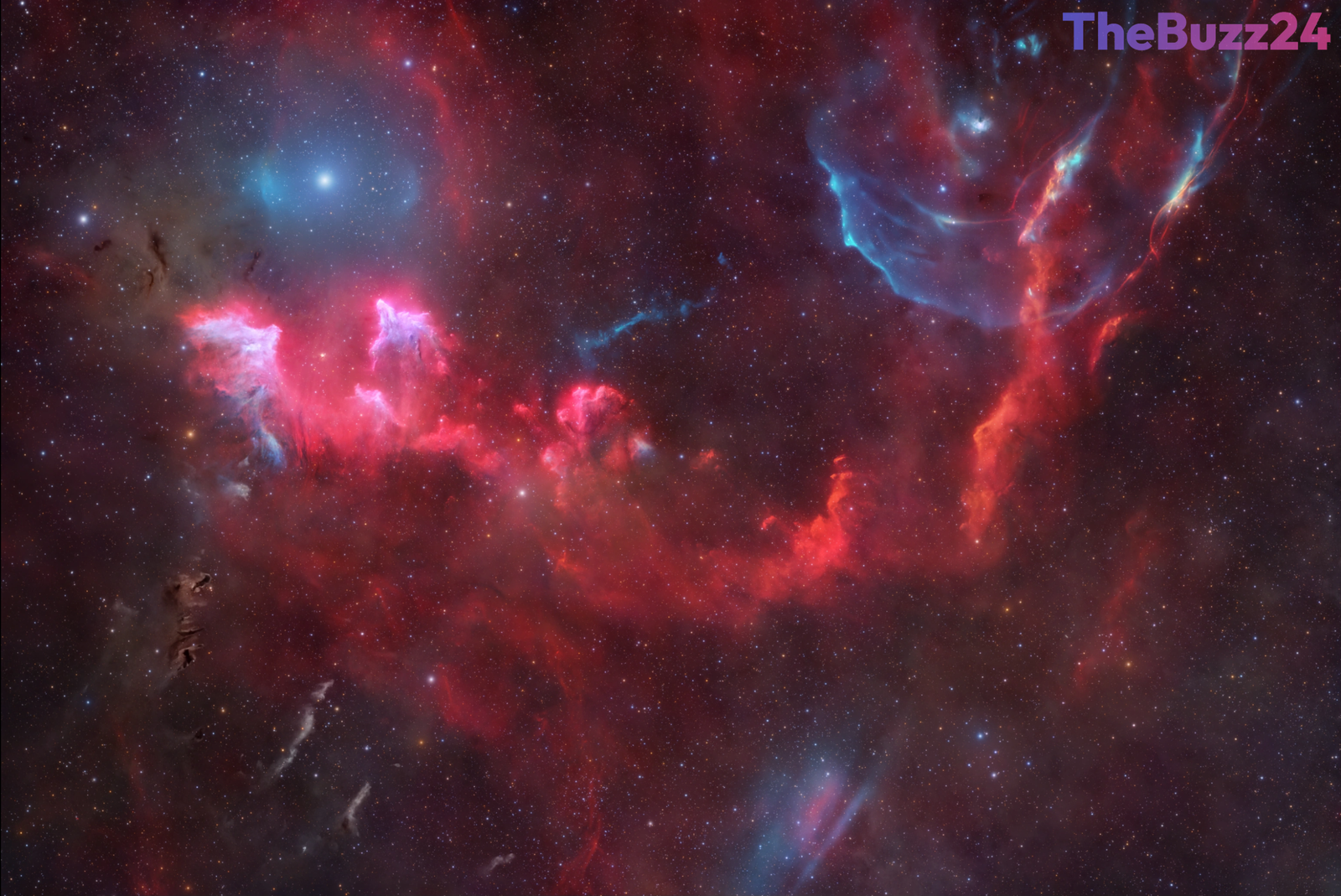
Astronomers Capture Mysterious ‘Ghosts’ Hidden in Cassiopeia
A dedicated team of astrophotographers has successfully captured a breathtaking and haunting view of the Cassiopeia constellation, revealing previously unseen cosmic structures. Requiring a grueling 100 hours of observation time and specialized oxygen filters, the resulting imagery showcases faint nebulas that have long eluded standard detection methods.
At the heart of this region lie IC 59 and IC 63, famously known as the Ghosts of Cassiopeia. These nebulas are illuminated by the multi-star system gamma Cassiopeiae, whose energetic radiation causes surrounding hydrogen gas to emit a distinct red glow, while cosmic dust simultaneously reflects and scatters blue-white starlight. Alongside these familiar structures, the deep-space image unveiled three newly identified blue phantoms, designated as Objects 1, 2, and 3.
The presence of ionized oxygen within these newly found apparitions has sparked intense debate among researchers regarding their exact origins. One prominent hypothesis suggests that gamma Cassiopeiae is creating a bow shock as it barrels through interstellar gas and dust, similar to the wake left by a speeding boat. This interaction could be responsible for heating and compressing the oxygen seen in Object 3, while astronomers speculate that Object 1 might be a planetary nebula awaiting the confirmation of a central white dwarf.
While this remarkable visual milestone enhances our understanding of stellar nurseries and interstellar dynamics, many questions regarding the precise formation mechanisms of these celestial phantoms remain unanswered. Researchers continue to analyze the data to decode the complex relationship between gamma Cassiopeiae and the surrounding interstellar medium.
Key Takeaways
- Astrophotographers captured faint nebulas in Cassiopeia after 100 hours of observation using specialized oxygen filters.
- The imagery highlights IC 59 and IC 63 alongside three newly discovered celestial objects glowing with ionized oxygen.
- Scientists theorize that stellar movement and bow shocks from gamma Cassiopeiae may be creating these mysterious cosmic structures.
Editor’s Analysis & Impact
The successful imaging of these faint nebulas highlights the rapid advancements in amateur and professional astrophotography equipment, allowing deeper and more detailed explorations of the cosmos than ever before. As imaging techniques improve and exposure times become more manageable, astronomers can continuously uncover hidden structures in well-studied constellations. This discovery not only enriches our catalog of interstellar phenomena but also provides crucial data on stellar winds, bow shocks, and the interaction between massive star systems and their surrounding dust clouds. Future observations utilizing space-based telescopes and advanced spectroscopy will likely confirm the origins of these oxygen-rich apparitions, offering deeper insights into stellar evolution and the lifecycle of gas clouds in our galaxy.
Frequently Asked Questions
Q: What are the Ghosts of Cassiopeia?
A: The Ghosts of Cassiopeia refer to the nebulas IC 59 and IC 63, which are illuminated and shaped by the energetic light of the nearby star system gamma Cassiopeiae.
Q: How long did it take to capture the new image?
A: The detailed image required 100 hours of observation and the use of a special oxygen filter to reveal the faint, hidden nebulas.
Q: What caused the newly discovered blue phantoms?
A: The exact origins are still under investigation, but scientists believe they are related to ionized oxygen, potentially driven by bow shocks as the gamma Cassiopeiae system moves through interstellar dust.
AI Disclosure: This article is based on verified data and official reports. Our Team and AI have cross-referenced every financial detail with primary sources to ensure total accuracy.
More from this Category