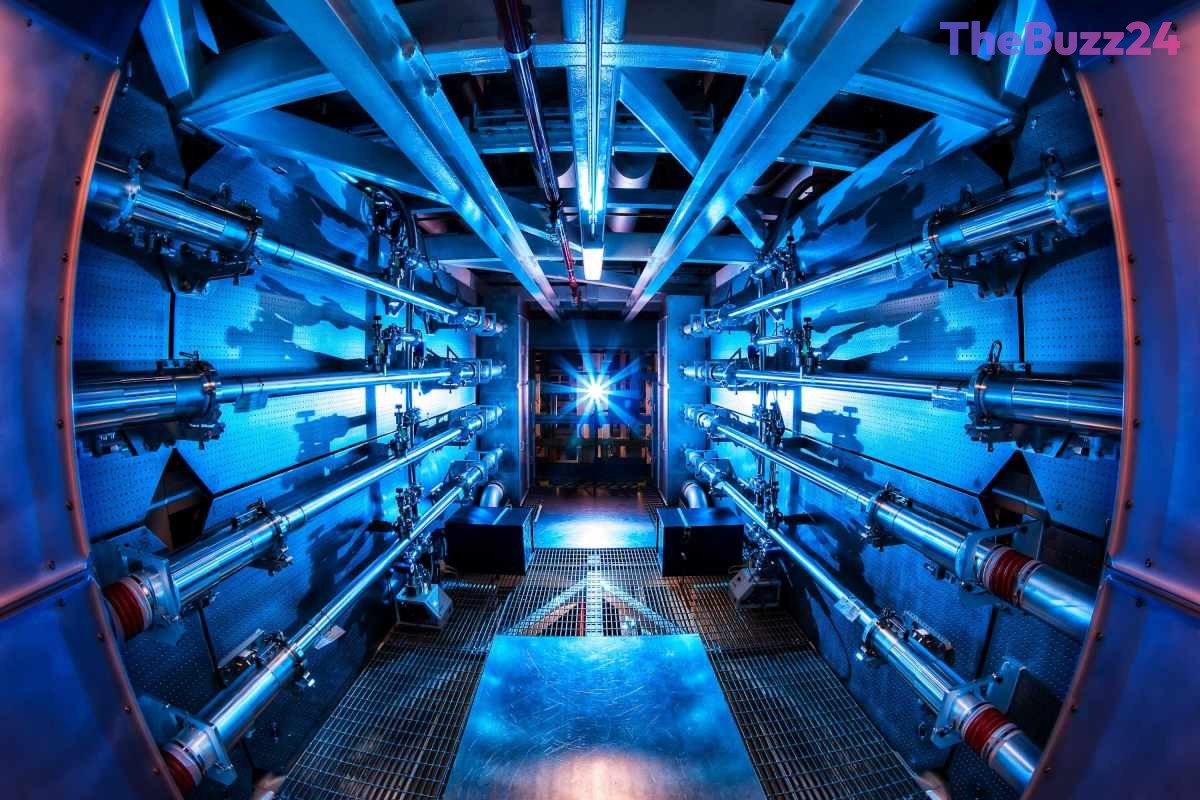
Cambridge Heavy Industries Unveils Compact Fusion Reactor Prototype
Cambridge Heavy Industries, a startup operating out of a laboratory near MIT, has emerged from stealth mode to reveal a breakthrough in fusion energy technology. Unlike traditional fusion projects that require massive industrial facilities, the company has developed a modular, tabletop-sized reactor. By focusing on a compact design, the team is able to conduct between 50 and 80 experimental ‘shots’ per day, allowing for rapid iteration and the use of artificial intelligence to refine reactor performance.
The company’s approach utilizes a unique laser-driven inertial confinement system. By employing two primary lasers, the device delivers light in precisely timed concentric rings to compress a fuel target. This method generates the extreme pressures necessary for fusion while requiring significantly less laser power than conventional designs. The technology originated from research at MIT, where scientists studying materials under extreme conditions discovered that their laser pulse techniques were nearing the thresholds required for fusion ignition.
To support its development, Cambridge Heavy Industries recently secured $6.2 million in seed funding from a group of investors including Azolla Ventures, Overlay, and the Neta Foundation. While the long-term goal is to build a commercial power plant roughly the size of two basketball courts within the next decade, the company has identified a lucrative intermediate business model: the production of tritium. As a rare hydrogen isotope essential for future fusion reactors, tritium is currently in short supply, and the startup aims to fill this market gap while perfecting its power generation technology.
Key Takeaways
- Cambridge Heavy Industries has developed a benchtop fusion reactor that allows for rapid daily experimentation and AI-driven design optimization.
- The company secured $6.2 million in seed funding to advance its laser-based inertial confinement technology.
- The startup plans to generate revenue by producing tritium, a rare and expensive isotope, while working toward a full-scale commercial power plant.
Editor’s Analysis & Impact
The fusion energy sector has long been characterized by ‘big science’—multi-billion dollar projects requiring massive infrastructure. Cambridge Heavy Industries represents a shift toward the ‘agile hardware’ movement, where modularity and high-frequency testing replace monolithic construction. By targeting the tritium supply chain, the company is solving a critical ‘chicken-and-egg’ problem in the fusion industry: the lack of fuel for future reactors. If successful, this dual-track strategy of producing high-value isotopes while scaling power generation could provide a sustainable path to commercial viability. However, the transition from a benchtop prototype to a power-generating plant remains a significant engineering hurdle. The ability to maintain fusion stability at scale, rather than just in short bursts, will be the ultimate test for this compact design.
Frequently Asked Questions
Q: How does the Cambridge Heavy Industries reactor differ from traditional fusion reactors?
A: Traditional fusion reactors typically require massive facilities and complex magnetic or laser arrays. Cambridge Heavy Industries uses a compact, modular design that fits on a tabletop, allowing for faster experimentation and lower power requirements for ignition.
Q: Why is the company focusing on tritium production?
A: Tritium is a rare hydrogen isotope essential for fusion power plants, and current global supplies are insufficient for the industry's future needs. By producing tritium, the company creates a revenue stream while simultaneously developing the technology for its future power plants.
AI Disclosure: This article is based on verified data and official reports. Our Team and AI have cross-referenced every financial detail with primary sources to ensure total accuracy.
More from this Category