Celestial Spectacle: The Milky Way and Aurora Converge Over Norway
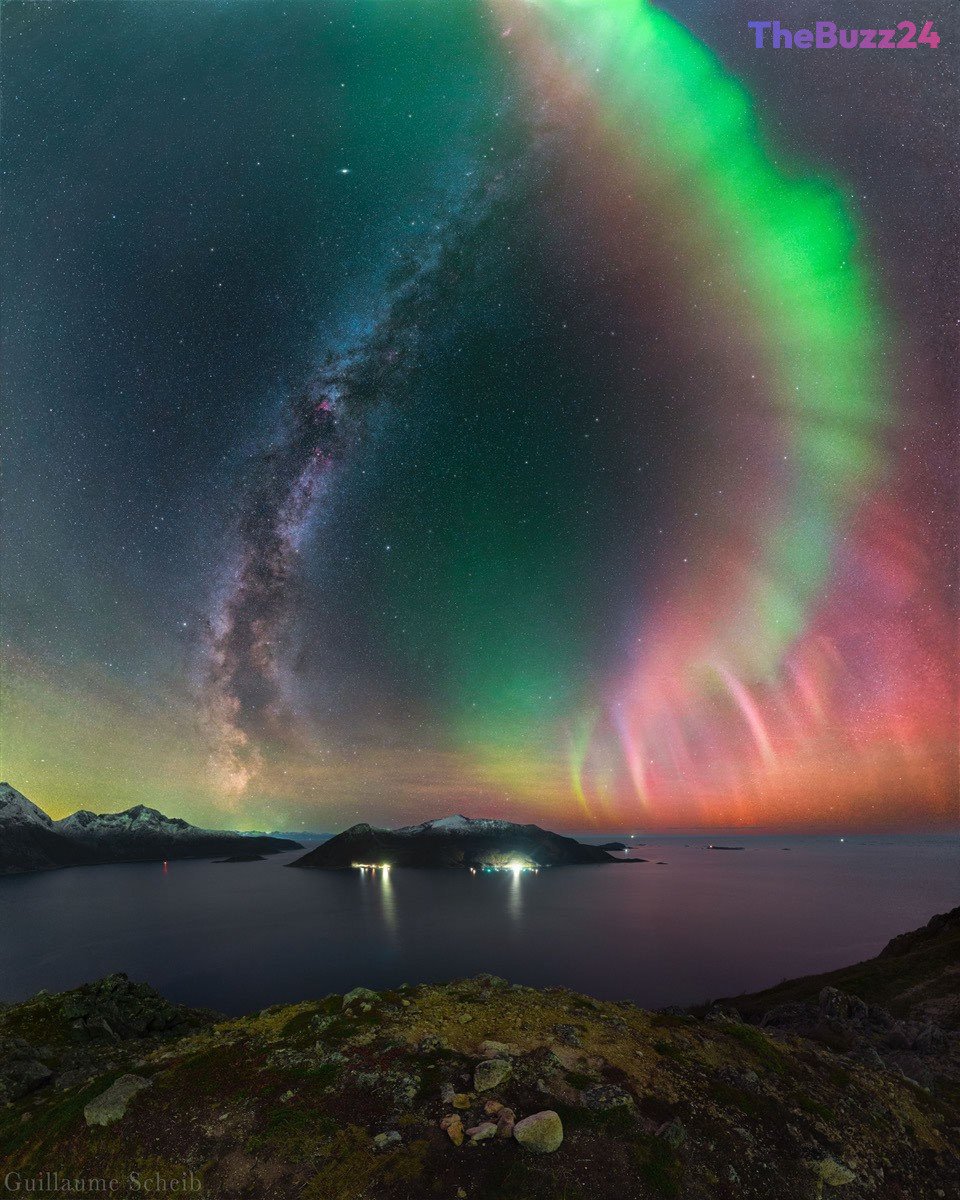
A breathtaking astronomical photograph captured in Kvaløya, Norway, showcases a rare visual alignment between the ancient structure of our galaxy and the fleeting beauty of Earth’s upper atmosphere. The image features two distinct, massive arches spanning the night sky, creating the illusion of a cosmic standoff between the Milky Way and a vibrant auroral ribbon.
While the two phenomena appear to intersect, they exist on vastly different scales of time and space. The arch on the left represents the central band of the Milky Way, a massive system of stars, gas, and dust that has existed for billions of years. In stark contrast, the auroral ribbon on the right is a localized atmospheric event, formed by energized particles interacting with Earth’s magnetic field just hours before the image was taken.
Despite their differences, both phenomena are linked by the Sun. The Milky Way serves as the host for our solar system, while the Sun’s energetic particle ejections are the direct cause of the auroral display. The composition is further enhanced by the presence of the Big Dipper positioned behind the aurora, and the distant Andromeda galaxy visible as a bright spot near the top center of the frame, highlighting the immense depth of the night sky.
Key Takeaways
- A new photograph from Norway captures the Milky Way and an aurora appearing as intersecting arches in the night sky.
- The Milky Way is a vast, ancient galactic structure, while the aurora is a localized, short-lived atmospheric phenomenon.
- Both celestial displays are connected by the Sun, which acts as a stellar member of the galaxy and the source of the particles that trigger auroras.
Editor’s Analysis & Impact
This image serves as a powerful reminder of the intersection between local atmospheric science and deep-space astronomy. By capturing these two phenomena in a single frame, the photographer highlights the dynamic nature of our night sky. From a scientific communication perspective, such imagery is vital for public engagement, as it simplifies complex concepts like solar-terrestrial interactions and galactic structure into a visually arresting narrative. As interest in astrophotography grows, these types of captures provide significant educational value, bridging the gap between professional astronomical research and amateur observation. The future of such imagery will likely continue to benefit from advancements in low-light sensor technology, allowing for even more detailed documentation of the delicate relationship between Earth’s magnetosphere and the broader cosmos.
Frequently Asked Questions
Q: Are the Milky Way and the aurora actually touching in the sky?
A: No. The appearance of them touching is a visual illusion caused by the perspective of the camera. The Milky Way is millions of light-years away, while the aurora occurs within Earth's upper atmosphere.
Q: What causes the auroral ribbon seen in the image?
A: Auroras are created when energetic particles ejected by the Sun interact with atoms and molecules in Earth's upper atmosphere, causing them to glow.
AI Disclosure: This article is based on verified data and official reports. Our Team and AI have cross-referenced every financial detail with primary sources to ensure total accuracy.
More from this Category