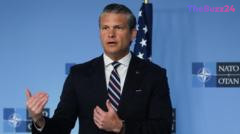
Defense Secretary Hegseth Initiates Strategic Review of US Military Presence in Europe
US Defense Secretary Pete Hegseth has launched a comprehensive six-month review of American military deployments across Europe, signaling a potential shift in the nation’s long-standing security commitments. Speaking at a gathering of NATO defense ministers in Brussels, Hegseth characterized the initiative as ‘NATO 3.0,’ aimed at ensuring European nations take a more proactive and leading role in their own regional security. The Secretary emphasized that the review would serve as a litmus test for member states, distinguishing between those meeting their obligations and those he described as ‘free-riding.’
The core of the tension lies in the demand for increased defense spending, with the US pushing for members to commit 5% of their national economic output to defense and related infrastructure. While NATO Secretary-General Mark Rutte noted that European defense spending has seen a significant uptick of nearly 20% recently, the US remains firm that current contributions are insufficient. Hegseth explicitly warned that future US financial contributions to the alliance would be directly contingent upon other nations meeting their specific spending targets, suggesting a more transactional approach to collective security.
This policy shift coincides with reports that the US is scaling back its commitments to the NATO Force Model, specifically regarding air and naval capabilities. The atmosphere at the summit was further complicated by the absence of a formal defense investment plan from the UK, alongside ongoing diplomatic friction between Washington and several European capitals. As the alliance prepares for an upcoming summit in Ankara, the pressure is mounting for member states to present concrete, credible roadmaps to reach the 5% GDP defense spending goal by 2035, a target that now appears central to the future of the transatlantic security partnership.
Key Takeaways
- Defense Secretary Pete Hegseth has announced a six-month review of US troop presence in Europe to force greater security self-reliance among NATO allies.
- The US is conditioning its future financial support for NATO on member states meeting a 5% GDP defense spending target by 2035.
- The US is actively scaling back certain air and naval commitments within the NATO Force Model, signaling a shift in military strategy.
Editor’s Analysis & Impact
The announcement of ‘NATO 3.0’ marks a significant pivot in US foreign policy, moving away from the traditional post-WWII security umbrella toward a more conditional, performance-based alliance structure. By linking US financial and military presence directly to GDP spending benchmarks, the administration is effectively forcing European powers to accelerate their rearmament efforts. This shift creates immediate market and geopolitical uncertainty, particularly for European defense contractors who may see increased demand, but also for the broader stability of the transatlantic trade and security bloc. If the US follows through on scaling back naval and air assets, European nations will face a rapid, costly transition to fill the capability gap. The long-term implication is a more fragmented NATO where the burden of security is increasingly decentralized, potentially altering the balance of power within the continent for decades to come.
Frequently Asked Questions
Q: What is the primary goal of the 'NATO 3.0' review?
A: The review aims to ensure that European nations take a leading role in their own security and to hold member states accountable for meeting specific defense spending targets.
Q: What is the new defense spending target requested by the US?
A: The US is pushing for NATO members to commit 5% of their national GDP to defense, which includes 3.5% for core defense and 1.5% for related infrastructure.
AI Disclosure: This article is based on verified data and official reports. Our Team and AI have cross-referenced every financial detail with primary sources to ensure total accuracy.
More from this Category