Delhi Police Detain Opposition Leaders Amid Escalating Electoral Roll Protests
Tensions in India’s capital reached a boiling point this week as leaders from the Cockroach Janta Party (CJP) were taken into police custody after breaching security barricades at the historic Jantar Mantar protest site. The activists were demonstrating against the Election Commission, specifically calling for the resignation of Chief Election Commissioner Gyanesh Kumar over a controversial overhaul of the nation’s electoral rolls. The incident occurred shortly after authorities officially de-notified Jantar Mantar as a designated protest venue, redirecting demonstrators to alternative, government-approved locations.
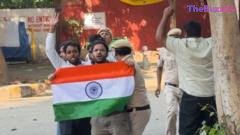
Footage circulating on social media captured the moment CJP leaders Ashutosh Ranka and Saurav Das climbed over police barriers while waving the Indian flag, chanting slogans before being apprehended. Despite the heavy security presence and the subsequent detention, the leaders remained defiant, broadcasting their resolve from a police transport vehicle. This confrontation is part of a broader wave of civil unrest in Delhi, where thousands of police and paramilitary personnel have been deployed to manage ongoing demonstrations and enforce strict movement restrictions across the city.
The current political climate has been further strained by allegations from opposition parties, including the Congress party, which has formally petitioned the Supreme Court regarding the voter list revision. Critics argue that the process has unfairly purged millions of eligible voters, potentially disenfranchising citizens and favoring the ruling party. While the Election Commission maintains that its decisions regarding the electoral rolls were unanimous and transparent, the public outcry continues to grow, fueled by reports of internal disagreements within the commission itself.
This latest surge in activism follows a year of heightened political engagement, particularly among the youth. The CJP, which previously gained prominence for its role in protests that led to the resignation of the federal Education Minister earlier this year, remains at the forefront of these challenges. As the government attempts to consolidate control over public assembly spaces, the standoff between demonstrators and state authorities highlights a deepening divide over the integrity of India’s democratic processes.
Key Takeaways
- Leaders of the Cockroach Janta Party were detained after defying a ban on protests at the historic Jantar Mantar site in Delhi.
- The protests are centered on demands for the resignation of the Chief Election Commissioner over controversial changes to national voter rolls.
- Opposition parties have escalated their concerns to the Supreme Court, alleging that the voter revision process is disenfranchising millions of eligible citizens.
Editor’s Analysis & Impact
The ongoing unrest in Delhi signals a critical juncture for India’s democratic institutions. The conflict over electoral roll revisions strikes at the heart of voter trust, which is the foundation of the country’s political stability. By de-notifying historic protest sites like Jantar Mantar, the government is attempting to manage dissent through spatial control, but this strategy risks further radicalizing opposition groups and alienating the youth demographic. The involvement of the Supreme Court suggests that the dispute will likely shift from the streets to the judiciary, which will be tasked with balancing public order against the constitutional right to protest. If the Election Commission cannot effectively address the transparency concerns surrounding the voter list, the political volatility is likely to persist, potentially impacting future electoral legitimacy and the overall stability of the governing administration.
Frequently Asked Questions
Q: Why are protesters targeting the Election Commission of India?
A: Protesters are demanding the resignation of the Chief Election Commissioner due to a controversial revision of electoral rolls, which critics claim has unfairly removed millions of eligible voters.
Q: What is the significance of Jantar Mantar in this context?
A: Jantar Mantar is a historic site in Delhi long associated with public protests. The government recently de-notified it as a protest venue, forcing demonstrators to seek permission for alternative locations.
AI Disclosure: This article is based on verified data and official reports. Our Team and AI have cross-referenced every financial detail with primary sources to ensure total accuracy.
More from this Category