Djibouti Joins Artemis Accords, Expanding African Footprint in Global Space Exploration
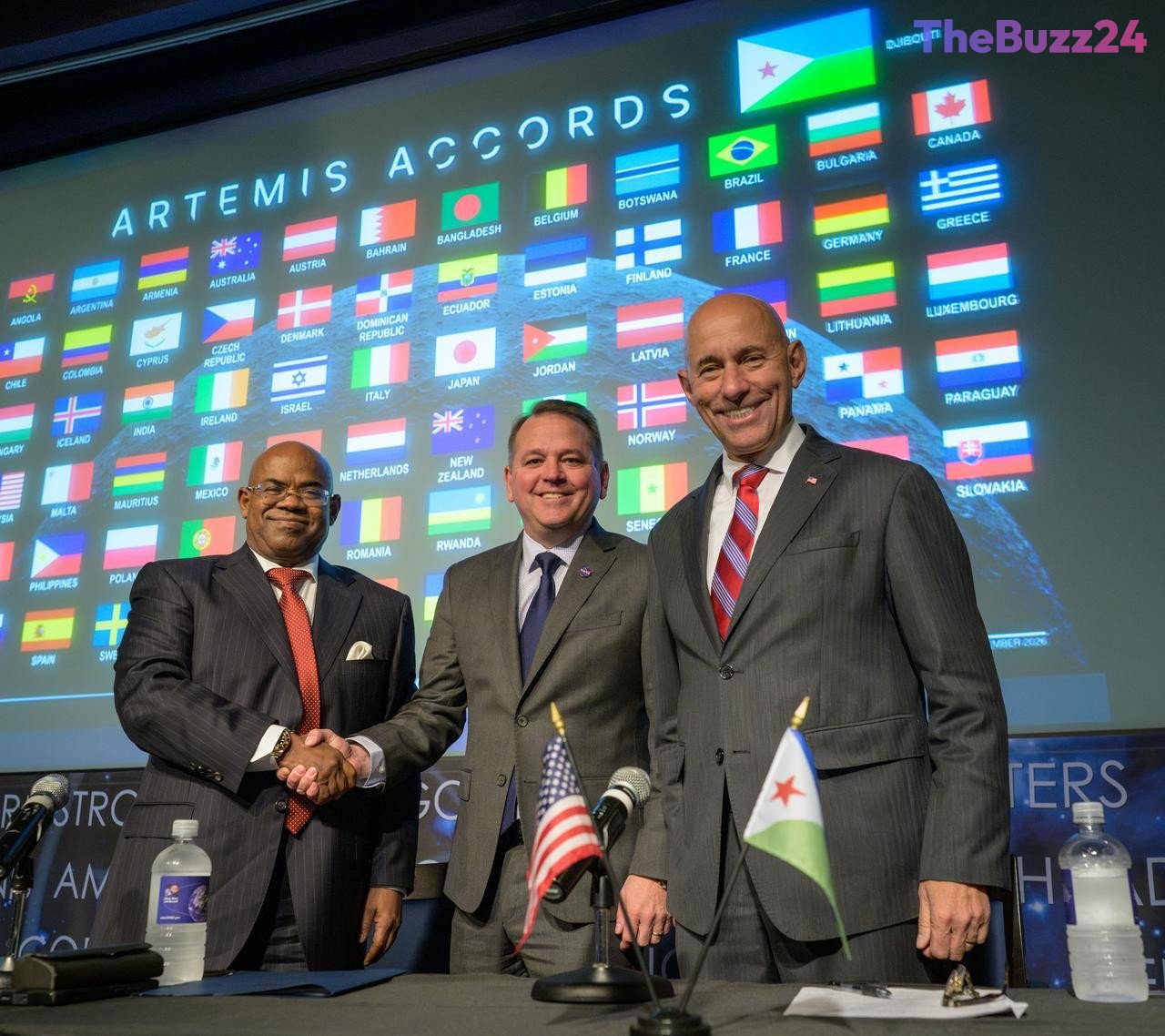
The Republic of Djibouti has officially become the 72nd nation to sign the Artemis Accords, marking a significant milestone in the country’s rapidly growing space ambitions. During a formal ceremony held at the Mary W. Jackson NASA Headquarters in Washington, Ambassador Mohamed Siad Douale signed the agreement on behalf of the East African nation. This signing establishes Djibouti as the eighth African country to join the international coalition, which is dedicated to promoting safe, peaceful, and cooperative exploration of the Moon, Mars, and deep space.
The ceremony, hosted by NASA Deputy Administrator Matt Anderson and attended by U.S. Assistant Secretary of State for African Affairs Frank Garcia, highlights the expanding global network supporting the Artemis program. As the United States aims to establish a sustainable human presence on the Moon and prepare for future crewed missions to Mars, international partnerships are becoming increasingly vital. Through the Accords, signatory nations are encouraged to contribute scientific payloads, hardware, CubeSats, and advanced technology to upcoming missions, fostering a collaborative environment for global space agencies.
Djibouti’s entry into the Accords follows a period of rapid development for its domestic space sector. Established in 2020 under the Ministry of Higher Education and Research, the nation’s space program has already achieved notable milestones, including the successful launches of its first satellites, Djibouti 1A and Djibouti 1B, in 2023 and 2024. Both satellites were deployed into orbit using American Falcon 9 rockets, demonstrating an ongoing technical partnership between Djibouti and U.S. aerospace entities.
Originally established in 2020 by NASA and the U.S. State Department alongside seven founding nations, the Artemis Accords outline key principles for responsible space exploration. These include commitments to peaceful exploration, transparency, mutual assistance in emergencies, open sharing of scientific data, and the preservation of historic space heritage sites. By aligning with these principles, Djibouti aims to enhance its educational, scientific, and technical capabilities, opening new doors for its local researchers, engineers, and students.
Key Takeaways
- Djibouti has signed the Artemis Accords, becoming the 72nd global signatory and the eighth nation from Africa to join the coalition.
- The agreement reinforces Djibouti's growing space capabilities, which include the successful launches of the Djibouti 1A and 1B satellites in 2023 and 2024.
- The Artemis Accords establish a framework for peaceful, transparent, and cooperative space exploration, paving the way for international collaboration on future lunar and Martian missions.
Editor’s Analysis & Impact
Djibouti’s accession to the Artemis Accords underscores a broader geopolitical shift as developing nations increasingly assert themselves in the modern space race. By welcoming its eighth African signatory, the U.S.-led coalition is actively diversifying its partnership base, countering competing space diplomacy efforts from nations like China and Russia. For Djibouti, a country strategically positioned along major global shipping lanes, building a robust space program and aligning with Western space standards offers significant economic and technological leverage. This partnership will likely accelerate local capacity-building, driving investments in STEM education and satellite technology that can address regional challenges such as climate monitoring and resource management. Ultimately, the expansion of the Accords to 72 nations signals that the future of lunar and deep-space exploration will be highly multilateral, relying on a complex web of international alliances rather than a single superpower.
Frequently Asked Questions
Q: What are the Artemis Accords?
A: The Artemis Accords are a set of non-binding principles designed to guide civil space exploration and cooperation in the 21st century. Initiated by NASA and the U.S. State Department in 2020, they focus on transparency, peaceful exploration, scientific data sharing, and safety.
Q: Why is Djibouti's participation in the Accords significant?
A: Djibouti is the 72nd country and the eighth African nation to sign the Accords. Its participation highlights the growing space capabilities of African nations and opens up opportunities for Djibouti to collaborate on international space missions, satellite technology, and scientific research.
Q: What achievements does Djibouti's space program already have?
A: Launched in 2020, Djibouti's national space program has successfully developed and launched two satellites, Djibouti 1A in 2023 and Djibouti 1B in 2024, both of which were carried into orbit by SpaceX Falcon 9 rockets.
AI Disclosure: This article is based on verified data and official reports. Our Team and AI have cross-referenced every financial detail with primary sources to ensure total accuracy.
More from this Category