NASA Accelerates Artemis Program, Targeting 2028 Lunar Return with New Mission Timelines
NASA is significantly advancing its ambitious Artemis program, with agency leaders outlining an accelerated timeline aimed at returning American astronauts to the lunar surface by 2028. This strategic push includes bringing the Artemis III test flight forward to 2027 and the subsequent Artemis IV landing mission to 2028. The agency is working closely with industry partners to rigorously test essential technologies, mitigate risks, and lay the groundwork for a sustainable human presence on the Moon.
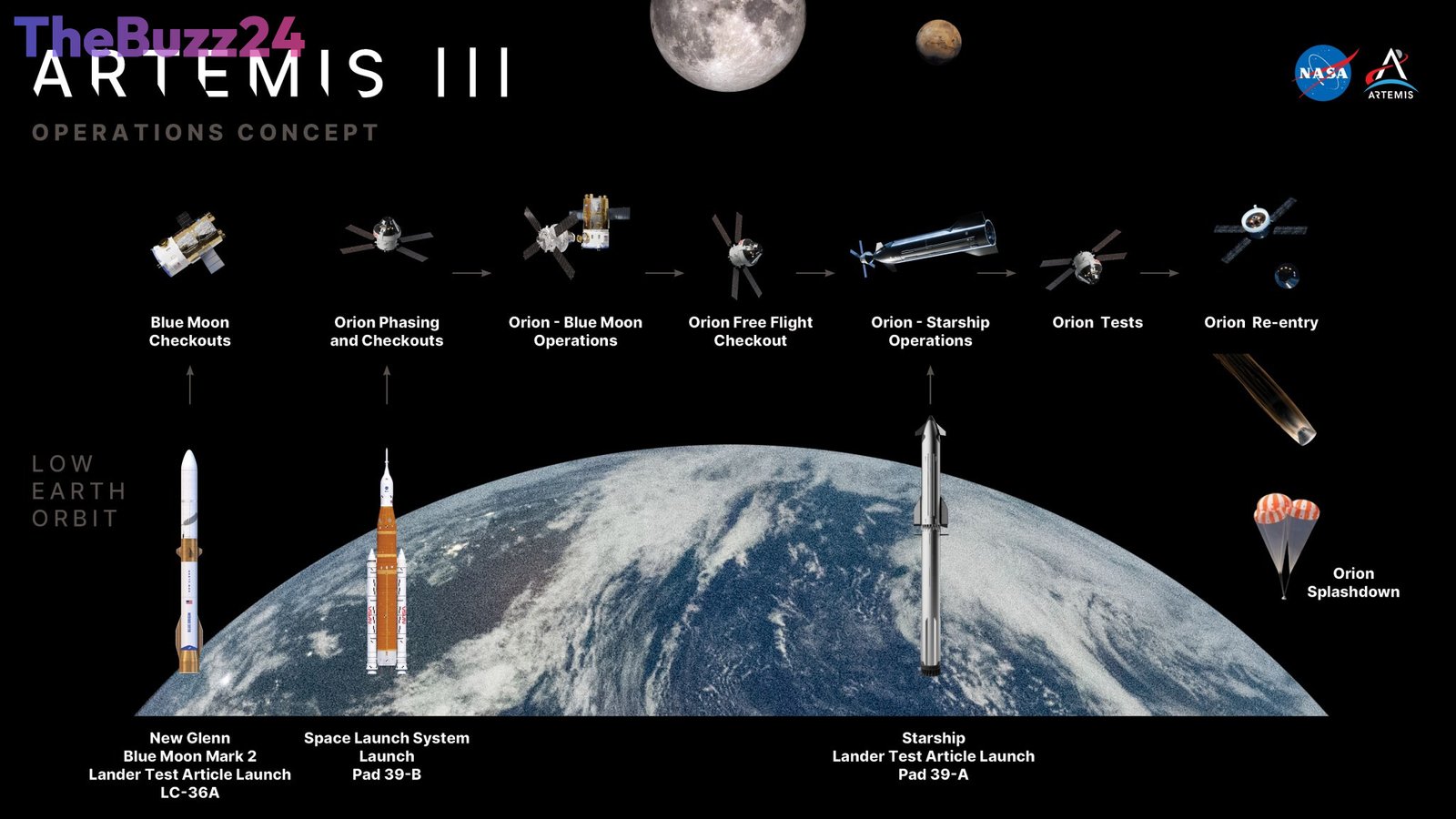
Key to these advancements is the Artemis III mission, which will involve four astronauts conducting a 14-day mission in Earth orbit. This orbital test flight will evaluate critical systems, including rendezvous and docking procedures between NASA’s Orion spacecraft and lunar lander test vehicles developed by SpaceX and Blue Origin. The mission’s sequence involves Blue Origin launching a Blue Moon lander test article, followed by the SLS rocket launching Orion and its crew. Orion will then dock with the Blue Moon lander, before undocking to rendezvous and dock with a SpaceX Starship lander test article. This phased approach aims to de-risk future lunar landing operations.
NASA is also pursuing multiple pathways for the Artemis IV mission, scheduled for 2028. Both SpaceX and Blue Origin are developing lunar landers designed to transport astronauts to the Moon’s surface. SpaceX’s Starship will be refueled in Earth orbit before proceeding to the Moon, while Blue Origin’s approach utilizes transfer stages to propel its Blue Moon Mark 2 lander towards lunar orbit. To enhance flexibility and prevent reliance on a single system, NASA is exploring two upper-stage options for its Space Launch System (SLS) rocket: its current interim cryogenic propulsion stage and a stretched version of ULA’s Centaur V. Furthermore, in collaboration with Axiom Space, NASA is developing a lighter-weight “Sortie suit” to facilitate initial moonwalks, complementing the primary suit designed for more extensive surface operations.
Key Takeaways
- NASA has accelerated its Artemis program, aiming for a crewed lunar landing in 2028.
- The Artemis III mission will test critical rendezvous and docking systems in Earth orbit using landers from SpaceX and Blue Origin.
- The agency is developing lighter spacesuits and exploring multiple upper-stage options for the SLS rocket to ensure mission flexibility.
Editor’s Analysis & Impact
NASA’s accelerated timeline for the Artemis program signals a renewed urgency in lunar exploration, driven by both scientific ambition and geopolitical considerations. The agency’s strategy of leveraging commercial partnerships with companies like SpaceX and Blue Origin, while also rebuilding in-house technical expertise, reflects a pragmatic approach to complex space missions. By de-risking lunar landing operations through orbital test flights and pursuing redundant systems for the SLS rocket, NASA aims to ensure mission success and establish a sustainable presence beyond Earth. This push not only advances scientific discovery and potential economic opportunities on the Moon but also serves as a crucial stepping stone for future Mars missions, positioning the United States at the forefront of deep space exploration.
Frequently Asked Questions
Q: When is NASA planning to return astronauts to the Moon?
A: NASA aims to return American astronauts to the lunar surface with the Artemis IV mission in 2028, following an accelerated timeline.
Q: Which companies are developing lunar landers for the Artemis program?
A: SpaceX and Blue Origin are developing lunar lander systems for NASA's Artemis missions.
Q: What is the purpose of the Artemis III mission?
A: The Artemis III mission is designed as a test flight in Earth orbit to validate critical systems, including rendezvous, docking, and lunar lander operations, before the actual lunar landing missions.
AI Disclosure: This article is based on verified data and official reports. Our Team and AI have cross-referenced every financial detail with primary sources to ensure total accuracy.
More from this Category